

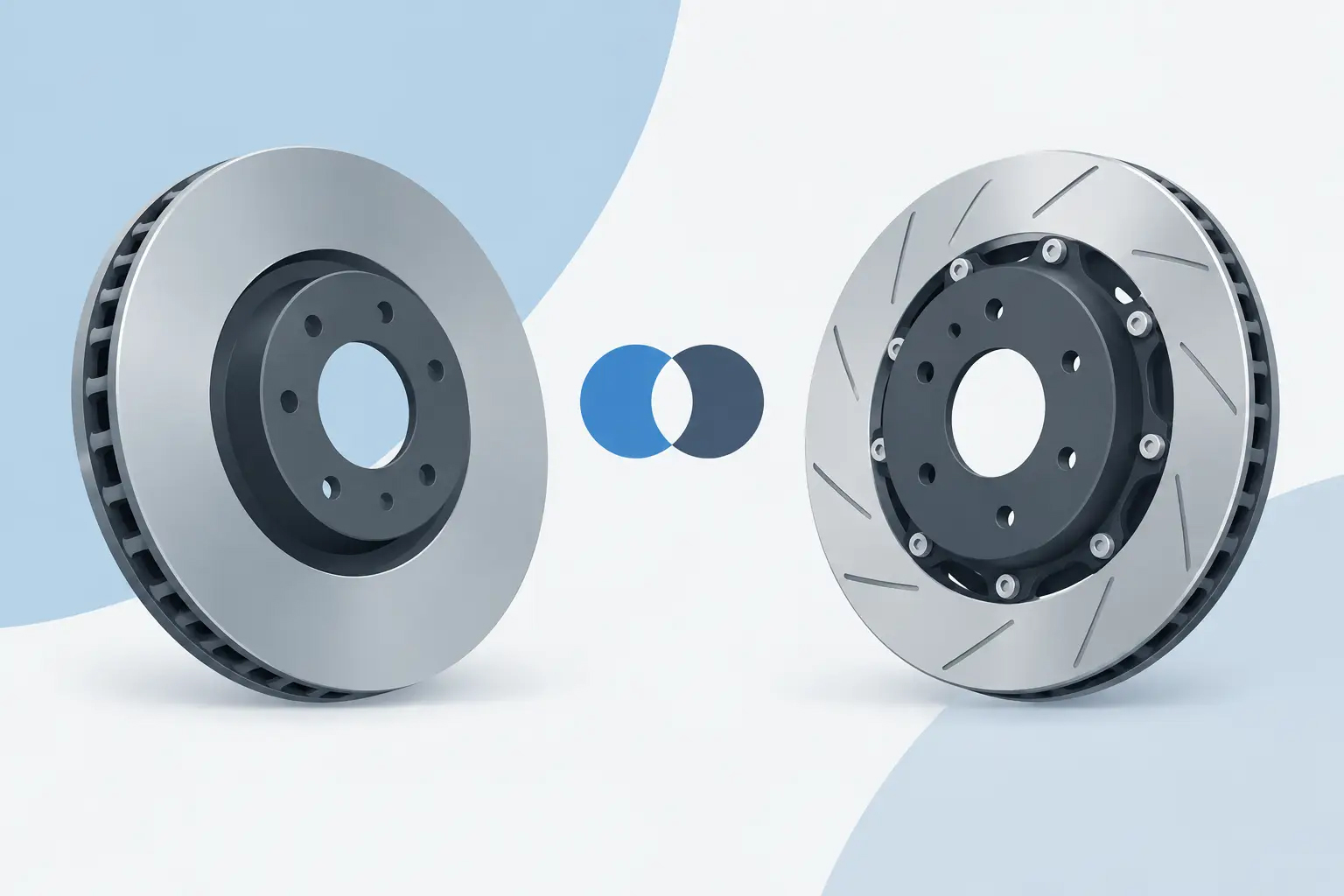
At highway speed, a brake pedal that goes long after repeated hard stops is not a minor inconvenience. It is a warning that heat, mass, friction, and component control are no longer working together. A proper two piece rotor comparison helps performance workshops and serious drivers choose brake hardware based on real operating demands, not appearance or marketing language.
Two-piece rotors are widely used in track-focused, premium street, and high-performance brake systems because they separate the friction ring from the center hat. That architecture can reduce unsprung weight, manage thermal expansion more effectively, and make future rotor service more economical. But it is not automatically the right answer for every vehicle or every driving style.
What Defines a Two-Piece Rotor?
A two-piece rotor consists of two primary components: the outer friction ring and the center hat that mounts to the wheel hub. The friction ring is the surface clamped by the brake pads. The hat provides the vehicle-specific mounting interface, bolt pattern, offset, and center bore needed for accurate fitment.
On many high-performance systems, the friction ring is cast iron while the hat is machined aluminum. The aluminum hat reduces mass near the hub, where weight savings improve suspension response and steering precision. In carbon ceramic systems, the disc material and attachment design differ, but the same engineering principle applies: separating the rotor’s braking surface from its mounting structure allows the system to address heat movement, fitment, and serviceability with greater control.
The connection between the ring and hat may be fixed, semi-floating, or fully floating. This detail matters. A fixed connection holds the components tightly together and can suit many street-performance applications. A floating arrangement gives the ring controlled freedom to expand radially as temperatures rise, helping reduce thermal stress and the tendency toward distortion under repeated heavy braking.
Two Piece Rotor Comparison: The Factors That Matter
The strongest comparison is not between “two-piece” and “one-piece” as labels. It is between the braking demands of the vehicle and the engineering of the complete system.
Unsprung Weight and Vehicle Response
The rotor is part of the vehicle’s unsprung mass, along with the wheel, tire, hub, and a portion of the suspension assembly. Reducing weight in this area helps the suspension follow uneven pavement more accurately. The result can be sharper turn-in, better wheel control, and more composed behavior over bumps.
A two-piece iron rotor usually saves weight by replacing the heavy cast-in center section of a one-piece rotor with an aluminum hat. The exact reduction varies by diameter, thickness, and vehicle application. On a heavy SUV or luxury EV, the percentage reduction may be modest, but the benefit still supports steering response and suspension control. On a lighter track car, every pound closer to the wheel center can be more noticeable.
Carbon ceramic brake systems can take weight reduction much further. For Porsche, Tesla, BMW, Nissan GT-R, Toyota Supra, and supercar applications, reduced rotor mass can be a major advantage when combined with correctly matched calipers, pads, hubs, and wheel clearance.
Heat Capacity Versus Heat Management
A larger or heavier rotor generally has more thermal mass. That means it can absorb more energy before reaching critical temperatures. This is why rotor size, thickness, vent design, and friction material must be considered before focusing only on construction type.
A two-piece rotor does not create extra thermal capacity simply because it has a separate hat. Its advantage is thermal management. The friction ring can expand under hard braking with less force transferred into the hat and hub area. A floating drive system is particularly useful during track sessions, mountain descents, towing, or repeated high-speed braking, where rotor temperatures cycle aggressively.
For a daily-driven premium vehicle, a well-engineered fixed two-piece rotor may provide the right balance of refinement, durability, and cost. For dedicated track work, a floating design with a properly ventilated ring offers greater protection against heat-related stress. The application determines the correct answer.
Serviceability and Long-Term Cost
Two-piece rotors are often more expensive at the initial purchase because they include precision-machined hats, hardware, drive mechanisms, and tighter manufacturing requirements. However, the long-term economics can be favorable when replacement rings are available separately.
Once the friction ring reaches minimum thickness or shows heat checking beyond acceptable limits, the owner may replace the ring while retaining the hat, provided the hat, fasteners, and drive hardware remain within specification. This reduces material waste and can lower the cost of future brake service.
That benefit depends on the manufacturer’s parts support. A low-cost rotor with nonstandard hardware, unavailable rings, or unclear torque specifications can become a disposable component despite its two-piece appearance. Professional buyers should confirm replacement-ring availability, hardware service intervals, and documented installation procedures before selecting a system.
Fitment Accuracy Is Not Optional
A rotor must do more than bolt onto the hub. It must place the friction ring precisely in the caliper centerline, maintain correct wheel offset, clear the suspension and wheel barrel, and match the vehicle’s ABS and parking-brake requirements where applicable.
The hat controls much of this geometry. Incorrect hat offset can cause pad overhang, caliper misalignment, uneven wear, or contact with nearby components. These are not cosmetic issues. They compromise braking consistency and may damage expensive calipers, wheels, or suspension parts.
For aftermarket brake kits, vehicle-specific engineering is more valuable than a universal rotor diameter. The complete package should account for rotor dimensions, mounting brackets, caliper piston sizing, brake pad shape, hub location, and wheel clearance. This is especially critical on modern performance vehicles with large factory wheels, electronic brake systems, and tightly packaged suspensions.
Fixed, Semi-Floating, and Floating Drive Systems
A fixed two-piece rotor uses bolts or hardware to secure the ring firmly to the hat. It is simple, quiet, and often appropriate for strong street use. Because the ring has limited freedom to move as it heats, it is less suited to the most extreme thermal cycles.
Semi-floating systems allow a controlled amount of movement while limiting noise and rattle. They can be an effective middle ground for road-and-track vehicles that need both daily usability and repeatable performance.
Full-floating rotors use bobbins, drive pins, or similar mechanisms that permit the ring to expand independently from the hat. This design is common in racing-grade systems because it reduces thermal loading at the attachment points. The trade-off is that some floating rotors may produce more mechanical noise at low speeds, particularly as hardware wears. That is normal in many motorsport applications, but it should be explained clearly to customers expecting OEM-level quietness.
Material Quality Determines Whether the Design Performs
A two-piece layout cannot compensate for poor metallurgy, inconsistent machining, or inadequate quality control. The ring must maintain stable friction characteristics, resist cracking, and survive repeated heat cycles. The hat must be machined accurately enough to control runout and mounting concentricity. Hardware must withstand temperature, vibration, and corrosion without loosening or galling.
Rotor balancing also matters. An imbalance at the wheel assembly can contribute to vibration, bearing stress, and an inconsistent pedal feel. Precision machining, controlled assembly, and inspection are essential, particularly on vehicles driven at sustained high speed.
For carbon ceramic applications, material quality becomes even more critical. The rotor, pad compound, caliper design, and thermal operating range must work as a matched system. Installing carbon ceramic discs without considering pad compatibility or brake bias can produce disappointing results, regardless of the price of the components.
CCYS applies in-house engineering and production control across 90% of its manufacturing process, supported by IATF 16949 and ISO 9001 quality systems. For distributors and workshops, that level of control supports a more dependable outcome than assembling a brake package from unrelated components with unknown tolerances.
When a One-Piece Rotor Still Makes Sense
One-piece rotors remain practical for many street vehicles. They are generally more affordable, straightforward to replace, and often sufficient for normal commuting, occasional spirited driving, and moderate loads. A quality one-piece rotor with the correct pad compound can outperform a poorly engineered two-piece setup.
They also make sense when replacement cost, local parts availability, and low-maintenance ownership are the priority. Fleet vehicles, standard daily drivers, and vehicles that never encounter repeated high-energy braking may not need the added capability of a two-piece design.
The decision changes when brake fade, repeated high-speed stops, wheel weight, track temperature, or long-term service costs become real concerns. At that point, the advantages of a two-piece rotor become measurable rather than theoretical.
Select the Rotor as Part of a Complete Brake System
Do not select a rotor by diameter, drilled pattern, or visual finish alone. Start with vehicle weight, tire grip, power output, intended use, wheel clearance, and the temperatures the brakes will actually see. Then evaluate the complete system: rotor construction, caliper stiffness, piston sizing, pad compound, brake fluid, cooling airflow, and installation accuracy.
The right two-piece rotor should deliver controlled expansion, repeatable friction, correct fitment, and a realistic service path. When braking confidence matters at the end of a straight, the best component is the one engineered to work with every other part of the system - every stop, every heat cycle, and every mile.