

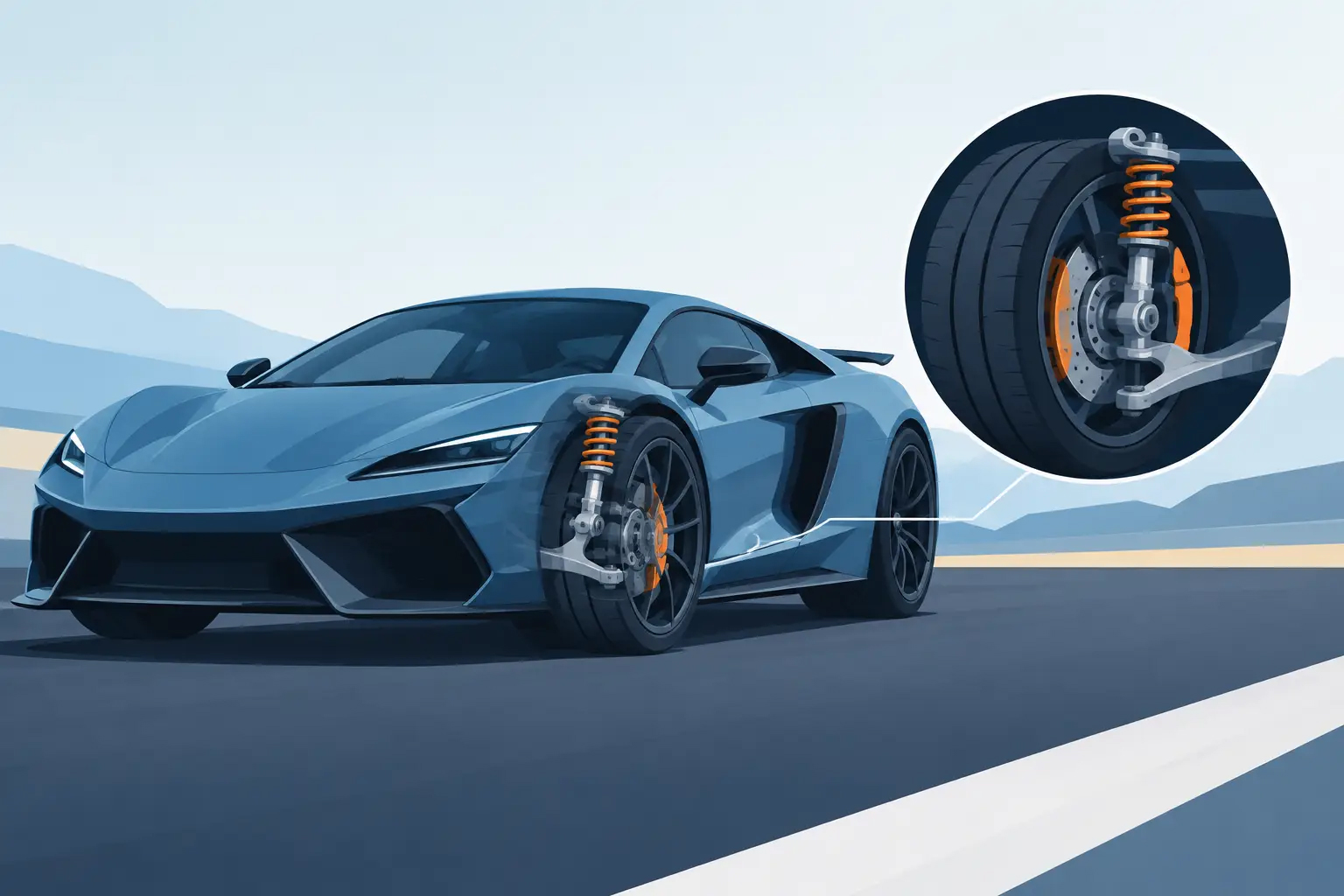
At 170 mph, a brake system cannot merely stop the car. It must remain stable over bumps, respond cleanly at turn-in, and give the driver confidence to brake later without upsetting the chassis. A practical supercar unsprung weight example makes clear why high-performance builders look beyond horsepower and rotor diameter: every pound removed from the wheel-end assembly changes how the tire follows the road.
For supercar owners, race shops, and performance-parts distributors, unsprung weight is not a marketing phrase. It is a chassis variable with direct effects on steering precision, ride quality, tire contact, and repeated high-speed braking control. Carbon ceramic brake systems can create a meaningful reduction at one of the most active areas of the vehicle - the corner assembly.
What Unsprung Weight Means on a Supercar
Unsprung weight is the mass not supported by the suspension springs. At each corner, it includes the wheel, tire, brake rotor, caliper, hub, a portion of the control arms, and other components that move directly with the road surface. By contrast, the chassis, engine, cabin, and most of the body are sprung mass.
The distinction matters because a wheel assembly must accelerate upward and downward every time it encounters a bump, curb, expansion joint, or uneven braking zone. More mass takes more force to control. When that mass is reduced, the suspension can react faster, helping the tire maintain more consistent contact with the road.
A supercar is especially sensitive to this effect. Its stiff spring rates, low-profile tires, large wheels, wide contact patches, and high cornering loads leave little room for imprecise wheel control. A vehicle can have exceptional peak braking force and still feel unsettled if its heavy wheel-end components cannot follow a rough surface effectively.
A Supercar Unsprung Weight Example With Carbon Ceramic Brakes
Consider a high-performance coupe equipped with 20-inch front wheels, large six-piston calipers, and 400 mm iron brake rotors. A two-piece iron front rotor can weigh approximately 14 to 16 kg, depending on its design and application. A properly engineered carbon ceramic rotor of comparable braking capacity may weigh approximately 7 to 9 kg.
That creates a potential reduction of 6 to 8 kg per front corner from the rotor alone. Across the front axle, the vehicle may remove 12 to 16 kg from the unsprung assembly. The exact result depends on rotor dimensions, hat design, caliper specification, mounting hardware, and whether the original system uses a one-piece or two-piece iron disc.
This is the point that is often misunderstood: removing 14 kg from the cabin is not equivalent to removing 14 kg from the front wheel ends. Weight saved at the wheels is repeatedly accelerated by road inputs. It also sits farther from the center of rotation than many other vehicle components, so a lighter rotor can reduce rotational inertia as well as vertical moving mass.
For a supercar used on the street and track, the driver may notice a more controlled front end over uneven pavement, cleaner steering feedback during trail braking, and less disturbance when braking hard over a surface change. The gains are not magic, and they do not replace correct damping or tire setup. They are a real chassis improvement when the brake system is engineered as a complete vehicle-specific package.
Why the Rotor Delivers the Biggest Opportunity
A brake rotor is a particularly valuable place to reduce mass because it is both unsprung and rotating. Large supercar brake discs carry substantial material at a wide radius from the hub center. Reducing mass there can help the vehicle respond more willingly when the driver accelerates, decelerates, and changes direction.
Carbon ceramic material offers a strong advantage in this area. Compared with conventional iron discs, it can deliver major mass savings while maintaining high thermal resistance under repeated heavy braking. This is why carbon ceramic systems are common on premium performance platforms where brake temperature, fade resistance, and wheel control are all part of the design brief.
The rotor is not the only component that matters. Lightweight monobloc calipers, optimized aluminum hats, high-quality mounting hardware, and compatible wheel hubs can further reduce corner mass. However, a brake kit should never pursue low weight by sacrificing stiffness, piston sealing, thermal capacity, pad support, or safety margin.
What Drivers Feel From Lower Unsprung Mass
The most useful improvements are often felt in transitions rather than measured in a single straight-line stop. On a rough braking approach, lighter wheel-end assemblies allow the tire to recover contact more quickly after a disturbance. That can support a more stable brake pedal feel and more predictable chassis behavior.
During turn-in, the front suspension has less mass to manage. The steering can feel more immediate, particularly on vehicles with heavy factory iron rotors and large-diameter wheels. On corner exit, better tire contact over imperfect pavement can help the driver apply power with more confidence.
There is also a ride-quality benefit, although it depends heavily on damper tuning. Lower unsprung mass can reduce the sharp impact transmitted when a wheel strikes broken pavement. On a street-driven supercar with stiff suspension settings, this can make the vehicle feel less busy without making it soft.
A professional workshop should set expectations accurately. A carbon ceramic conversion will not correct worn bushings, weak dampers, poor alignment, damaged tires, or excessive wheel runout. It works best as part of a disciplined chassis and braking package.
Thermal Performance Is Part of the Weight Conversation
Reducing unsprung mass is only valuable if the replacement system can survive the duty cycle. Supercars create extreme brake temperatures, especially during repeated high-speed deceleration, mountain driving, track sessions, and heavy vehicles with large power outputs.
Carbon ceramic discs are valued not only because they are lighter, but because they are designed to tolerate demanding thermal conditions with strong resistance to fade and heat-related distortion. Their behavior must be matched to the correct pad compound, caliper design, hydraulic balance, and rotor dimensions. A poorly matched kit can create noise, inconsistent cold performance, abnormal pad wear, or an unsuitable pedal response.
This is why complete-system engineering matters. The most reliable conversion is not a collection of lightweight parts. It is a vehicle-specific brake package developed around rotor offset, caliper mounting position, piston area, wheel clearance, ABS behavior, thermal loading, and intended use.
Trade-Offs Workshops Should Explain Clearly
Carbon ceramic brake systems are premium components, and the decision should be based on the vehicle's purpose. For a daily-driven performance car that sees only light commuting, the return on investment may be less immediate than it is for a supercar that regularly encounters high-speed braking or track heat.
Cold behavior can also vary by disc and pad selection. Some aggressive friction materials are optimized for elevated temperatures and may not offer the refinement expected during short urban trips. Brake noise, bedding procedures, replacement cost, and wheel fitment should all be discussed before installation.
Wheel clearance is critical. Large rotor and caliper combinations require confirmation of spoke profile, barrel diameter, offset, and balancing-weight position. Even when the nominal wheel diameter appears sufficient, the internal geometry can prevent safe fitment.
For distributors and installers, documented manufacturing control is equally important. CCYS produces 90% of its brake-system components in-house and supports its performance focus with IATF 16949 and ISO 9001 quality systems. That level of control helps protect fitment consistency and gives workshops a clearer foundation for supplying complete braking solutions rather than assembling uncertain combinations.
Choose the Right System for the Vehicle
The best supercar brake upgrade starts with an honest assessment of use. A street-focused Porsche, BMW, Tesla, Nissan GT-R, or exotic platform may prioritize quiet operation, corrosion resistance, and confident emergency braking. A track-oriented vehicle may place more value on thermal capacity, pedal consistency, and rapid recovery between repeated braking zones.
Ask for the vehicle's wheel specification, factory brake configuration, tire size, horsepower level, vehicle weight, and typical driving conditions. Then select the rotor diameter, caliper configuration, pad compound, and supporting chassis components to suit the job. The objective is not simply the lowest possible scale reading. It is a lighter, stiffer, thermally capable system that preserves predictable braking under load.
When a supercar feels nervous over a bumpy braking zone, the answer is rarely just more clamping force. Start at the wheel end. A properly engineered carbon ceramic system can remove meaningful unsprung and rotating mass while giving the driver the thermal confidence to use the car as intended.