

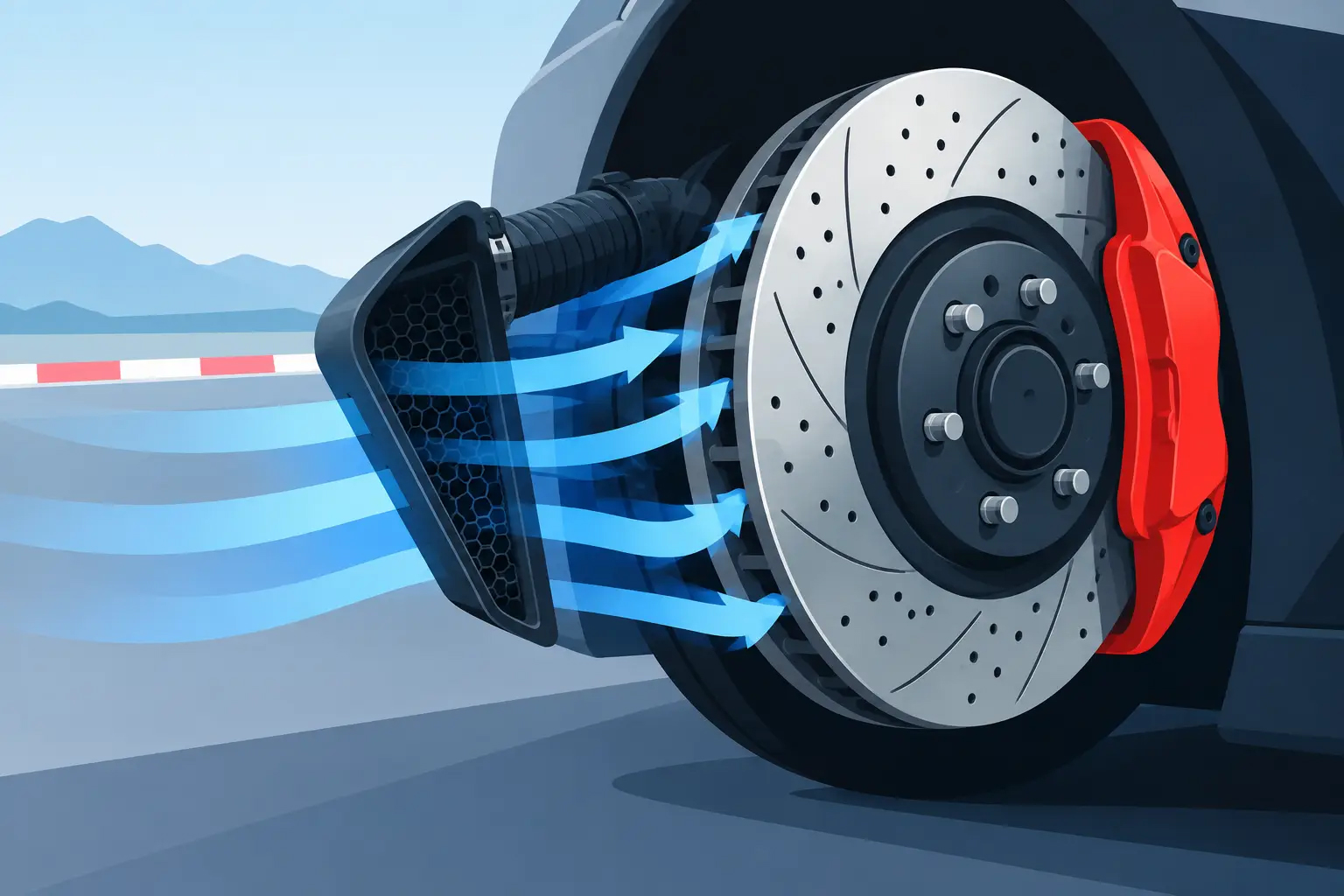
Brake fade is not a minor inconvenience when the next braking zone arrives too quickly. A long pedal, inconsistent bite, or a rotor that has absorbed more heat than it can release changes driver confidence immediately. The best brake cooling upgrades are not simply larger parts added for appearance. They are a coordinated system that moves heat away from the friction surfaces, protects critical hydraulic components, and keeps braking response repeatable under load.
For performance workshops, distributors, and serious drivers, the right solution depends on vehicle packaging, wheel design, brake-system capacity, and how the vehicle is actually used. A street-driven BMW with occasional canyon use needs a different approach than a Porsche running repeated track sessions or a heavy Tesla accelerating hard between braking events. The objective remains the same: keep the brake system within a stable operating window.
Why Brake Heat Becomes the Real Limitation
Every hard stop converts vehicle speed into heat. The rotor absorbs most of that energy, while pads, calipers, brake fluid, wheel bearings, dust boots, and nearby suspension components experience the consequences. During repeated braking, heat enters the system faster than it can escape. That is when a brake package that feels strong during one stop can lose consistency after several.
High rotor temperatures can alter pad friction behavior, create uneven pad deposits, accelerate disc wear, and place extreme stress on seals and fluid. Brake fluid that reaches its boiling point can form vapor, producing a compressible pedal and reducing hydraulic precision. At the same time, excess heat transferred into wheels and hubs can affect surrounding components over long periods.
Cooling does not create stopping force by itself. It preserves the braking force that an engineered system is designed to deliver. That distinction matters. A cooling modification cannot correct undersized rotors, poor pad selection, or an improperly matched caliper kit. It can, however, prevent a capable system from becoming inconsistent when the driving intensity rises.
Best Brake Cooling Upgrades: Start With Airflow
The most effective cooling improvement is usually controlled airflow directed at the rotor. Factory brake ducts are often designed around broad production requirements, including cost, noise, water management, packaging, and low-speed operation. On high-performance vehicles, especially those used on track, those compromises can leave considerable thermal capacity unused.
Vehicle-Specific Brake Ducting
Proper brake ducting collects high-pressure air from the front of the vehicle and sends it through heat-resistant hose toward the center of the brake rotor. The target is not the outer rotor face. Air should enter the rotor hat or inner vane area, where the rotating disc can pump air through its internal passages and discharge heat efficiently.
A duct aimed randomly at the caliper or rotor surface may provide some benefit, but it is less efficient than feeding the rotor's internal vanes. The rotor itself becomes part of the cooling system. This is why duct geometry, hose diameter, backing-plate design, and the position of the outlet all matter.
A well-engineered duct kit must also survive steering movement, suspension travel, road debris, and high temperatures. Poorly routed hose can collapse, rub against a tire, interfere with the control arm, or become detached under track vibration. For shops, that is a fitment and liability issue, not just a performance issue. Select vehicle-specific hardware where possible, then verify clearance at full lock and full compression before returning the vehicle to service.
High-Flow Backing Plates and Air Guides
Backing plates with integrated air inlets help direct ducted air into the rotor center while shielding nearby suspension and ball-joint boots from radiant heat. They are especially valuable when a vehicle's factory dust shield blocks the ideal duct path or traps heat around the disc.
The design must match rotor diameter, offset, and caliper clearance. A generic plate that sits too close to the disc can rattle, restrict airflow, or contact the rotor under load. With larger brake conversions, the backing plate, duct outlet, and rotor hat geometry must be evaluated as one package.
Upgrade the Components That Must Survive the Heat
More airflow is highly effective, but it is only one part of thermal management. The brake system still needs materials capable of operating at elevated temperature without losing control or durability.
Two-Piece and Carbon Ceramic Rotors
Rotor selection is central to heat control. A larger effective rotor diameter increases leverage and thermal mass, while greater thickness provides more material to absorb energy. Two-piece designs can reduce unsprung and rotating weight while allowing an optimized iron friction ring and lightweight center hat. For repeated heavy use, correct vane design and airflow path are as important as diameter alone.
Carbon ceramic brake systems take thermal resistance and weight reduction further. Their lower mass can improve steering response and suspension control, while their high-temperature capability supports demanding driving conditions. However, carbon ceramic conversions must be engineered as complete systems. Rotor dimensions, caliper piston area, pad compound, brake bias, wheel clearance, and vehicle-specific mounting hardware all need to work together.
A carbon ceramic disc is not automatically the correct upgrade for every car. Replacement cost, intended use, cold-weather behavior, and pad compatibility should be considered honestly. For premium vehicles, supercars, and track-focused builds where reduced unsprung weight and heat resistance are priorities, a complete carbon ceramic kit can offer a substantial advantage over piecemeal changes.
Performance Pads and Temperature-Matched Fluid
The pad is the thermal interface between the vehicle and the rotor. A compound chosen for low dust and quiet street behavior may not maintain a stable friction level during repeated high-speed stops. A track-oriented pad can resist fade at higher temperatures, but it may produce more noise, dust, and rotor wear during normal commuting.
Brake fluid deserves equal attention. High-quality fluid with an appropriate dry and wet boiling point protects pedal consistency as caliper temperatures rise. Fluid should be changed on a service schedule that reflects actual use, not only mileage. A vehicle that sees frequent track days needs more disciplined fluid maintenance than one used exclusively on public roads.
Stainless braided brake lines can improve pedal feel by reducing line expansion, but they are not a cooling upgrade by themselves. Present them accurately as a supporting control upgrade, not a substitute for proper airflow, rotor capacity, and fluid selection.
Caliper Design and Hardware Matter More Than Appearance
A stiff monobloc caliper helps maintain consistent pad pressure and pedal response under high load. It can also be designed with thermal shielding, optimized fluid passage routing, and pad volume appropriate for sustained braking. But adding a multi-piston caliper without calculating piston area and brake balance can create a system that feels aggressive yet performs unpredictably.
The same principle applies to hardware. Quality mounting brackets, hub interfaces, rotor hats, and fasteners must handle heat cycles without movement or distortion. A brake kit should be specified for the exact vehicle application, wheel diameter, spoke clearance, and intended rotor size. There is no engineering value in a visually large brake package that compromises wheel fitment or alters braking balance.
This is where factory-controlled production provides real value. CCYS produces 90% of its braking components in-house, allowing direct control over machining, assembly consistency, and quality management. For distributors and performance workshops, that level of manufacturing control supports dependable fitment and a more complete technical solution than sourcing unrelated components from multiple suppliers.
Avoid Cooling Changes That Create New Problems
Not every modification marketed as brake cooling delivers measurable improvement. Drilled rotor holes may reduce some surface gas effects, but they can also become stress concentration points under severe thermal cycling. For high-load applications, properly engineered slotted discs or application-specific rotor designs are often the more durable choice.
Removing dust shields without a ducting plan is another common shortcut. It may create more open space around the rotor, but it can also expose sensitive components to heat and debris while doing little to feed cooling air into the vane structure. Likewise, oversized wheels do not guarantee better cooling. Some wheel designs restrict airflow around the caliper and rotor more than smaller, open-spoke options.
The most common mistake is treating cooling as a single product purchase. If a vehicle has inadequate rotor mass, street pads, old fluid, and no duct routing, one upgraded component will not solve the overall thermal problem. Diagnose the full system before recommending the parts.
Build the Upgrade Around the Vehicle's Duty Cycle
For spirited street driving, a quality pad, fresh high-temperature fluid, and an appropriately sized rotor package may be enough. For occasional track use, add vehicle-specific ducting and backing plates to preserve rotor and pad performance during consecutive sessions. For dedicated track cars, heavy SUVs, EV performance builds, and supercars, a complete brake system with high thermal capacity, controlled airflow, and documented fitment is the more credible path.
The best result comes from matching every component to the energy the vehicle must manage. When braking performance is treated as a thermal system rather than a collection of aftermarket parts, the pedal stays consistent, the hardware lasts longer, and the driver can brake with confidence when it matters most.