

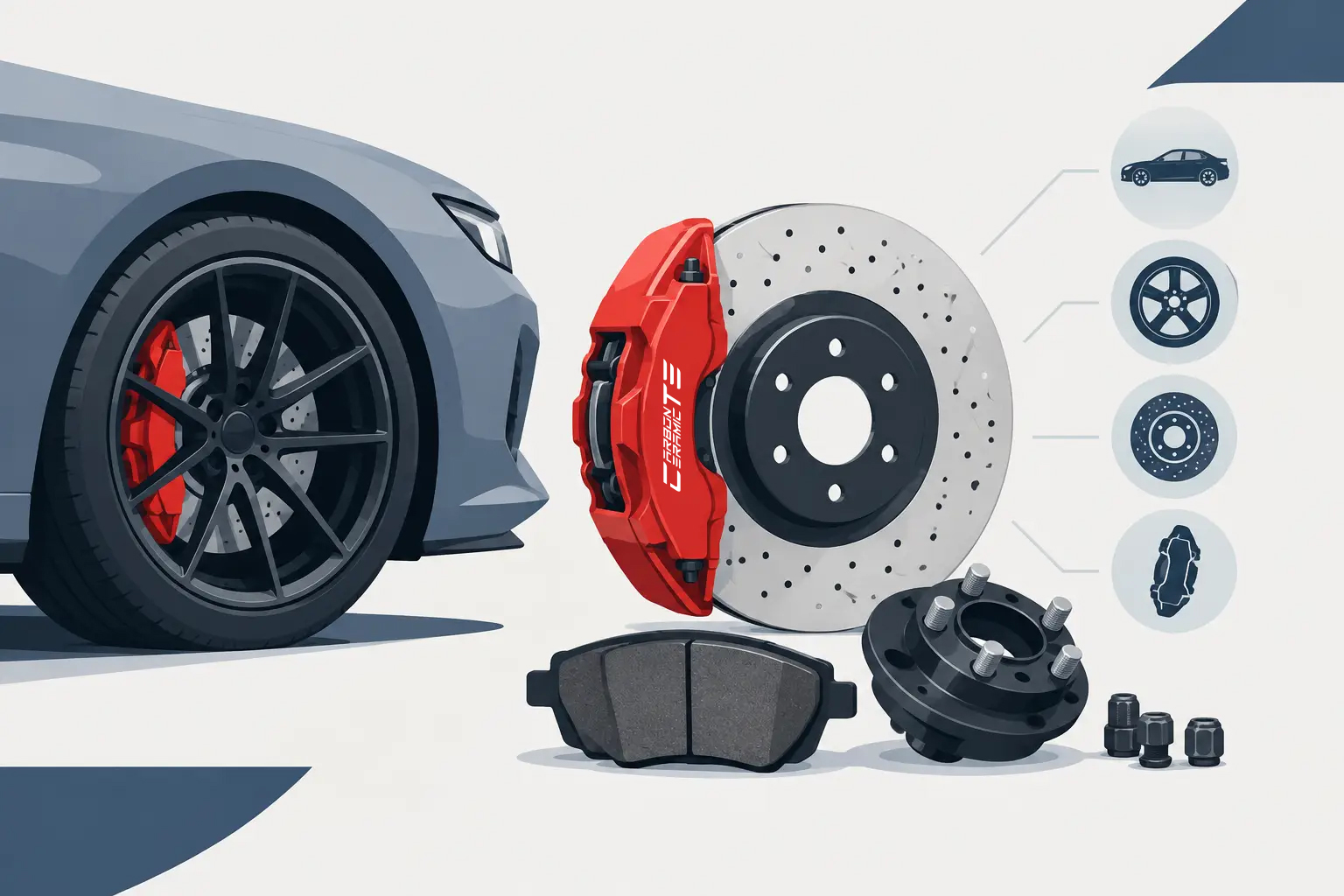
A performance brake kit that does not clear the wheel, match the hub, or maintain correct rotor position is not a performance upgrade. It is a safety risk, an installation delay, and an expensive source of rework. This brake fitment guide explains the measurements and vehicle details that must be confirmed before specifying a carbon ceramic or big brake system for road, track, and high-output applications.
For performance workshops and distributors, fitment is more than selecting a rotor diameter. A correctly engineered system must place the caliper precisely over the disc, preserve wheel and suspension clearance, work with the vehicle's mounting architecture, and support the intended operating load. The best brake components cannot compensate for incorrect application data.
Start the Brake Fitment Guide With the Vehicle Specification
Vehicle make, model, model year, and trim are the starting point, but they are not enough on their own. Premium and performance platforms frequently use different braking systems across engine variants, production years, option packages, and regional specifications. A BMW, Porsche, Tesla, Land Rover, Toyota Supra, or Nissan GT-R can have meaningful differences in hub dimensions, rotor offsets, caliper mounting points, wheel diameter, and electronic parking brake configuration.
Confirm the exact chassis code, drivetrain, engine package, factory brake option, and current wheel specification before assigning a kit. If the vehicle has already been modified, document the wheel model, wheel width, offset, tire size, suspension setup, hub conversion, and any existing spacers. These details directly affect clearance.
A vehicle-specific application is always preferable to a kit assembled from approximate dimensions. Complete systems are engineered around the platform's knuckle, hub, rotor hat, caliper bracket, brake line routing, and wheel envelope. This reduces installation uncertainty and protects the braking balance intended by the vehicle manufacturer or performance system designer.
Rotor Fitment Is About More Than Diameter
A larger rotor can increase leverage and thermal capacity, but diameter alone does not define fitment. The disc must align with the hub and caliper in every critical dimension. That includes overall diameter, disc thickness, friction-ring height, center bore, bolt pattern, hat offset, and total rotor height.
Rotor offset is especially critical. It determines where the friction faces sit relative to the hub mounting face. Even a small offset error can move the rotor out of the caliper centerline, causing uneven pad contact, piston overextension, drag, abnormal wear, or interference with the bracket. A rotor may physically bolt to the hub and still be unsuitable for the system.
Carbon ceramic rotor systems add further requirements. Carbon ceramic discs provide major advantages in reduced unsprung weight, thermal resistance, corrosion resistance, and repeated high-load durability, but they must be paired with the correct floating hardware, hats, caliper geometry, and pad compound. Do not substitute hardware, alter mounting interfaces, or mix disc components between applications unless the engineering specification explicitly permits it.
For a performance vehicle that sees repeated heavy braking, disc thickness and thermal mass must also match the duty cycle. A road-focused setup may prioritize weight savings and daily refinement. A track-oriented vehicle may require a larger friction surface, greater thickness, and caliper capacity designed to manage sustained temperature. The correct choice depends on how the vehicle is actually driven, not only how much power it produces.
Check Hub and Mounting Interfaces
The hub is the foundation of the brake assembly. Confirm the center bore, wheel bolt pattern, hub flange profile, mounting face condition, and rotor retaining method. Rust, damage, debris, or incorrect seating at the hub can introduce lateral runout. That runout may feel like pedal pulsation, but the root cause is often installation accuracy rather than a defective brake disc.
Hub conversions and aftermarket wheel hubs require extra attention. Their dimensions may differ from the original equipment part, changing the effective rotor position or wheel clearance. Measure the installed hardware rather than relying only on the vehicle's original catalog data.
Caliper Mounting and Rotor Centering
A racing-grade caliper must be mounted squarely and centered over the rotor. This is controlled by the caliper bracket, knuckle mounting points, rotor offset, and caliper bridge geometry. The goal is equal clearance between each side of the rotor and the caliper body, with pads fully supported across the friction track.
Do not treat brackets as universal adapters. A bracket designed for one rotor height, caliper, and knuckle combination cannot be assumed to work with another. Changing bracket thickness or adding washers to force alignment can compromise fastener engagement, caliper rigidity, and braking consistency. Where shims are specified by the brake manufacturer, use only the approved configuration and torque procedure.
Caliper selection also affects wheel clearance. Monobloc calipers deliver high stiffness and precise pedal response, but their exterior profile must clear the wheel barrel and spoke shape. Two wheels with the same nominal diameter can have dramatically different internal contours. A 20-inch wheel does not automatically clear a particular 400 mm rotor and six-piston caliper package.
Wheel Clearance Must Be Verified on the Actual Wheel
Wheel diameter is only the first clearance check. The critical areas are radial clearance to the wheel barrel, axial clearance to the spokes, caliper-to-wheel clearance at full steering lock, and clearance during suspension movement. Wheel offset, spoke curvature, barrel drop center, and inner wheel design all matter.
A brake template is the most reliable way to confirm wheel compatibility before installation. It should be printed at 100% scale, checked against a reference measurement, and held against the inside of the actual wheel. Digital images and wheel-size assumptions are not fitment verification.
Wheel spacers may solve a spoke-clearance problem, but they introduce trade-offs. Increasing track width can affect scrub radius, bearing load, fender clearance, and wheel fastener engagement. If a spacer is required, use a hub-centric solution with proper hardware length and confirm that the final assembly remains safe through steering and suspension travel. A wheel that clears in the workshop can still contact a caliper under cornering load if the total setup has not been verified.
Brake Lines, Parking Brakes, and Electronic Systems
Hydraulic connections must match the vehicle and caliper design. Brake lines need sufficient length for full steering and suspension travel, secure routing away from moving parts and heat sources, and correct end fittings. After installation, inspect the lines at full lock in both directions and through the suspension range where possible.
Many modern vehicles add complexity through electronic parking brakes, brake wear sensors, stability control, regenerative braking, and brake-by-wire functions. Tesla and other electrified platforms require particular care because mechanical brake changes must coexist with regenerative braking strategy and electronic system diagnostics. A brake upgrade should never disable a required safety function simply to simplify installation.
If the original rear caliper integrates a parking brake motor, the replacement system must retain a compliant parking-brake solution for the application. Likewise, brake pad wear sensors may require a dedicated provision, an approved adapter, or appropriate system coding depending on the vehicle. Treat these elements as part of fitment, not as afterthoughts.
Match the Kit to the Vehicle's Real Use
A brake system should be specified around vehicle mass, power, tire grip, driving environment, and thermal demand. A luxury SUV, a track-prepared coupe, and a high-performance EV may all need large brakes, but not for the same reason. Vehicle weight influences energy absorption. Tire grip determines how much brake torque can be used. Repeated high-speed deceleration determines thermal capacity.
Front and rear changes should also be considered as a system. Oversizing only one axle can alter brake balance, ABS intervention, pedal feel, and stability under threshold braking. In some cases, a front axle upgrade is appropriate because it addresses the primary thermal load. In others, matched front and rear hardware delivers the more predictable result. The answer depends on the platform and the engineering behind the kit.
Pads are equally application-specific. A pad compound that performs strongly at track temperature may generate more noise, dust, or cold-bite variation during daily driving. A street-focused compound may offer quieter operation and better cold response but reach its limit sooner during repeated circuit sessions. Specify the friction material according to the customer's operating conditions.
Installation Checks That Protect Brake Performance
Professional installation is the final fitment control. Before road testing, verify rotor seating, caliper centering, fastener torque, brake line routing, pad installation, fluid condition, and wheel rotation. Confirm that the wheel clears the caliper before the vehicle leaves the lift, then recheck after torqueing the wheel hardware.
Bleed the system using the correct sequence and fluid specification. A firm pedal at rest is not the only standard. The system must maintain pedal consistency under temperature, with no leaks, no line contact, and no abnormal noise or drag. Follow the specified pad and rotor bedding procedure so the friction surfaces establish an even transfer layer.
CCYS applies vehicle-specific engineering, 90% in-house production control, and IATF 16949 quality discipline to help distributors and workshops supply braking systems with the consistency demanding vehicles require. Provide complete vehicle and wheel information before ordering, and treat every measurement as part of the safety system. The right fitment decision gives the driver something far more valuable than larger hardware: confidence to brake hard when the road, track, and vehicle demand it.