

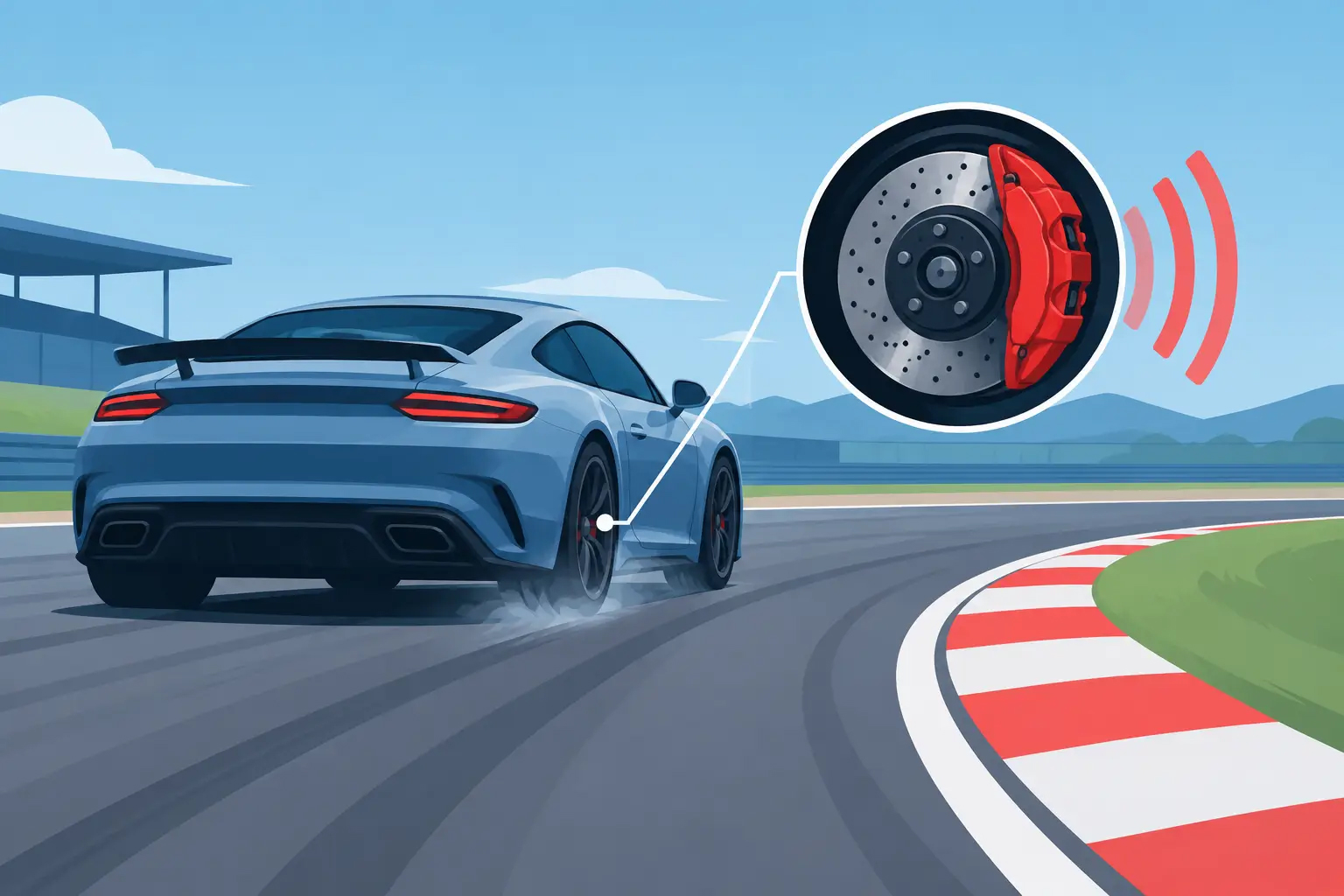
A long brake pedal at the end of a fast straight changes more than one corner. It changes the driver’s willingness to brake late, commit to turn-in, and trust the car. Track braking essentials are therefore not a shopping list of aggressive parts. They are a complete thermal and hydraulic system designed to deliver repeatable stopping force when heat, speed, vehicle weight, and lap after lap abuse expose every weak link.
For performance workshops, distributors, and serious drivers, the goal is not simply bigger brakes. The goal is controlled deceleration, stable pedal feel, predictable balance, and hardware that remains within its working range through a full session. That requires matching the brake system to the vehicle, tire grip, track conditions, driving style, and intended duty cycle.
Track Braking Essentials Start With Heat Control
Every braking event converts vehicle speed into heat. On track, that heat arrives faster than it can be released. Rotor temperatures rise, pads transfer material, fluid absorbs energy through the caliper and pistons, and surrounding components face sustained thermal stress.
Brake fade is not one single failure. Pad fade occurs when the friction material exceeds its effective temperature range and loses a consistent coefficient of friction. Fluid fade occurs when overheated fluid boils, creating compressible vapor and a soft or sinking pedal. Rotor distress can include cracking, excessive wear, uneven deposits, or thermal distortion. A car may still stop, but it will no longer give the driver the same precise, repeatable response.
This is why track hardware must be selected as a system. A high-friction pad alone cannot compensate for insufficient rotor mass, poor airflow, tired fluid, or calipers that flex under pressure. Likewise, a premium rotor cannot deliver its full capability with an unsuitable pad compound or incorrect bedding procedure.
Choose Rotors for Thermal Capacity, Not Appearance
Rotor diameter and thickness matter because they influence leverage, heat capacity, and cooling surface area. A larger effective rotor radius increases braking torque for a given clamping force. More rotor mass can absorb more energy before temperatures climb into a critical range. Yet larger is not automatically better if the added weight, wheel clearance, and vehicle application have not been considered.
For repeated high-energy braking, carbon ceramic brake discs offer a distinct advantage in thermal resistance and weight reduction. Lower unsprung and rotating mass can improve suspension response and steering feel, while the material’s heat tolerance supports demanding use. The trade-off is that carbon ceramic systems must be engineered around the correct caliper, pad formulation, disc dimensions, mounting hardware, and operating conditions. They are not a universal replacement for every street-focused iron setup.
Rotor construction also affects serviceability and thermal behavior. Two-piece designs can reduce weight at the hub area and allow the friction ring and hat to manage heat expansion more effectively. Directional internal vanes must be installed correctly. A left and right rotor pair is not cosmetic - vane direction determines whether air is pumped through the disc as intended.
Inspect rotors before every track event. Look for surface checking, cracks extending toward the outer edge or vane area, severe lip formation, discoloration, and uneven pad deposits. Some superficial heat marks are expected in track use. Structural cracks and abnormal wear are not.
Carbon Ceramic Systems Need Application-Specific Fitment
A carbon ceramic conversion should be treated as an engineered upgrade, not a material swap. The kit must provide proper caliper positioning, pad sweep, brake line routing, wheel clearance, and compatibility with the vehicle’s ABS and electronic stability systems. Changes in front-to-rear brake torque can affect balance, especially on high-grip tire packages or heavily modified vehicles.
CCYS develops vehicle-specific carbon ceramic brake systems with control over 90% of production in-house, from engineering and precision machining through quality management. For workshops, that level of manufacturing control matters because fitment accuracy and component consistency directly affect installation time, pedal behavior, and long-term reliability.
Match Pad Compound to the Session
Track pads are defined by more than their advertised friction level. The useful questions are: What temperature range does the compound need? How stable is friction as temperatures rise? How quickly does it release? How much rotor wear, noise, and dust is acceptable?
An aggressive pad with a high operating window may be excellent for a heavy vehicle running long sessions, but unpleasant or ineffective when cold on the street. A dual-purpose compound can simplify ownership, but it may sacrifice the ultimate heat tolerance and modulation of a dedicated race pad. There is no single best pad for every Porsche, Tesla, BMW, Nissan GT-R, Toyota Supra, or supercar application.
Pad bedding is equally important. Proper bedding establishes an even transfer layer on the rotor face. Without it, the driver may experience vibration, inconsistent bite, or deposits that are mistaken for warped discs. Follow the pad and rotor manufacturer’s procedure, then allow adequate cooling before the next high-load session.
Do not mix pad compounds on a used rotor without understanding what transfer layer is already present. When changing compounds, resurface or properly prepare the rotor as required. This small service decision can prevent a weekend of poor pedal feel and uneven braking.
Fluid, Lines, and Pedal Feel Are Safety Components
A firm, repeatable pedal begins with fresh high-temperature brake fluid. Standard street fluid can absorb moisture over time, reducing its boiling point. During track use, that margin disappears quickly. Flush the system before an event when fluid age, condition, or prior heat exposure is uncertain.
Use fluid with dry and wet boiling points appropriate for the vehicle’s expected duty. The dry boiling point matters for fresh fluid under severe heat. The wet boiling point matters because no brake system remains moisture-free forever. For cars that see frequent track use, fluid service intervals should be based on heat exposure and pedal condition, not only mileage.
Brake lines, fittings, and caliper seals deserve the same attention. Stainless braided lines can improve pedal consistency by reducing line expansion, but they cannot cure boiling fluid or flexing calipers. Inspect every connection for seepage, abrasion, and damage. A brake pedal that changes character during a session is a signal to pit and diagnose, not a condition to drive through.
Cooling Is a Performance Upgrade
Airflow is one of the most cost-effective tools in track braking. Proper ducting directs cool air toward the rotor center or internal vane entry, where it can travel through the disc and remove heat. Random air aimed at the caliper may offer limited benefit while leaving the rotor’s thermal load unchanged.
Cooling design depends on wheel shape, suspension movement, underbody packaging, and the vehicle’s existing airflow path. Ducts must remain secure at full steering lock and suspension travel. They must also avoid directing debris into vulnerable areas. On heavier platforms, high-speed circuits, or cars with sticky tires, effective cooling can extend pad life, protect dust boots and seals, and preserve pedal consistency.
Brake Balance Must Follow the Whole Build
More front brake torque can improve stopping power only until it exceeds available front-tire grip or disrupts the car’s balance. Too much front bias can activate ABS early, increase front tire temperatures, and leave rear braking capacity unused. Too much rear bias can create instability under trail braking.
The correct setup depends on vehicle weight distribution, aero load, tire compound, suspension geometry, and the track itself. A Tesla or large luxury platform may demand exceptional thermal capacity because of mass. A lightweight rear-engine Porsche may require careful attention to balance and ABS behavior. A high-power GT-R or Supra with major tire and power upgrades may exceed the thermal limits of its original brake package even if the car feels acceptable on the street.
For professional installers, complete kits provide a safer path than piecemeal upgrades because rotor size, caliper piston area, brackets, pads, and hardware are specified to work together. Supporting chassis components also matter. Worn control-arm bushings, ball joints, tie-rod ends, or wheel hubs can create instability that a brake upgrade cannot solve.
Pre-Session Checks That Prevent Lost Track Time
Before entering the grid, verify rotor and pad condition, fluid level, wheel torque, brake line clearance, and caliper hardware. Confirm that no warning lights are present and that the pedal is firm before the car moves. After the first session, inspect for unusual smells, smoke, fluid leaks, or uneven pad wear.
Drivers should build temperature progressively. The out lap is not the time for maximum braking. Bring tires, pads, and rotors into their working range, then use decisive, controlled brake applications rather than repeated light dragging. At session end, avoid holding the pedal firmly while stationary with very hot brakes, since this can encourage uneven transfer deposits.
The right braking system gives a driver more than shorter stops. It creates the confidence to brake at the same point on lap eight as lap two, with the same pedal, the same balance, and the same control. Select components as a matched package, inspect them with discipline, and work with a manufacturer or technical partner that understands the heat your vehicle must manage.