

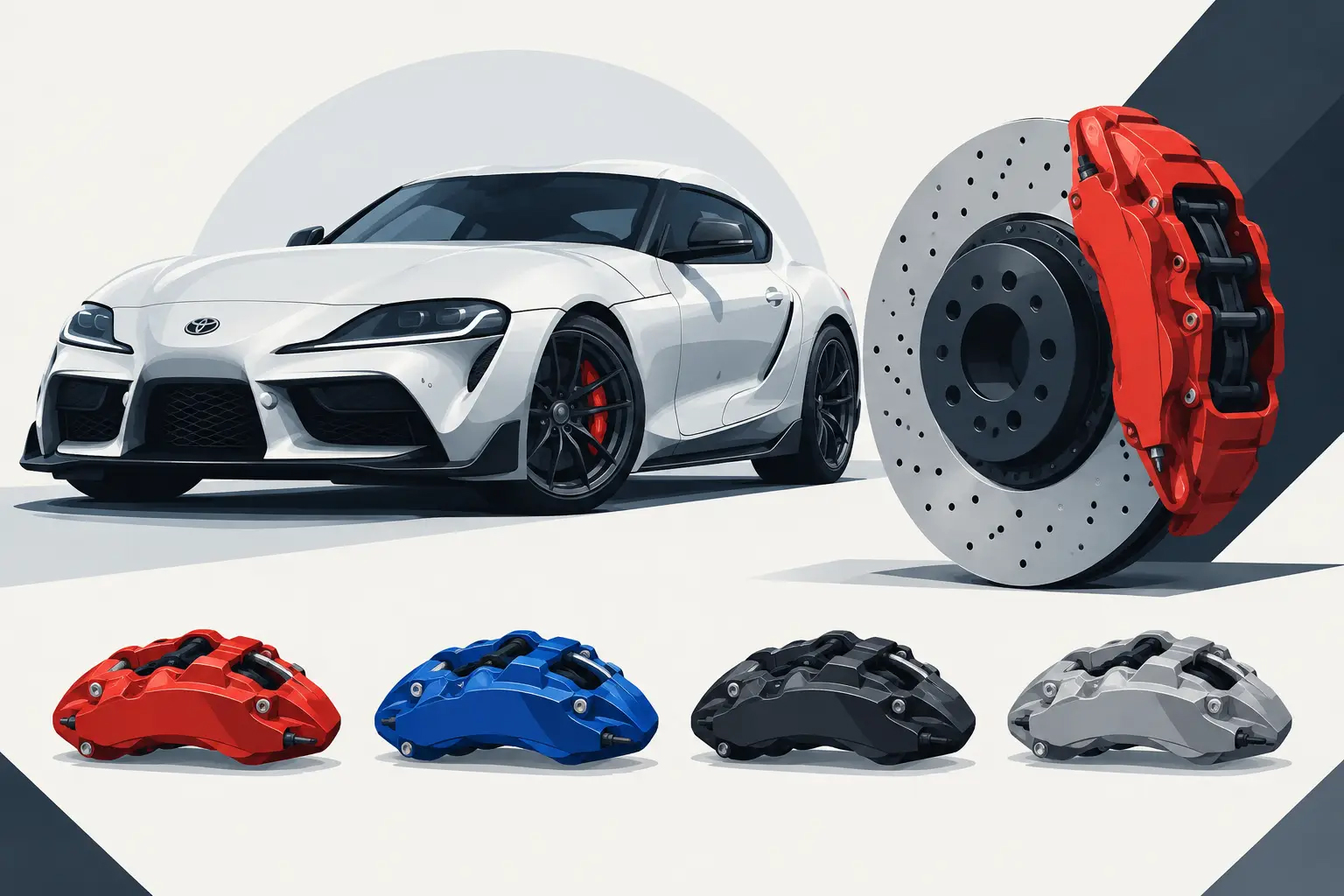
A brake pedal that goes long after repeated high-speed stops is not an inconvenience. It is the moment an under-specified system tells the driver it has reached its limit. Toyota Supra caliper fitment is therefore not a matter of choosing the largest caliper that fits behind a wheel. It is an engineering decision involving the chassis, rotor, hydraulics, wheel barrel, and intended use.
For performance workshops, distributors, and serious Supra owners, the correct approach is to specify a vehicle-specific brake system. A properly engineered caliper upgrade can improve pedal consistency, thermal capacity, brake modulation, and confidence under repeated braking. A mismatched setup can create wheel interference, poor brake balance, uneven pad wear, warning lights, or a pedal feel that is worse than stock.
Toyota Supra Caliper Fitment Starts With the Platform
The Supra name covers fundamentally different vehicle architectures. An A80 Mk4 Supra, including turbo and naturally aspirated variants, does not share its knuckle geometry, hub arrangement, brake dimensions, or hydraulic requirements with the A90/A91 GR Supra. Treating every Supra as one fitment category is the fastest way to order the wrong hardware.
A80 Supra fitment considerations
The A80 chassis is a popular restoration, street-performance, and track platform, but vehicle condition matters as much as model year. Many cars have changed wheels, altered suspension, swapped hubs, or received earlier brake upgrades over decades of use. Before selecting calipers, a workshop should confirm the actual spindle and hub configuration, existing rotor dimensions, wheel specifications, and brake line routing.
An A80 upgrade may require a dedicated adapter bracket, a rotor with the correct center bore and hat offset, and lines designed for the vehicle's mounting points. A caliper that physically bolts to a bracket is not necessarily centered over the rotor or compatible with the rotor thickness. Those details determine whether the pads sweep the braking surface correctly and whether the caliper can operate without drag.
A90 and A91 GR Supra fitment considerations
The GR Supra uses a newer chassis with different electronic brake controls, factory wheel designs, and packaging constraints. Some versions already have capable OE braking hardware, so an upgrade should address a defined need: repeated track heat, lower unsprung weight, increased rotor thermal capacity, replacement of worn components, or a change in wheel and tire performance.
For this platform, caliper fitment must account for the electronic parking brake at the rear, factory sensor routing, brake hose interfaces, and the relationship between the upgraded hardware and the vehicle's ABS and stability-control calibration. Front and rear brake changes should be planned as a system, not selected as unrelated parts.
A Caliper Never Fits in Isolation
A performance caliper is one component in a tightly controlled assembly. The mounting ears may appear close, yet a few millimeters of error in radial position or axial offset can make the installation unsafe. The important question is not, “Will this caliper bolt on?” It is, “Does this caliper work correctly with this rotor, hub, wheel, and hydraulic system?”
Rotor diameter sets the caliper's radial position. Rotor thickness determines the caliper bridge and pad-gap requirement. Rotor hat offset positions the disc within the caliper, while the center bore and bolt pattern establish how the rotor sits on the hub. If any of these dimensions are wrong, the rotor can run off-center, the pad may overhang the disc edge, or the caliper can contact the rotor under load.
Caliper piston area also matters. Larger pistons do not automatically produce better braking. They alter the hydraulic ratio between the master cylinder and caliper, which can change pedal travel and front-to-rear brake balance. A well-designed multi-piston caliper uses piston sizing, stiffness, pad area, and effective rotor radius to produce predictable braking behavior rather than simply maximum clamp force.
For a complete Toyota Supra caliper fitment evaluation, confirm these items before ordering:
- Exact chassis, model year, trim, drivetrain, and front or rear axle
- Current wheel diameter, width, offset, spoke profile, and internal barrel clearance
- Rotor diameter, thickness, hat offset, center bore, and mounting pattern
- Knuckle mounting geometry and the required bracket or direct-mount interface
- Brake line connection type, sensor provisions, and parking-brake requirements
- Intended use, from street driving to repeated track braking
Wheel Clearance Is More Than Wheel Diameter
A 19-inch wheel does not guarantee that a racing-grade caliper will clear. The critical space is inside the wheel, particularly around the spokes and barrel. Two wheels with the same diameter, width, and offset can have very different spoke curvature and inner profiles.
The caliper may clear the barrel but contact the back of a spoke. It may clear while static and touch under cornering load if a wheel spacer, bearing condition, or suspension movement changes the relationship. This is why a dimensional wheel template or verified clearance drawing is more reliable than a wheel-size assumption.
Wheel spacers can create clearance, but they are not a universal correction. Adding spacing changes effective offset and can increase load on wheel bearings, alter fender clearance, and affect steering geometry. If a spacer is required, it should be selected deliberately with proper hub-centric location, thread engagement, and wheel-fastener requirements.
Rotor and Pad Materials Must Match the Job
A large caliper paired with an unsuitable rotor or pad compound will not deliver a dependable system. Street-focused pads need cold bite, low noise, and manageable dust. Track-focused compounds must tolerate elevated temperatures and maintain friction through repeated high-energy stops, but they may be noisier and less refined in daily traffic.
Carbon ceramic braking systems offer clear benefits when the application supports them: substantial weight reduction, high thermal resistance, corrosion resistance, and long service life under appropriate operating conditions. However, carbon ceramic rotors require compatible pads, controlled mounting geometry, and a properly designed caliper and hardware package. They are not a casual rotor substitution for an iron-disc setup.
A carbon ceramic system can reduce unsprung and rotating mass, helping the suspension react more effectively while reducing heat transfer through the braking assembly. For track-capable Supra builds, that benefit is most valuable when the entire package has been engineered around the platform rather than assembled from mixed components.
Hydraulic Balance and Electronic Controls Need Respect
The front axle generally performs most of the braking work, but rear braking remains essential for vehicle stability and total deceleration. Changing front caliper piston area without evaluating the rear system can move brake bias too far forward or rearward. Either condition can compromise stopping performance, tire utilization, and ABS intervention behavior.
Pedal feel is influenced by caliper piston volume, brake fluid condition, hose expansion, pad compressibility, and master-cylinder sizing. A firm pedal is not automatically a safe pedal, and a soft pedal is not always caused by the caliper. Workshops should inspect fluid, bleeding procedure, hose condition, pad bedding, rotor runout, and hub cleanliness before diagnosing a performance brake system.
Modern GR Supra applications also require careful attention to wheel-speed sensors, brake wear sensors where equipped, and electronic parking-brake operation. No warning light should be treated as normal after an upgrade. The system should retain proper clearance, sensor routing, and function before the vehicle returns to the road or track.
Specify a Complete Supra Brake Package
The strongest result comes from a kit designed around the exact platform. A complete package should include matched calipers, rotors, brackets, pads, brake lines, mounting hardware, and installation guidance. It should also provide wheel-clearance information and technical support when a vehicle has nonstandard wheels or suspension modifications.
CCYS applies this system-level approach through vehicle-specific carbon ceramic brake solutions supported by in-house engineering and production control. With 90% of manufacturing completed internally and quality systems aligned with IATF 16949 and ISO 9001 standards, component consistency is controlled from machining through final inspection rather than left to a collection of unrelated suppliers.
For distributors and workshops, this matters commercially as well as technically. A verified kit reduces installation time, limits avoidable returns, and gives the customer a clear answer on what is included and what must be checked before fitting. For the driver, it means braking hardware built to remain composed when road speed, vehicle weight, and heat load rise together.
Verify the Installation Before the First Hard Stop
After installation, inspect rotor centering within each caliper, pad contact area, brake-line routing, fastener torque, wheel clearance, and wheel rotation lock-to-lock. Bed the pads and rotors according to the supplied procedure, then recheck hardware after the initial heat cycle. Track-driven cars should receive routine inspections of pad thickness, rotor condition, fluid quality, and caliper seals.
The right Supra brake upgrade is not the one with the biggest caliper body or the most aggressive appearance. It is the system that fits the exact chassis, clears the actual wheel, preserves controlled hydraulic behavior, and manages heat when the driver needs braking performance most. Provide the vehicle details and wheel specifications before selecting hardware, and the final result will be worthy of the Supra badge.