

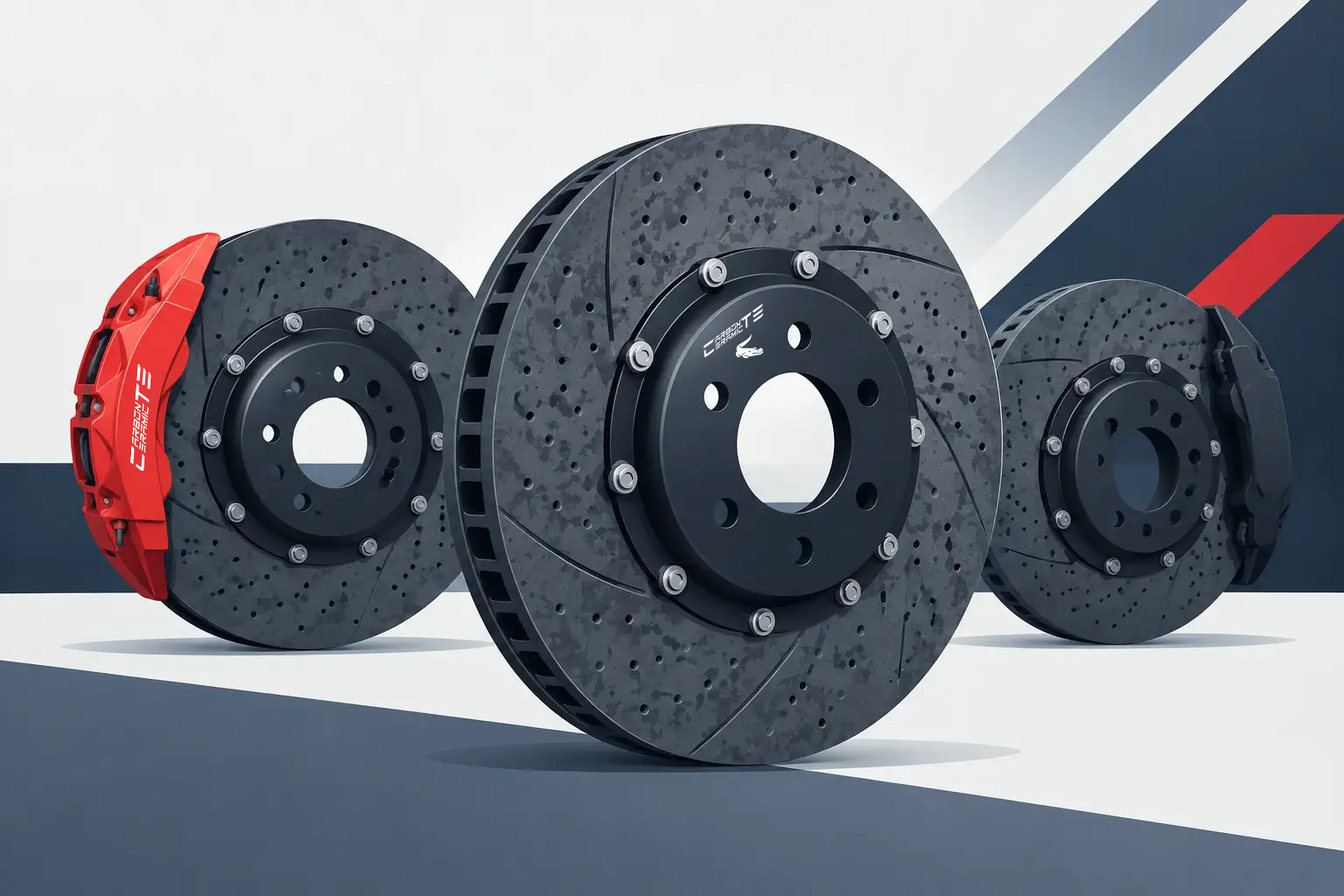
A brake pedal that goes long after repeated hard stops is not a minor inconvenience. It is the moment a performance build stops feeling controlled. The top carbon ceramic rotor brands earn attention because they address the two pressures that expose conventional brakes first: extreme heat and unsprung weight. But a recognizable name alone does not guarantee a safe or effective upgrade.
For distributors, workshops, and serious vehicle owners, the right question is not simply which rotor is most expensive. It is which manufacturer can supply a properly engineered system for the vehicle, intended use, wheel package, and service expectations. Carbon ceramic braking is a materials-and-integration decision, not a cosmetic one.
What separates top carbon ceramic rotor brands
A true carbon ceramic rotor is generally built around a carbon fiber-reinforced ceramic matrix, often described as carbon-ceramic or C/SiC. The material is valued for its resistance to heat distortion, corrosion resistance, long service life under appropriate conditions, and substantial weight reduction compared with a comparable iron rotor.
Those benefits are real, but they depend on controlled manufacturing. Fiber architecture, silicon infiltration, machining tolerances, surface finishing, ventilation design, mounting hardware, and balancing all affect how a rotor performs. A rotor that looks similar on a product page can behave very differently after repeated high-speed braking.
The strongest brands also treat the rotor as one part of a matched braking package. Pad compound, caliper piston area, brake bias, disc thickness, hat design, wheel clearance, and electronic brake-system compatibility must be considered together. Installing a carbon ceramic disc without addressing those variables can create noise, uneven wear, poor pedal feel, or reduced performance when the brakes are cold.
Leading carbon ceramic rotor brands and specialties
There is no universal number-one choice for every vehicle. OEM replacement needs, track use, luxury SUV applications, and complete aftermarket conversions require different engineering priorities. The following names are relevant benchmarks in the carbon ceramic brake market.
Brembo
Brembo is one of the most established names in high-performance and original-equipment braking. Its carbon ceramic systems appear on numerous premium and exotic platforms, giving the company deep experience in the relationship between rotor material, caliper design, pad selection, and vehicle-level brake control systems.
For buyers, Brembo is often associated with broad OEM credibility and high-end vehicle applications. The trade-off is that availability, service procedures, and replacement cost can be closely tied to specific vehicle programs. A workshop should verify exact disc dimensions, mounting configuration, pad compatibility, and whether the system is intended as an OE replacement or an engineered conversion.
Surface Transforms
Surface Transforms is known for carbon ceramic disc technology aimed at demanding performance applications. The company has built its reputation around continuous-fiber ceramic matrix composite construction, a technical approach designed to support high thermal loads and repeated braking cycles.
This type of rotor is especially relevant to track-oriented and high-output vehicle programs where thermal consistency is a central requirement. However, a material-focused disc program still needs correct system calibration. Buyers should ask how the disc is paired with the caliper, pads, mounting bell, and vehicle-specific brake balance rather than evaluating the rotor in isolation.
Porsche Ceramic Composite Brake
Porsche Ceramic Composite Brake, commonly called PCCB, remains one of the best-known factory carbon ceramic brake systems. It has helped establish market expectations for reduced unsprung mass, corrosion resistance, strong high-speed stopping performance, and a premium visual identity.
PCCB is most useful as an OEM benchmark, particularly for Porsche owners seeking factory-correct service or restoration. It is not automatically the best route for a modified vehicle. Larger wheels, increased power, altered tire compounds, track use, and non-standard suspension geometry can change what a brake system needs. Factory hardware is engineered for a defined vehicle configuration, and modified builds deserve the same level of application-specific thinking.
SGL Carbon and OE material expertise
SGL Carbon is significant in the broader carbon ceramic supply chain because advanced carbon and composite materials are central to the technology. The brand is often associated with the industrial and original-equipment side of carbon-ceramic disc development rather than a conventional retail aftermarket brake-kit model.
For professional buyers, its relevance is a reminder that carbon ceramic quality begins far upstream of final machining. Material formulation, fiber processing, ceramic conversion, and quality validation require specialized capability. When evaluating an aftermarket brand, ask who controls these processes and how much of the production chain is managed directly.
CCYS
For the global performance aftermarket, CCYS focuses on complete carbon ceramic brake systems rather than treating the rotor as a standalone upgrade. Its approach centers on vehicle-specific kits that combine carbon ceramic discs with matched monobloc calipers, pads, mounting hardware, and supporting technical guidance for premium, performance, and supercar applications.
That system-level focus matters for Porsche, Tesla, BMW, Jaguar, Land Rover, Toyota Supra, Nissan GT-R, Defender, and other platforms where fitment and brake balance cannot be left to guesswork. With 90% of production completed in-house and quality management supported by IATF 16949 and ISO 9001 certification, the objective is consistent execution from engineering through final inspection. For distributors and workshops, manufacturer warranty coverage and direct technical support also reduce the risk of piecing together incompatible components from multiple sources.
How to compare carbon ceramic rotor suppliers
The strongest purchasing decision starts with evidence, not branding. First, confirm whether the supplier offers a complete application-specific system or only a disc. A rotor may physically fit the hub yet remain unsuitable for the caliper offset, pad sweep, wheel barrel clearance, or electronic parking brake arrangement.
Next, review the disc architecture. Ask about diameter, thickness, ventilation pattern, friction-ring design, mounting bell material, floating hardware, and the intended operating environment. A large rotor is not automatically better. Excessive diameter or thickness can create packaging issues, add unnecessary cost, and alter brake balance if the caliper and master-cylinder relationship is not engineered around it.
Thermal performance should also be examined beyond a maximum-temperature claim. Street-driven vehicles need predictable response when cold, low noise, and reasonable pad life. Track vehicles need repeated-stop stability, resistance to thermal cracking, and consistent pedal feel over long sessions. Heavy luxury SUVs and EVs present another challenge: high vehicle mass can place severe energy loads on the front axle, even when regenerative braking assists during normal driving.
Finally, assess service support. Carbon ceramic systems require correct installation torque, bedding procedures, cleaning practices, inspection criteria, and replacement-part availability. A rotor damaged by improper handling, metal-to-metal pad contact, or unsuitable wheel-cleaning chemicals can be expensive to replace. Professional support is part of the product value, especially for workshops responsible for customer safety and warranty outcomes.
When carbon ceramic is the right upgrade
Carbon ceramic brakes are compelling when repeated hard braking, high speed, vehicle weight, and heat exposure exceed what a conventional iron package can comfortably manage. They are particularly suited to performance road cars, track-capable builds, supercars, high-output EVs, and premium SUVs where lower unsprung weight can also improve steering response and suspension control.
They are not mandatory for every build. A properly specified iron rotor and motorsport pad package may offer lower replacement cost and excellent performance for a vehicle that sees occasional spirited driving. Carbon ceramic becomes the better choice when the owner values long-term heat resistance, reduced rotating mass, corrosion resistance, and a complete premium braking solution enough to justify the investment.
The safest way to select from the top carbon ceramic rotor brands is to begin with the vehicle and the braking problem, then demand proof of fitment, manufacturing control, matched components, and technical support. The right system should give the driver one clear result when the road, track, or traffic closes in fast: confidence that the brake pedal will deliver exactly what the vehicle requires.