

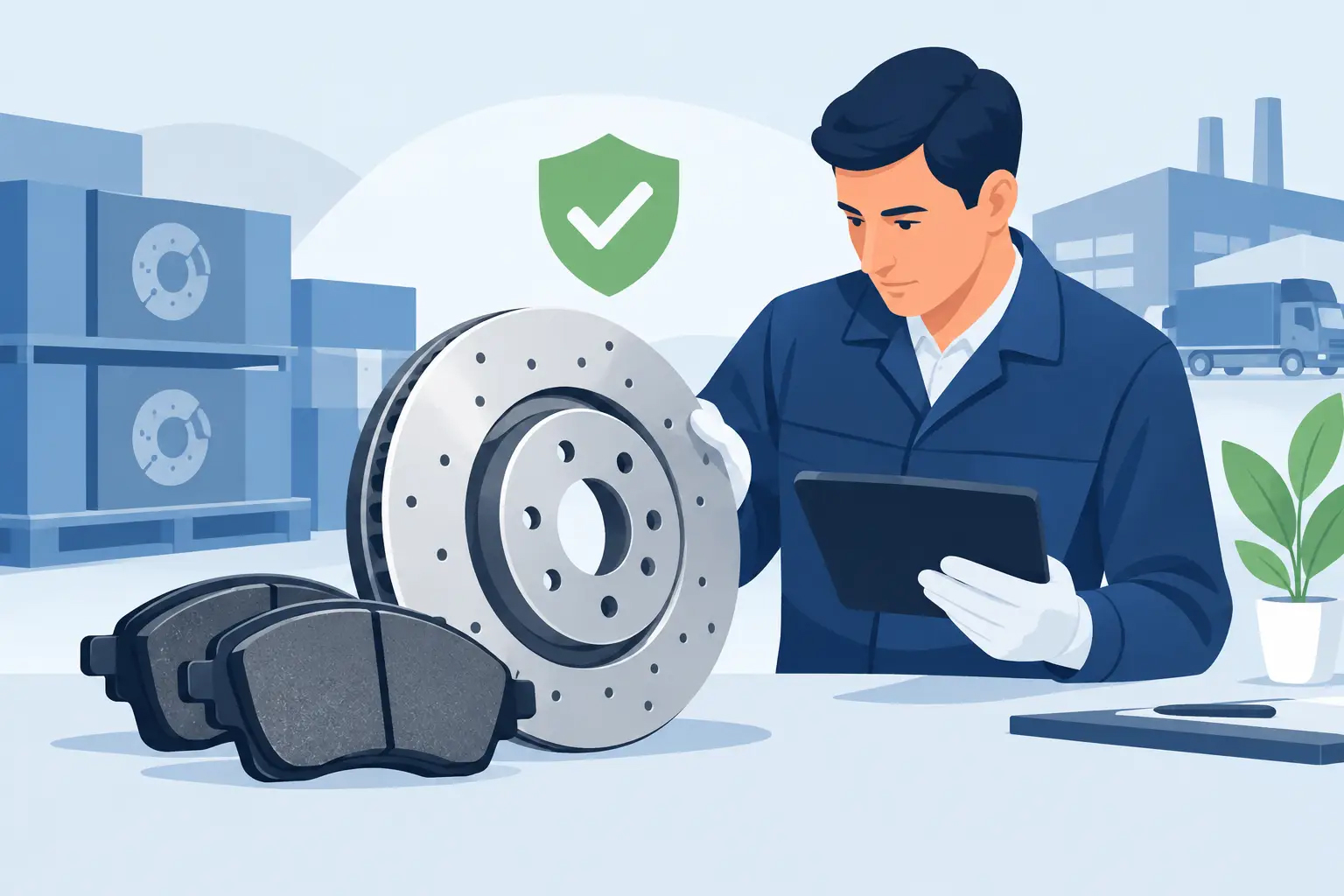
A brake system does not get a second chance when the pedal goes long at speed. That is why a serious brake supplier quality case study cannot be built around polished calipers, catalog claims, or one successful dyno pull. It has to show how a supplier controls materials, machining, fitment, inspection, and accountability before the kit reaches a workshop or customer vehicle.
For distributors and performance workshops, quality is not an abstract purchasing requirement. A rotor with inconsistent material properties, a caliper with poor machining control, or a bracket that misses vehicle-specific tolerances can create expensive rework, reputational damage, and a genuine safety concern. The strongest suppliers treat every component as part of one braking system, not as a collection of parts in a box.
The Quality Challenge: Repeated Heat, Repeated Pressure
This case study follows a typical performance aftermarket requirement: a distributor needs a carbon ceramic brake package for premium street and track-focused applications. The program must support repeated high-energy stops while reducing unsprung weight, maintaining predictable pedal response, and fitting the intended platform without modification at installation.
The buyer is not only evaluating stopping performance. They are evaluating the risk behind the product. Can the supplier maintain dimensional control across production batches? Are rotor, pad, caliper, mounting hardware, and hub interfaces engineered to work together? Can the supplier identify where a component came from if a technical issue is reported months later?
Those questions matter more with carbon ceramic systems. The material offers major advantages in thermal resistance and weight reduction, but it also demands disciplined manufacturing and application engineering. A low-quality process can turn an advanced material into an inconsistent product.
Brake Supplier Quality Case Study: The Evaluation Framework
A credible evaluation starts at the factory, not at the shipping dock. In this case, the purchasing team assesses the supplier through five connected controls: manufacturing ownership, material and process traceability, precision inspection, vehicle-specific validation, and technical support after delivery.
1. Manufacturing Ownership Reduces Blind Spots
A supplier that outsources every major stage may still deliver usable parts, but it has less direct authority when a tolerance, finish, or production sequence needs correction. For a braking system, that delay can become costly quickly.
CCYS completes 90% of production in-house, covering R&D, precision machining, and quality management. That level of control allows engineering and quality teams to work from the same production reality. When a caliper machining feature, disc interface, or mounting dimension requires review, the team can investigate the process directly rather than wait for multiple outside vendors to respond.
Vertical control is not automatically better in every category. A specialized outside process may be appropriate when it offers a capability the manufacturer cannot reproduce internally. The key is whether the supplier owns the specification, validates the result, and can document corrective action. For brake buyers, accountability matters more than the location of a single process.
2. Traceability Must Follow the Part, Not Just the Purchase Order
A brake kit should be traceable beyond the invoice number. In a disciplined quality process, parts are linked to identifiable material lots, production batches, inspection records, and assembly information. That documentation gives the supplier a path to investigate an issue without guessing.
Consider a workshop report of uneven pad wear after installation. The responsible response is not to immediately blame driving style or installation. The supplier should first verify the vehicle application, rotor specification, caliper position, pad compound, hardware selection, and relevant production records. Traceability narrows the investigation from hundreds of possible causes to a manageable set of facts.
This matters to distributors because it protects their customer relationships. A supplier that can isolate a batch, review measurement data, and provide a technical answer helps the distributor resolve issues professionally. A supplier that cannot identify what was built, when it was built, or how it was checked leaves the channel partner carrying the risk.
3. Precision Inspection Protects Fitment and Pedal Feel
Performance brake systems depend on tolerances that are easy to overlook in a catalog image. Rotor runout, disc thickness variation, caliper mounting alignment, hub interface geometry, and hardware fit can all affect how the system performs and feels.
In this case, inspection is not limited to a final visual check. Critical dimensions are checked through the production process, with final verification before packing. The objective is to prevent a nonconforming part from moving downstream, rather than relying on installers to discover the problem during a brake job.
For the workshop, correct fitment means less time solving avoidable issues. For the driver, it supports even pad contact, stable braking response, and confidence under repeated load. It also reinforces an often-missed point: a premium brake system is only as reliable as its smallest interface. A high-performance rotor cannot compensate for an inaccurate bracket or poor mounting hardware.
4. Certification Supports Process Discipline, Not Marketing Alone
IATF 16949 and ISO 9001 certification are meaningful signals when they are reflected in daily production behavior. They indicate that the manufacturer operates within documented quality-management structures, including process control, recordkeeping, corrective action, and continuous improvement.
Certification alone does not prove that every part will be perfect. No serious manufacturer should promise that. What it does provide is a framework for identifying nonconformities, containing risk, and improving the process instead of repeating the same failure. Buyers should look for certification alongside factory capability, inspection discipline, warranty support, and product-specific technical knowledge.
For a distributor comparing suppliers, this is where price needs context. A lower upfront purchase cost may be attractive, but it can disappear after returns, shipping claims, installation labor, and lost customer confidence. Quality documentation is not paperwork for its own sake. It is part of the commercial value of the product.
Validation Must Match the Vehicle and the Use Case
A brake package for a Porsche, Tesla, BMW, Jaguar, Land Rover, Toyota Supra, Nissan GT-R, Defender, or supercar platform cannot be treated as a universal kit with a different label. Vehicle mass, wheel clearance, mounting geometry, electronic systems, intended use, and thermal demands all influence the correct system configuration.
The case study requirement is therefore vehicle-specific validation. The supplier needs to confirm that the selected rotor size, caliper configuration, bracket design, pad specification, and hardware package are appropriate for the application. Wheel clearance is especially important with larger calipers and discs. A system can be technically capable yet unsuitable if it conflicts with the customer’s wheel design.
Use case also changes the recommendation. A customer focused on spirited road driving may prioritize low dust, stable cold response, and reduced unsprung weight. A track-oriented driver may accept different pad behavior in exchange for stronger high-temperature performance. The right answer depends on the vehicle and operating conditions, which is why technical support must be available before purchase, not only after a problem appears.
What the Distributor Learns From the Case
The result of this brake supplier quality case study is not simply a pass or fail decision. It is a purchasing standard. The distributor gains a clear way to qualify braking partners: confirm who controls production, ask how parts are traced, review the inspection approach, verify certifications, check vehicle-specific fitment support, and understand the warranty process.
This framework also exposes warning signs. Be cautious when a supplier cannot explain its manufacturing responsibility, has vague answers about fitment, offers no identifiable quality documentation, or treats rotors, calipers, and pads as unrelated items. Those gaps may not appear in the first shipment. They tend to surface when the customer is braking hard, the vehicle is expensive, and the installer needs answers immediately.
For performance workshops, the practical benefit is confidence in the recommendation. A complete, engineered brake system gives technicians a stronger foundation for installation and gives end users a braking upgrade built for the conditions that made them seek better stopping power in the first place.
When evaluating your next brake supplier, ask for proof that follows the part from engineering through delivery. The best partner will not rely on promises of racing-grade performance. They will show the manufacturing control, quality discipline, fitment knowledge, and technical accountability needed to stand behind it.