

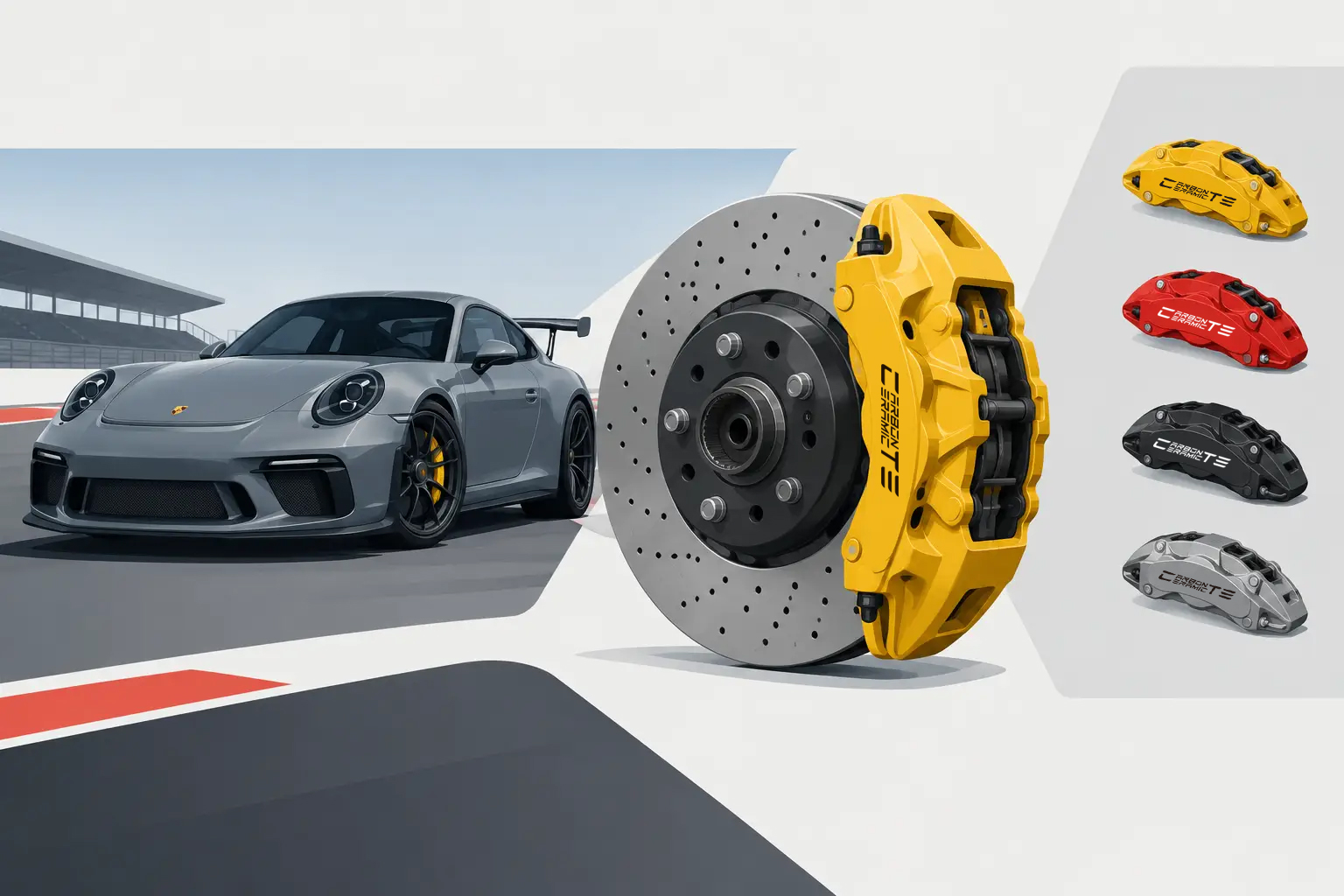
A Porsche caliper fitment example starts where every serious brake upgrade should start: with the moment a fast car needs to stop repeatedly and the pedal begins telling a different story. A larger caliper may look like an obvious answer, but a caliper that is not engineered around the rotor, hub, wheel, and master cylinder can create poor pad contact, clearance interference, unstable brake balance, or an unsafe pedal feel.
For Porsche applications, fitment is not simply a matter of matching bolt spacing. It is a complete system calculation. The strongest result comes from a vehicle-specific brake package in which caliper geometry, carbon ceramic rotor dimensions, mounting hardware, hydraulic piston area, and wheel clearance have been verified as one assembly.
Why Porsche Caliper Fitment Is a System Decision
Porsche platforms are highly capable from the factory, yet their braking requirements can change dramatically with higher power, heavier wheels and tires, track use, or repeated mountain-road braking. A system that works well for an occasional spirited drive may run out of thermal capacity during consecutive high-speed stops.
The caliper is only one part of the answer. It must clamp the correct rotor at the correct radial position and lateral position. The pad must sweep a usable friction path without overhanging the disc edge. The mounting bracket must resist deflection under load. The wheel must clear the caliper body, bridge, bleed screws, and brake line at full steering lock where applicable.
This is why mixing components from different Porsche models without measurement is a gamble. A caliper from a later or higher-specification model may have an impressive piston count, but that does not establish compatibility with the donor vehicle's rotor offset, hub geometry, brake lines, ABS calibration, or wheel barrel profile.
Porsche Caliper Fitment Example: Front-Axle Conversion
Consider a hypothetical front brake conversion for a Porsche 997 Carrera that sees frequent track days. The objective is to increase thermal capacity and reduce unsprung weight with a six-piston monobloc caliper and a 380 mm carbon ceramic rotor. The target is not the largest possible assembly. The target is a correctly proportioned package that fits the car, clears the selected wheels, and remains predictable under threshold braking.
The first measurement is rotor diameter. If the factory rotor is smaller, the upgraded caliper must sit farther from the hub center so the pads engage the 380 mm rotor correctly. This radial position is controlled by the caliper mounting ears and, where required, a precisely machined adapter bracket. A bracket is not a universal spacer. Its material, fastener specification, location features, thickness, and machining tolerances are structural requirements.
Next comes rotor thickness. A caliper designed around a 34 mm rotor cannot be assumed to accept a 36 mm or 38 mm disc. The disc must sit centrally in the caliper throat with enough clearance for thermal expansion, pad backing plates, anti-rattle hardware, and normal pad movement. A rotor that is too thick can cause drag or prevent installation. A rotor that is too thin can leave excessive piston extension and reduce caliper rigidity in use.
Rotor offset is equally critical. Offset describes where the rotor friction faces sit relative to the hub mounting face. If the disc is positioned too far inboard or outboard, the caliper will not be centered over it. Even a small offset error can produce uneven pad wear, partial pad sweep, or contact between the rotor and caliper body. The correct approach is to measure the hub face, rotor hat depth, rotor centerline, and caliper centerline before any bracket geometry is finalized.
In this example, the six-piston caliper is then selected with piston sizes that support the Porsche's front-to-rear hydraulic balance. More pistons do not automatically mean more effective braking. Total piston area determines the hydraulic force created for a given line pressure. If front piston area rises too far relative to the rear axle, the car can become excessively front-biased, increasing the chance of premature front lockup and reducing stability under hard braking.
A well-engineered kit addresses this with matched front and rear components, or with a front configuration designed to remain within the operating range of the factory rear system. Pad compound also matters. A high-friction front pad combined with a mild rear compound can change balance just as surely as a piston-area mismatch.
Wheel Clearance Is More Than Wheel Diameter
A 19-inch wheel does not guarantee clearance for a 380 mm rotor and six-piston caliper. Wheel diameter is only the first filter. The internal barrel shape, spoke contour, wheel offset, and thickness of the mounting face determine whether the caliper has usable space.
Radial clearance is the gap between the outer edge of the caliper and the wheel barrel. Axial clearance is the gap between the caliper face and the back of the spokes. Both need margin for wheel flex, manufacturing variation, wheel weights, and heat. A setup that clears by a fraction of a millimeter while stationary is not a professional fitment standard.
A wheel template based on the finished caliper and rotor assembly is the practical way to verify clearance before ordering wheels or machining components. The template should represent the widest and tallest parts of the installed brake assembly, not only the main caliper body. It should also account for brake line routing and hardware locations.
The Details That Determine Pedal Feel and Reliability
A Porsche caliper conversion must retain a sound hydraulic system. Brake hose fittings need the correct thread type, sealing method, length, and routing through suspension travel and steering movement. A line that looks acceptable on a lift may stretch, twist, or touch a wheel at full lock.
The master cylinder and brake booster also influence results. A significant increase in total caliper piston area can produce a longer pedal travel. Reducing piston area too much can create an overly firm pedal that requires greater driver effort. Neither condition is automatically unacceptable, but both must be evaluated against the vehicle's intended use and the driver's expectations.
ABS and stability-control behavior deserve the same respect. These systems interpret wheel-speed changes and are calibrated around the vehicle's original brake response. A properly proportioned upgrade can work very well with factory electronics, but extreme changes in brake torque distribution or tire setup may require additional validation. For road-driven cars, predictability and repeatability are more valuable than a dramatic specification sheet.
Thermal management completes the fitment discussion. Carbon ceramic rotors offer meaningful resistance to heat and substantial weight savings, particularly at the wheel ends where reduced unsprung and rotating mass can improve response. Their performance still depends on the complete system: appropriate pad material, effective airflow, correct bedding procedure, and caliper seals designed for repeated high-temperature operation.
What a Complete Fitment Verification Should Cover
Before release or installation, a performance workshop should verify the full assembly rather than approving a caliper based on appearance. The essential checks include rotor diameter and thickness, rotor offset and centerline, caliper radial location, pad sweep, hub and bracket mounting surfaces, fastener torque specifications, wheel clearance, brake-line routing, and full suspension or steering travel.
The technician should then inspect pedal response, fluid level, rotor runout, pad movement, and any signs of interference before road or track use. After bedding the pads and rotors, recheck fasteners and inspect the friction surfaces. This process is not excessive caution. Brake components carry extreme load, heat, and safety responsibility every time the car decelerates from speed.
Choose Engineering Over Parts Mixing
A Porsche brake upgrade should never be judged by caliper size alone. The right caliper is the one that matches the rotor, wheel, hydraulic system, intended use, and vehicle dynamics with measured accuracy. That is how a track-capable installation delivers stronger, more consistent stopping performance without sacrificing confidence on the road.
For distributors and performance workshops, complete vehicle-specific packages also reduce installation uncertainty and protect the reputation of the finished build. CCYS applies in-house control across the majority of its production process, backed by IATF 16949 and ISO 9001 quality standards, to deliver carbon ceramic brake systems built around that level of fitment discipline. When the next Porsche arrives with braking that feels outmatched by its performance, begin with measurements and system design, not a caliper catalog photo.