

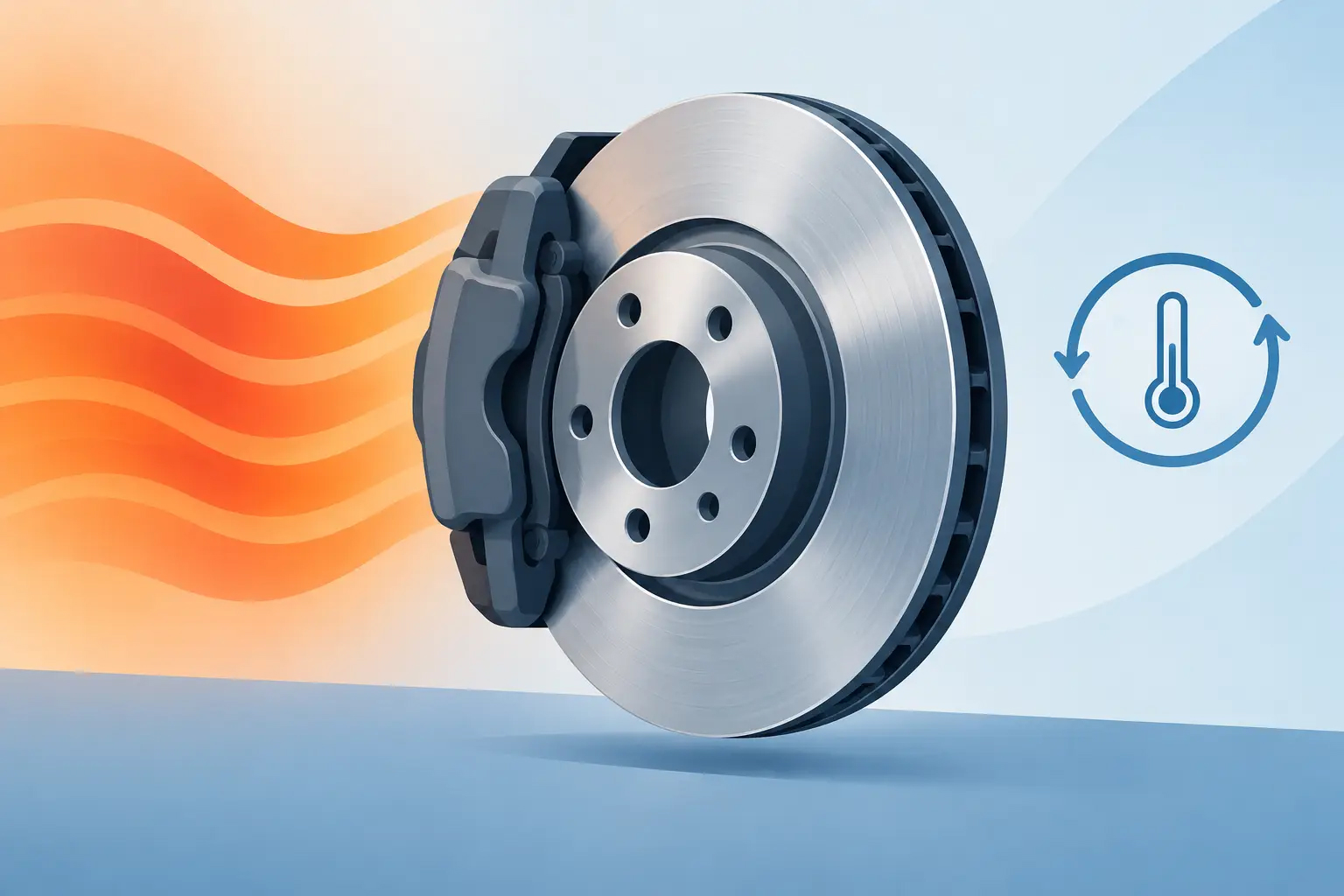
A long brake pedal at the end of a high-speed stop is not a minor inconvenience. It is the moment a performance vehicle reveals whether its braking system was engineered for real load or only for ordinary use. Brake rotors carry the heat, friction, and mechanical stress of every stop, making them a central factor in pedal consistency, confidence, and repeatable stopping performance.
For premium street builds, heavy EVs, track-capable cars, and supercars, rotor selection cannot be reduced to diameter alone. Material, thermal capacity, disc design, fitment, caliper compatibility, and manufacturing precision all determine how a brake system behaves when temperatures rise.
Why Brake Rotors Matter Under Repeated Braking
A rotor converts vehicle speed into heat through friction with the brake pad. During one hard stop, that heat can be substantial. During repeated stops on a mountain road, a fast highway run, a track session, or while controlling the weight of an EV or SUV, the system has less time to recover between braking events.
When rotor temperature exceeds the effective operating range of the disc, pad, fluid, or surrounding hardware, drivers may experience longer pedal travel, reduced friction, vibration, surface cracking, or inconsistent response. These problems are often described broadly as brake fade, but the underlying cause matters. A pad losing friction at high temperature requires a different solution than a rotor with insufficient heat capacity or an improperly matched disc and caliper combination.
The right rotor supports stable friction conditions. It absorbs and releases heat predictably, maintains structural integrity, and provides a consistent surface for the pad. That is why braking performance should be evaluated as a complete system rather than a collection of individual parts.
Iron vs. Carbon Ceramic Brake Rotors
Traditional cast-iron rotors remain common because they are affordable, familiar to service, and effective for many daily-driven applications. A quality iron disc can perform well when its size, ventilation, pad compound, and caliper configuration match the vehicle's intended use. For standard road duty, the value proposition is straightforward.
The trade-off appears when vehicle mass, speed, and repeated braking loads increase. Iron is heavy, and that weight sits at the wheel. Increased unsprung and rotating mass can affect steering response, suspension behavior, and acceleration. Iron rotors also retain considerable heat, which can place additional demand on pads, fluid, calipers, and wheel-area components.
Carbon ceramic brake rotors address a different performance requirement. Their carbon-fiber-reinforced ceramic structure is designed for lower weight and high thermal resistance. Reducing rotor mass can improve wheel control and steering response while reducing the inertia that the drivetrain must accelerate and decelerate. Under repeated heavy braking, a properly engineered carbon ceramic system can provide more consistent performance with less fade-related stress.
That does not mean carbon ceramic is automatically the right answer for every vehicle. It depends on driving conditions, service expectations, wheel fitment, budget, and whether the system is designed as a matched kit. Carbon ceramic components require the correct pad material, caliper geometry, mounting hardware, and vehicle-specific engineering. Installing a high-spec rotor into an unmatched system is not a performance strategy.
What Determines Rotor Performance
Rotor diameter is visible, but it is only one part of the equation. A larger effective braking radius increases leverage, allowing the brake system to generate torque more efficiently. Thickness and internal construction influence heat capacity and stiffness. Ventilation design affects airflow and thermal recovery. The disc surface and pad pairing affect friction stability, noise, wear, and feel.
For performance applications, the most relevant questions are practical:
- Can the rotor manage the vehicle's weight and expected speed?
- Is the disc engineered for repeated heat cycles rather than a single maximum-effort stop?
- Does the caliper provide even, controlled clamping across the pad?
- Are the pad compound and rotor material designed to work together?
- Does the kit fit the specific hub, wheel, suspension, and electronic brake configuration?
These factors are interdependent. A large rotor with poor mounting precision can create runout and pedal pulsation. An aggressive pad on an unsuitable disc may accelerate wear or create unstable friction. A caliper with inadequate stiffness can reduce pedal precision even when the rotor itself is capable. Engineering excellence comes from controlling the complete interface.
Rotor Design Must Match the Vehicle
A Porsche used for occasional track days has different braking demands than a Tesla carrying battery mass through repeated urban and highway deceleration. A Nissan GT-R, Toyota Supra, BMW M platform, Jaguar performance model, Land Rover, or Defender may require a different balance of thermal capacity, wheel clearance, corrosion resistance, and road durability.
Vehicle-specific fitment is therefore more than a catalog detail. It includes rotor offset, hat design, mounting pattern, disc diameter and thickness, caliper bracket geometry, brake line routing, wheel clearance, and compatibility with the vehicle's ABS and stability-control behavior. Professional workshops and distributors should verify these specifications before recommending a conversion.
A complete brake kit reduces uncertainty because the major components are developed to operate together. The rotor, caliper, bracket, pads, and hardware are not left to chance. For customers moving from stock iron brakes to carbon ceramic technology, this system-level approach is especially important.
The Value of Lower Unsprung Weight
Performance buyers often focus on stopping distance, but lower rotor weight has benefits beyond deceleration. Weight at the wheel is unsprung mass. Reducing it can help the suspension react more accurately to surface changes, supporting steering precision and tire contact over uneven pavement.
The difference is most noticeable where a vehicle is being driven hard: fast direction changes, braking over imperfect roads, corner entry, and repeated transitions. Lower rotating mass can also improve the sense of response under acceleration and braking. The gain is not a substitute for proper suspension setup or tire selection, but it is a meaningful part of a cohesive performance build.
Manufacturing Control Protects Brake Consistency
High-performance brake rotors are safety-critical components. Their performance depends on material quality, machining accuracy, thermal processing, dimensional control, and inspection discipline. Small inconsistencies can become real-world issues at speed: vibration, uneven pad contact, heat concentration, premature wear, or fitment complications.
This is why production control matters as much as headline specifications. CCYS completes 90% of production in-house, covering development, precision machining, and quality management to maintain closer control over component consistency. IATF 16949 and ISO 9001 quality systems reinforce the process discipline required for global aftermarket and performance applications.
For distributors and workshops, manufacturing transparency is commercially valuable. It supports more confident fitment decisions, fewer avoidable installation issues, and stronger after-sales conversations with customers who expect OEM-grade execution. For drivers, it means the braking system is built around repeatability, not just appearance.
When to Inspect or Replace Brake Rotors
Rotors should be inspected whenever pads are replaced, when vibration appears under braking, or after sustained high-temperature use. Visual appearance alone is not enough. A disc may look acceptable while falling below minimum thickness, developing uneven wear, or showing signs of heat damage.
Warning signs include steering-wheel or pedal pulsation, a change in braking feel, visible cracking, severe scoring, blue or discolored heat marks, unusual noise, and uneven pad deposits. These symptoms do not always mean the rotor is the only fault. Hub condition, wheel-bearing play, improper torque, caliper movement, pad material, and installation cleanliness can all contribute.
For carbon ceramic systems, inspection procedures should follow the component manufacturer's requirements. Unlike conventional iron discs, carbon ceramic rotors should not be evaluated casually by assumptions carried over from standard service practices. Use the correct measurement process, approved pads, and trained installation support.
Build Braking Confidence Into the System
A performance brake upgrade should make the vehicle more controlled, not merely more dramatic. The best brake rotors are selected as part of a system that reflects vehicle weight, wheel package, power level, driving environment, and the driver's expectation for repeated performance.
Whether the goal is a lighter, more responsive street car or a racing-grade setup prepared for sustained heat, choose components with proven fitment, compatible hardware, and manufacturing discipline behind them. When braking load rises, confidence comes from knowing the system was engineered to keep working after the first hard stop.