

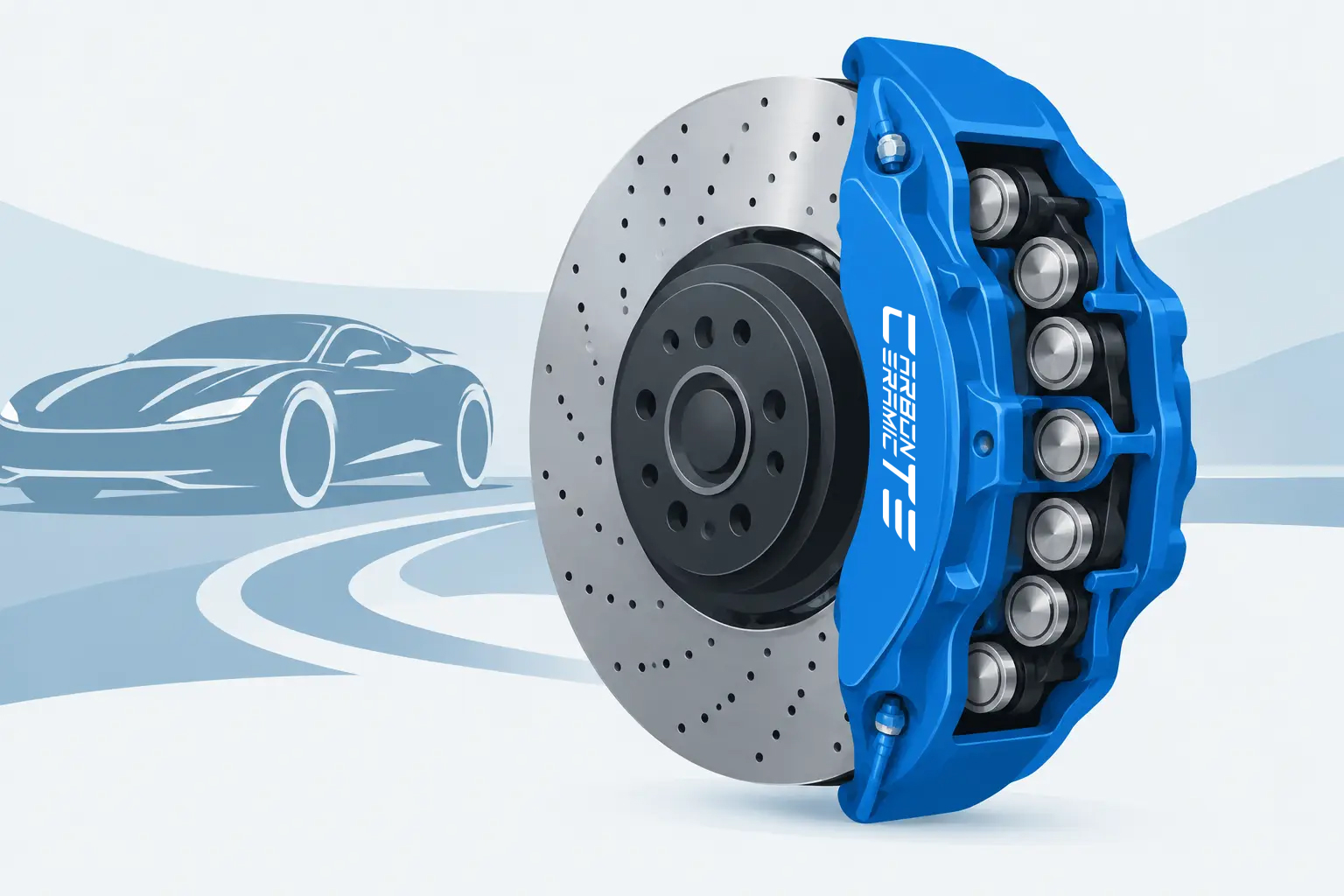
A hard brake pedal means little if the vehicle will not repeat the same stop when speed, weight, and temperature rise. That is where six piston calipers earn their place. On a fast street car, heavy SUV, EV, or track-focused build, a correctly engineered six-piston system delivers more controlled pad pressure, greater thermal capacity, and the confidence to brake hard without waiting for fade to reveal a weak setup.
A six-piston caliper is not automatically the right answer for every vehicle. But when it is matched to the correct rotor diameter, thickness, pad compound, brake bias, and wheel clearance, it can be a serious upgrade over an undersized factory system or a cosmetic big-brake conversion.
What Six Piston Calipers Actually Do
Most performance six-piston calipers are fixed, opposed-piston designs. Three pistons act on the inboard brake pad and three act on the outboard pad. Rather than relying on a sliding caliper body to pull the outer pad into the rotor, the pistons apply force from both sides of the disc.
This architecture spreads clamping load across a larger pad backing plate. The result can be more even pad contact, reduced taper wear, and greater stability when repeated high-energy stops push the braking system beyond normal road temperatures. A rigid monobloc caliper body also resists flex more effectively than many conventional floating calipers, helping preserve a direct, predictable pedal response.
The number of pistons alone does not create stopping power. Hydraulic line pressure and total piston area determine clamping force, while tire grip ultimately determines how much braking force reaches the road. Six pistons are valuable because they allow engineers to distribute that force across a larger, properly shaped pad while packaging a caliper around a larger rotor.
Why Piston Layout Matters Under Heat
Hard braking creates heat at the rotor and pad interface. If the system cannot absorb and release that heat, friction changes, pedal travel can increase, and stopping performance becomes inconsistent. Brake fade is not merely inconvenient at track speeds or on a long descent. It reduces the driver's margin for error.
A six-piston caliper supports thermal management in several ways. Its larger pad profile can increase the available friction surface, while the caliper is commonly paired with a larger-diameter and thicker rotor. More rotor mass provides a larger heat sink. Greater diameter also moves the pad's friction radius farther from the hub center, increasing braking torque for a given clamping load.
Staggered piston sizing is another important engineering detail. The pistons are often not all identical in diameter. Carefully selected piston sizes help balance pressure across the pad as the rotor rotates through the caliper. This can reduce uneven wear and maintain more consistent friction across the pad face.
For vehicles operating with carbon ceramic rotors, caliper and pad selection become even more critical. Carbon ceramic discs offer major advantages in heat resistance, corrosion resistance, and unsprung-weight reduction, but they must be paired with compatible friction materials and hardware. A high-quality system is engineered as one assembly, not assembled from unrelated parts.
Six-Piston vs. Four-Piston Calipers
A quality four-piston caliper can be the better solution for many street applications. It may offer excellent pedal feel, sufficient thermal capacity, easier wheel packaging, and lower overall cost. A piston count is not a performance ranking by itself.
Six piston calipers become more compelling when vehicle mass, speed, tire capability, and repeated braking loads increase. They are especially relevant for performance sedans, high-output coupes, electric vehicles with substantial curb weight, premium SUVs, and vehicles used for aggressive canyon driving or track days. Platforms such as Porsche, Tesla, BMW, Toyota Supra, Nissan GT-R, Jaguar, Land Rover, and Defender models can place serious demands on brake hardware when modified beyond factory intent.
The trade-off is that a six-piston setup requires more precise integration. It may demand a larger wheel diameter, a specific spoke profile, a properly sized master cylinder, and a rotor that is designed for the caliper's pad sweep. If those details are ignored, the upgrade can produce poor clearance, excessive front bias, uneven pad wear, or a pedal feel that does not match the vehicle's intended use.
The Rotor Is Half the System
Installing a large caliper over an inadequate rotor defeats the purpose of a big-brake upgrade. Rotor diameter, thickness, cooling vane design, disc material, hat offset, and mounting accuracy all affect performance.
A larger rotor improves leverage and thermal mass, but size must be chosen around the wheel, suspension geometry, and target brake balance. A two-piece floating rotor can reduce weight at the hub and allow thermal expansion to occur with less stress. Carbon ceramic rotor systems take weight reduction further, lowering rotating and unsprung mass while maintaining resistance to high operating temperatures.
Rotor cooling is equally important. Directional internal vanes draw air through the disc as it rotates, helping remove heat between braking events. The caliper must be positioned precisely over the rotor so the pad sweeps the intended friction track. Poor radial placement wastes available rotor surface and can create a damaging pad ridge.
A complete kit should therefore include the correct calipers, rotors, pads, brackets, brake lines, mounting hardware, and fitment guidance. Piecing together components based only on appearance or mounting bolt spacing is a risk no professional workshop should accept.
Fitment, Bias, and Pedal Feel
Brake upgrades must preserve control, not just add visual impact behind the wheel. The front and rear systems work together to determine vehicle stability during deceleration. An oversized front conversion without consideration for rear braking capacity, tire selection, ABS calibration, and weight transfer can alter balance in ways the driver may not expect.
Piston area is a central part of that calculation. Increasing total piston area can increase clamp force at a given line pressure, but it can also require more brake fluid displacement. Depending on the master cylinder and pedal ratio, that may change pedal travel. Proper engineering considers the full hydraulic system rather than treating the caliper as an isolated component.
Wheel clearance must also be verified against the caliper's radial and axial dimensions. A wheel can have the required diameter and still interfere with the caliper body or bridge because of spoke shape. Vehicle-specific templates and measured fitment data are essential before ordering, particularly on premium wheels and tight OEM applications.
What to Look for in a Six-Piston Brake Kit
Professional buyers should evaluate more than piston count and finish color. The caliper body should be rigid, precisely machined, and designed with protected seals and serviceable hardware. Pad availability matters because a brake system is only as useful as the friction compounds available for street, track, or mixed-duty use.
Manufacturing control matters as well. CCYS produces 90% of its braking components in-house, giving its engineering and quality teams direct control over machining, assembly, and consistency. For distributors and workshops, that level of control is meaningful when fitment accuracy, repeatable supply, warranty support, and technical accountability affect the customer relationship.
Look for documented quality processes, vehicle-specific engineering, and components built to work together. IATF 16949 and ISO 9001-based manufacturing disciplines are stronger indicators of process control than generic performance claims. A manufacturer should also be able to explain rotor material, piston sizing, pad compatibility, wheel-clearance requirements, and the intended operating range of the kit.
Choosing the Right Application
The best six-piston package starts with an honest assessment of the vehicle. A lightly modified daily driver may benefit most from high-quality pads, fluid, lines, and a four-piston conversion. A heavy electric sedan, supercar, tuned GT car, or track-capable SUV may justify the additional rotor capacity and pad coverage of a six-piston front system.
Consider how the vehicle is actually used: repeated high-speed braking, mountain roads, towing, track sessions, or high-load street driving. Then select a complete system designed for that duty cycle and platform. Correct installation, proper bedding, fresh high-temperature brake fluid, and periodic inspections are not optional finishing steps. They are part of braking performance.
When the pedal goes firm at speed and the braking zone arrives faster than expected, component quality becomes personal. Choose six piston calipers as part of an engineered system, verify every fitment detail before installation, and give the driver the same controlled response on the tenth hard stop as the first.