

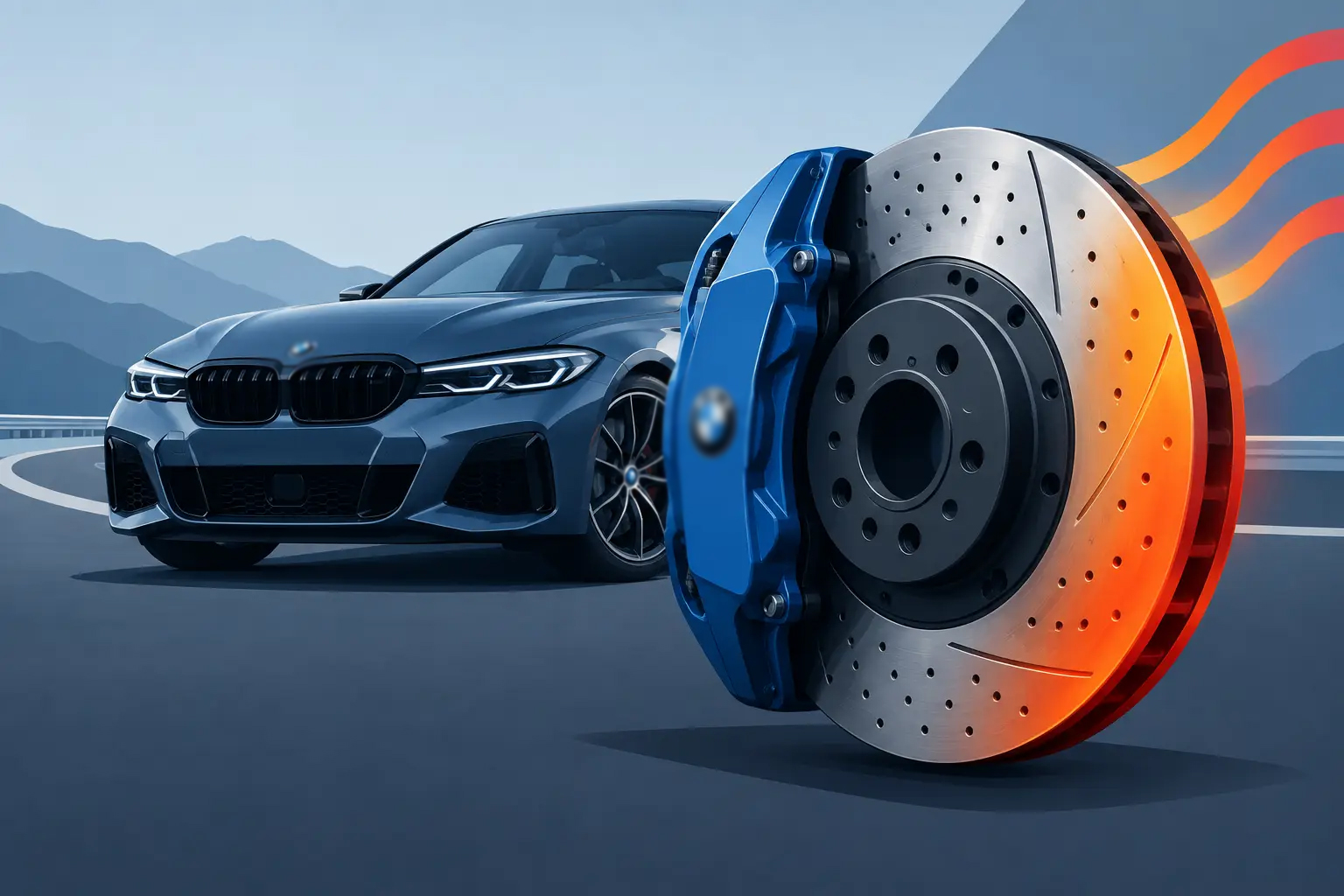
The brake pedal goes long at the end of a fast straight. The steering wheel is steady, the tires still have grip, but the car will not shed speed with the same certainty it had two laps earlier. That is the moment BMW brake upgrades stop being a cosmetic modification and become a safety-critical engineering decision.
BMW platforms can be exceptionally capable, but added power, vehicle weight, repeated high-speed braking, and aggressive driving expose the limits of factory brake systems. The right upgrade does more than install a larger caliper behind the wheel. It must manage heat, preserve pedal consistency, fit the vehicle correctly, and deliver predictable braking when the system is working hardest.
Why BMW Brake Upgrades Are Often Necessary
Factory brakes are designed around a broad ownership profile. They need to meet cost, noise, comfort, cold-weather, service-life, and everyday driving requirements. For normal commuting, that balance is appropriate. For a modified M car, a heavy BMW SUV, or a vehicle used for canyon driving and track events, it may no longer be enough.
Brake fade is usually the first warning. As rotor and pad temperatures rise beyond their intended operating range, the pad friction characteristics change. The driver needs more pedal pressure for the same deceleration, stopping distances can increase, and the pedal may feel inconsistent. Fluid can also reach damaging temperatures, while repeated thermal cycles can accelerate rotor cracking, surface checking, pad glazing, and seal wear.
A brake upgrade should address the whole thermal system, not merely one visible component. Rotor mass and material, caliper rigidity, pad compound, ventilation, brake fluid, mounting hardware, and wheel clearance all affect the result. Replacing pads alone can help in limited cases, but it cannot create the heat capacity or clamping stability required by a demanding vehicle application.
Start With the BMW and Its Real Driving Load
A suitable brake package begins with an honest assessment of the vehicle. A BMW M2 that sees occasional track sessions has a different braking demand from an X5 used for mountain towing. An M3 with higher-output tuning, sticky tires, and frequent highway pulls places more energy into the brakes than a stock sedan driven on public roads.
Vehicle weight matters as much as horsepower. A larger BMW SUV or EV carries substantial kinetic energy into every braking event. Tire grip matters too. When wider, stickier tires allow later and harder braking, the brake system must absorb more heat in a shorter period. Drivers often increase engine output and tire capability before considering the braking system, creating an imbalance that becomes obvious only under pressure.
Usage should guide component selection. Street-focused vehicles need quiet operation, stable cold response, and reasonable service requirements. Track-oriented cars need exceptional thermal resistance and repeatable pedal feel, with some acceptance of higher operating demands. The best setup is not automatically the largest one. It is the system engineered for the platform, wheel size, vehicle mass, and duty cycle.
Choose a Complete System, Not a Collection of Parts
A complete kit provides the strongest foundation because its critical components are designed to work together. Properly engineered BMW brake upgrades pair caliper piston area with rotor diameter and thickness, bracket geometry, pad shape, hydraulic behavior, and vehicle-specific mounting locations.
This matters because oversized or mismatched components can introduce new problems. An incorrect front-to-rear brake balance can affect stability during hard deceleration. Poor bracket tolerances can compromise caliper alignment. A caliper that does not clear the wheel barrel is not a minor inconvenience - it is a fitment failure.
For workshops and distributors, complete systems also reduce installation uncertainty. Vehicle-specific hardware, documented wheel-clearance requirements, compatible pads, and technical support protect both the installer and the end customer from avoidable rework.
Carbon Ceramic Brakes: Where the Advantage Comes From
Carbon ceramic brake systems are built for drivers who need lower unsprung weight, high thermal resistance, and reliable braking through repeated severe use. Compared with conventional iron rotors, a carbon ceramic rotor can substantially reduce rotating and unsprung mass. That reduction supports suspension response, steering precision, and the vehicle’s ability to follow uneven pavement without the brake assembly adding unnecessary inertia.
The greater benefit is thermal stability. A quality carbon ceramic system is engineered to tolerate extreme heat with less risk of the distortion and performance loss associated with conventional braking systems under sustained load. On fast road applications, track days, and performance SUVs carrying significant mass, that resistance can preserve confidence when a standard system begins to soften.
There are trade-offs. Carbon ceramic systems are a premium investment and demand disciplined fitment. Pad selection must suit the rotor material and operating environment. Installation procedures, torque specifications, and bedding practices must be followed precisely. A carbon ceramic package is not the right answer for every daily driver, especially where budget-focused replacement cost is the main concern. But for performance-focused BMW owners who value weight reduction, high-temperature durability, and long-term braking consistency, it is a serious upgrade rather than a luxury accessory.
Caliper Stiffness and Pedal Confidence
The caliper converts hydraulic pressure into clamping force. A rigid monobloc caliper resists flex under load, helping maintain a firm, precise pedal response. Multi-piston layouts can distribute clamping force more evenly across the pad, supporting consistent contact and controlled wear when properly matched to the rotor and master-cylinder characteristics.
The goal is not simply more pistons. Piston configuration, bore sizing, bridge strength, fluid routing, and pad volume must be engineered as a system. A racing-grade caliper should deliver controlled force at high temperature without sacrificing the predictable modulation required on the street.
Fitment Is a Safety Requirement
BMW brake systems vary widely across generations, trims, wheel packages, and electronic braking configurations. Even within a single model line, rotor offsets, hub dimensions, caliper mounting points, parking-brake architecture, and wheel-spoke clearance can differ. A kit that fits one M-model application may not fit another without modification.
Before specifying a system, confirm the exact chassis, model year, drivetrain, factory brake package, wheel diameter, and inner-wheel profile. Wheel diameter alone does not guarantee clearance. The spoke shape and barrel contour can interfere with a larger caliper even when the wheel appears large enough.
Professional installation should also include careful hose routing, hub-surface inspection, proper rotor mounting, hardware torque verification, fluid service, and bedding procedures. Brakes are not a place for improvised spacers, altered brackets, or assumptions based on visual similarity. Every interface must be correct because every interface carries load.
What to Demand From a Brake Manufacturer
For distributors, workshops, and performance buyers, product specifications should be backed by manufacturing control. A brake system is only as dependable as the consistency of its materials, machining, quality inspection, and technical documentation.
Look for a manufacturer that controls critical production processes rather than relying entirely on fragmented sourcing. In-house engineering and machining improve accountability when a fitment detail, material specification, or quality concern needs a clear answer. Formal quality systems such as IATF 16949 and ISO 9001 provide added assurance that production discipline is built into the operation, not added after a problem occurs.
CCYS completes 90% of production in-house, combining carbon ceramic brake development, precision machining, quality management, and application-focused support. That level of control matters when supplying complete braking systems for premium and high-performance BMW platforms, where component consistency and vehicle-specific execution cannot be treated as optional.
Warranty coverage and technical support should be part of the decision as well. Performance workshops need more than attractive product photos. They need clear installation information, reliable availability of replacement components, and a manufacturer prepared to support the system after the sale.
Build Braking Confidence Before the Next Hard Stop
The strongest BMW brake upgrade is the one that remains composed when speed, heat, and vehicle weight expose the limits of the original system. Specify the package around the car’s actual workload, verify fitment before installation, and choose engineering that treats every stop as a controlled transfer of energy. When the braking zone arrives faster than expected, that preparation is what gives the driver room to act.