

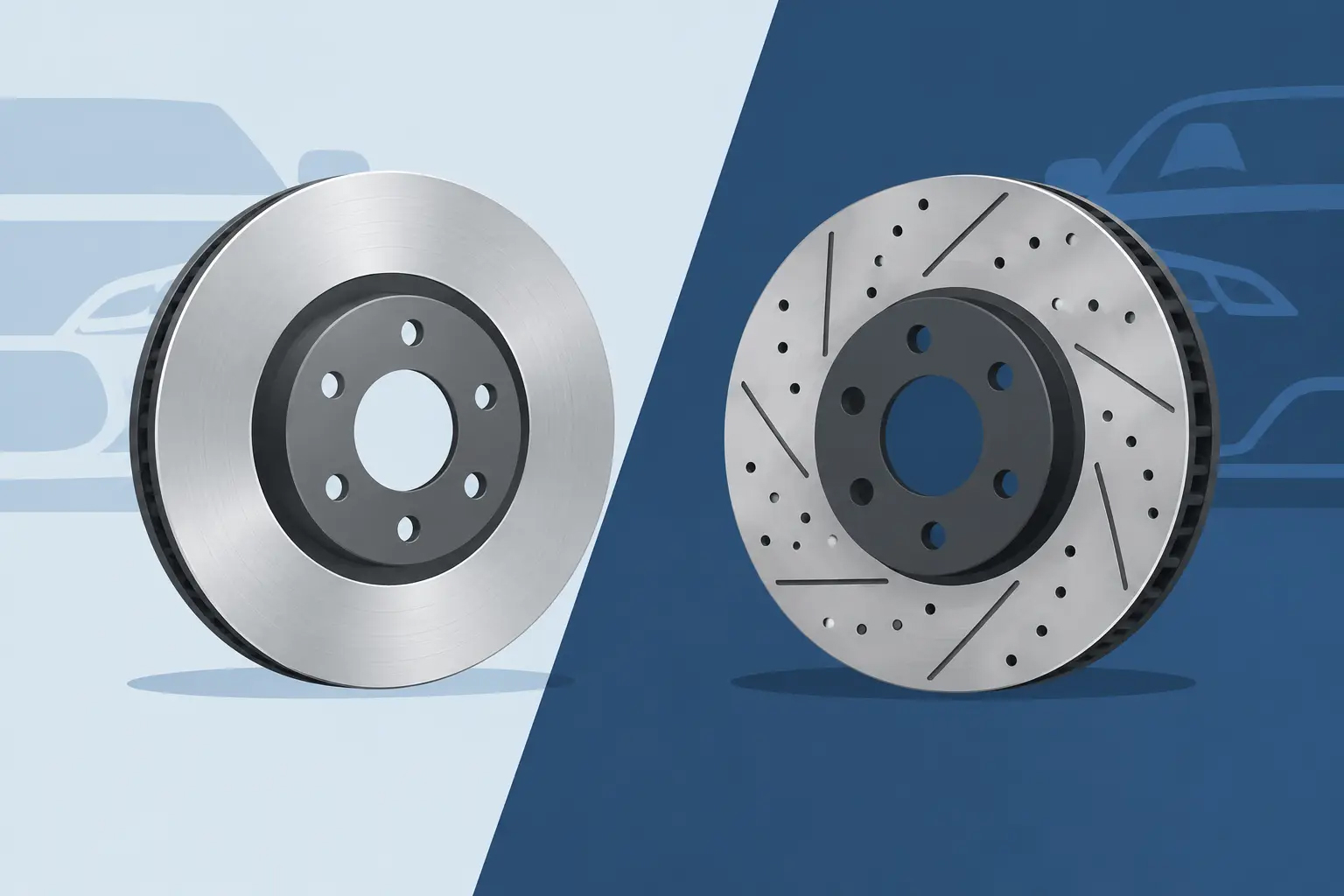
A long downhill section, a late braking zone, or repeated high-speed stops exposes every weak link in a brake system. The OEM versus aftermarket rotors decision is not simply a question of price. It determines how consistently the vehicle responds when rotor temperatures climb, pad friction changes, and the driver needs the same confident pedal on the fifth stop as the first.
For daily commuting, an original-equipment replacement may be the correct answer. For a modified Porsche, Tesla, BMW, Nissan GT-R, Toyota Supra, Defender, or track-focused build, the original rotor may become the limiting component. The right choice depends on the vehicle’s use, the complete brake system, and whether the rotor is engineered for the loads it will actually see.
OEM Versus Aftermarket Rotors: Start With the Job
OEM rotors are designed to meet the vehicle manufacturer’s original targets for fitment, noise, braking balance, service life, cost, and mass production. On an unmodified street vehicle driven in normal conditions, that balance is usually effective. An OEM rotor also provides a familiar baseline for workshops restoring a vehicle to factory specification.
The term aftermarket rotor is far broader. It can describe a low-cost replacement disc built to basic dimensions, a premium high-carbon iron rotor, a two-piece floating rotor, or a carbon ceramic system developed for sustained thermal load. Treating all aftermarket rotors as one category creates expensive mistakes. Some are engineered upgrades. Others are simply alternatives with different sourcing, materials, and quality control.
The useful question is not, “Is aftermarket better?” Ask whether the rotor has the correct dimensions, thermal capacity, material specification, mounting design, and validation for the vehicle and driving conditions. A rotor that fits the hub is not automatically a rotor that belongs in the brake system.
Where OEM Rotors Remain the Smart Choice
OEM equipment has clear strengths. Vehicle manufacturers validate the rotor with the factory caliper, pad compound, brake booster behavior, electronic brake controls, wheel clearance, and noise targets. For a customer whose priority is factory feel, predictable replacement intervals, and conventional road use, OEM-spec rotors can be a sound and efficient service decision.
They are especially appropriate when the rest of the system remains stock and the vehicle is not repeatedly loaded beyond its original braking duty cycle. Fleet vehicles, standard luxury sedans, and daily-driven vehicles with no towing, mountain use, or performance modifications often benefit more from correct installation and quality pads than from an aggressive rotor design.
OEM does not automatically mean maximum performance, however. Original equipment is built around the manufacturer’s full product brief. That brief may favor low noise, broad-market operating cost, cold performance, and production scale over lower unsprung weight or repeated track-level thermal resistance. Those priorities are reasonable, but they are not the same as a performance workshop’s priorities.
What a Performance Aftermarket Rotor Can Change
A properly engineered aftermarket rotor addresses specific limits in the original setup. Depending on the design, it can increase thermal capacity, reduce heat transfer into surrounding components, lower rotating mass, improve ventilation, or provide a serviceable two-piece assembly. The benefit must be matched to the application.
Heat management is usually the central issue. Under repeated heavy braking, a conventional iron rotor stores enormous energy. As temperatures rise, the pad compound can lose friction consistency, brake fluid can be stressed, and the driver may experience longer stopping distances or a changing pedal. Rotor cracking, distortion, surface deposits, and accelerated pad wear are also signs that the system is operating outside its intended range.
High-quality venting and internal vane design help move heat through the disc. A two-piece iron rotor can reduce weight at the hub area and allow the friction ring to manage expansion more effectively when engineered correctly. Carbon ceramic rotors pursue a different level of performance: lower weight, exceptional heat resistance, and durability under demanding use. They are not a cosmetic upgrade. They require matched calipers, pads, brackets, hardware, and vehicle-specific engineering.
For a high-performance vehicle, reducing unsprung and rotating mass matters beyond braking. A lighter brake assembly can support sharper steering response, suspension control, and acceleration feel. The improvement is most meaningful when the complete system has been designed as a package rather than assembled from unrelated parts.
Drilled, Slotted, or Plain Faces
Rotor face design deserves a practical view. Slots can help refresh the pad surface and provide a controlled path for dust and gases produced under high load. Drilled patterns can reduce mass and are often selected for appearance or specific engineered applications, but poor drilling design or low-quality material can concentrate stress and encourage cracking under extreme heat cycles.
A plain-face rotor is not automatically basic. Many serious track and endurance applications use plain or lightly slotted friction faces because material integrity, vane design, thickness, and pad selection matter more than appearance. The correct choice comes from the brake system’s thermal demands, not a visual preference.
Fitment Is More Than Diameter
Rotors are safety-critical components. Exact diameter, thickness, overall height, center bore, bolt pattern, friction-ring offset, vane direction, and mounting interface all matter. A small variation can affect caliper centering, pad sweep, wheel clearance, ABS sensor relationships, and brake balance.
This is why generic “performance rotor” claims should be examined carefully by distributors and workshops. Confirm the application, axle position, wheel requirements, and compatibility with the intended caliper and pad. On premium and modified platforms, confirm clearance against wheel spokes and suspension components before installation. Large brake kits frequently require a documented wheel template for this reason.
For carbon ceramic conversions, replacing only the discs is rarely the correct path. The rotor’s friction behavior, thickness, thermal expansion, and operating range must be matched with the caliper and pad compound. A complete kit protects the performance objective and reduces the risk of noise, poor cold behavior, uneven wear, or compromised stopping consistency.
Quality Control Separates an Upgrade From a Risk
The difference between OEM versus aftermarket rotors often comes down to manufacturing discipline. Rotor metallurgy, carbon content, heat treatment, machining accuracy, balancing, coating, hardware quality, and inspection standards determine how a component behaves long after installation day.
For professional buyers, the relevant questions are direct. Is the manufacturer controlling machining and quality verification? Are material specifications traceable? Is the rotor designed for a vehicle-specific application rather than adapted from a generic blank? Is there technical support when fitment or system matching requires confirmation? Warranty coverage also matters, but it should support documented engineering rather than replace it.
CCYS applies this approach to carbon ceramic brake systems through in-house control of approximately 90% of production, supported by IATF 16949 and ISO 9001 quality systems. That level of production ownership helps maintain consistency across rotors, calipers, pads, brackets, and the supporting hardware that allows a complete system to perform as intended.
Cost: Compare the Complete Ownership Picture
An OEM replacement rotor often has the lower initial cost. A performance aftermarket system may carry a higher purchase price because it uses more complex materials, machining, hardware, and vehicle-specific development. Neither price point tells the entire story.
The real comparison includes pad life, rotor life, serviceability, heat-related maintenance, wheel and caliper clearance, vehicle use, and the cost of a brake system that fades when it should not. For a vehicle that sees occasional city traffic, paying for race-level thermal capacity may not be justified. For a heavy, high-powered vehicle used on mountain roads, track days, or repeated high-speed runs, under-specifying the brakes can cost more in wear, downtime, and driver confidence.
Workshops should also account for installation requirements. Bedding procedures, torque specifications, rotor orientation, pad selection, and wheel clearance checks are part of the result. Even the best rotor cannot compensate for contaminated friction surfaces, old brake fluid, seized caliper hardware, or a pad compound that is wrong for the temperature range.
Choose for the Braking Load You Actually Create
Select OEM rotors when factory behavior and normal-road reliability are the primary requirements. Select a premium aftermarket iron rotor when the application needs better materials, thermal control, or a serviceable performance design. Select a complete carbon ceramic system when lower unsprung weight, racing-grade thermal resistance, and repeated high-load braking are central to the vehicle’s mission.
Do not let a familiar logo or an aggressive rotor pattern make the decision for you. Build the brake package around vehicle weight, power, tire grip, intended speed, road or track use, and the driver’s tolerance for compromise. When the brake system is specified for the heat it must absorb, every hard stop becomes less of a question mark and more of a controlled result.