

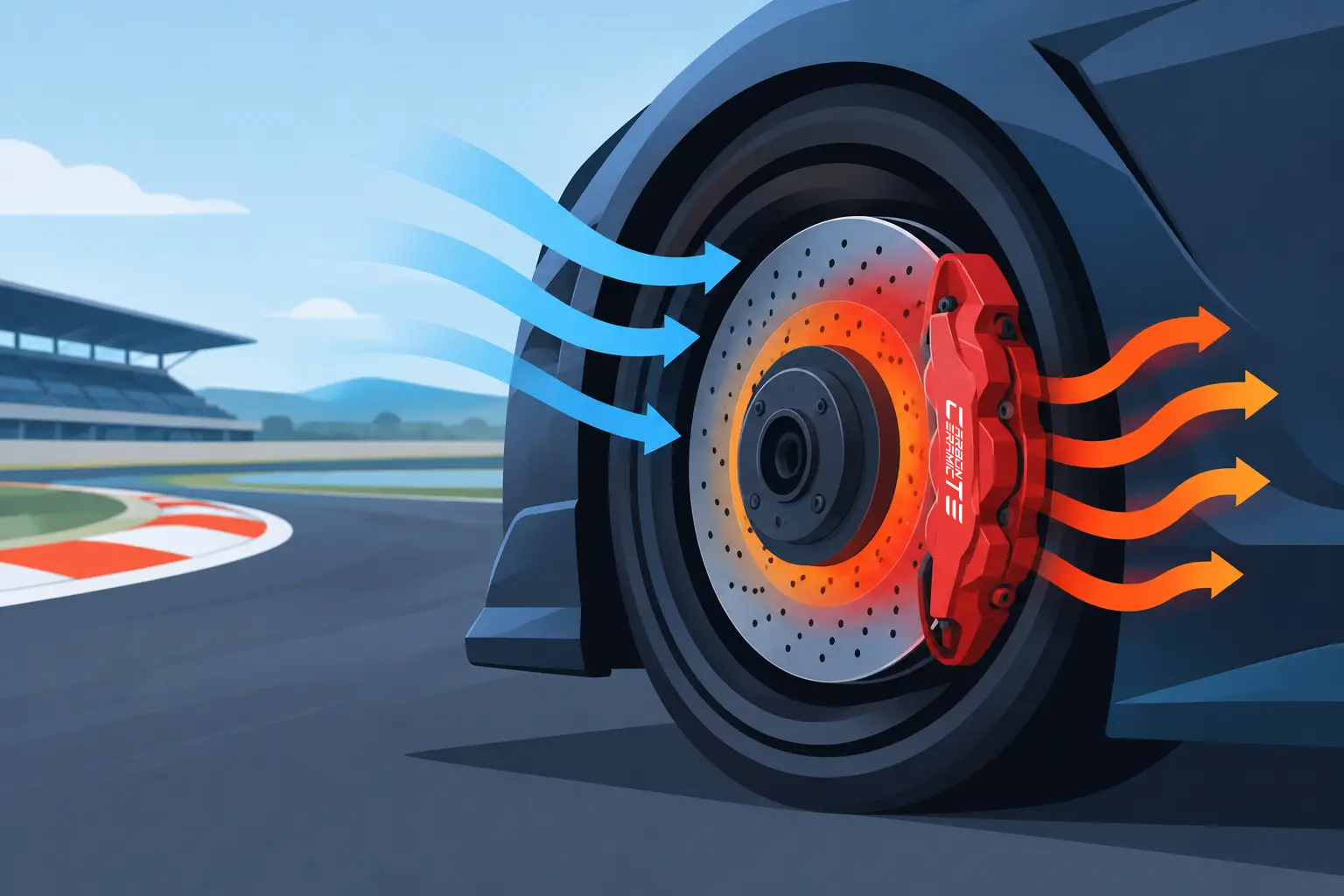
A long brake pedal at the end of a fast straight is not a minor inconvenience. It is the moment when heat has exceeded the system’s working window, and the driver has to decide whether the next braking zone can still be trusted. To improve braking heat management, the answer is not simply fitting a larger rotor or choosing a more aggressive pad. It is engineering the entire braking system to absorb, move, and reject heat without sacrificing balance, pedal consistency, or vehicle fitment.
For performance workshops, distributors, and drivers of high-output street and track vehicles, thermal control is what separates a brake upgrade that looks serious from one that delivers repeatable stopping force under load.
Why Brakes Lose Performance When Temperature Rises
Every braking event converts kinetic energy into heat. The harder the vehicle is driven, the greater the energy load placed on the rotors, pads, calipers, fluid, wheel bearings, and surrounding components. A single high-speed stop may not expose a weak system. Repeated stops, heavy vehicle weight, elevation changes, short cooldown periods, or a fully loaded performance SUV will.
Brake fade is often described as one problem, but it can come from several different sources. Pad fade occurs when friction material exceeds its intended temperature range and delivers less consistent friction. Fluid fade occurs when brake fluid boils, creating compressible vapor and a soft pedal. Rotor heat checking, cracking, distortion, and uneven deposits can develop when thermal stress is repeatedly concentrated in the same areas.
The correct response depends on the failure mode. More pad bite will not solve boiling fluid. Larger calipers alone cannot compensate for inadequate rotor mass or poor cooling airflow. A reliable system treats thermal capacity, heat transfer, and component compatibility as one engineering problem.
Start With Rotor Thermal Capacity
The rotor is the brake system’s primary heat sink. Its diameter, thickness, material, internal vane design, and mass determine how much energy it can absorb before temperatures become excessive. Increasing effective rotor diameter also increases braking leverage, which can reduce the clamping force required for a given deceleration.
However, larger is not automatically better. A rotor must fit the wheel barrel, clear the suspension and steering components, and work with a caliper designed for its thickness and swept area. Excessive rotor weight can also add unsprung mass, affecting steering response and suspension control. The right specification balances thermal capacity with vehicle dynamics.
Carbon ceramic systems offer a different approach to heat management. Carbon ceramic rotors are engineered to tolerate extreme temperatures while delivering substantially lower weight than comparable iron assemblies. Reducing unsprung and rotating mass can improve turn-in response, suspension reaction, and acceleration characteristics, particularly on performance vehicles where every kilogram at the wheel matters.
Their advantage is not a license to ignore system design. Pad compound, caliper selection, cooling airflow, and proper bedding remain essential. Carbon ceramic rotors should be paired with friction materials and hardware validated for their operating characteristics, not treated as a universal substitute for a complete brake package.
Rotor Design Must Move Air, Not Just Add Diameter
Internal ventilation is critical because heat needs a path out of the disc. Directional vanes act as an air pump, drawing cooler air through the rotor and pushing heated air outward. Properly engineered vane geometry can improve cooling efficiency without relying solely on added mass.
Slotted faces can help evacuate gas, dust, and debris from the pad contact area. Drilling may reduce mass and contribute to surface cleaning, but the design and material quality matter. Poorly executed drilled rotors can create stress risers under severe heat cycles. For demanding track use, rotor selection should be based on validated metallurgy or carbon ceramic construction, vane architecture, and the real duty cycle of the vehicle.
Match Pads and Calipers to the Heat Load
Brake pads determine how effectively the system converts hydraulic pressure into friction. A pad that performs well on the street may offer quiet operation and low dust, yet lose consistency after repeated high-energy stops. A race-focused compound may withstand higher temperatures but require heat to operate correctly, produce more noise, and accelerate rotor wear in normal road use.
This is why application matters. A Porsche used for occasional canyon driving needs a different friction window than a Nissan GT-R running repeated track sessions, or a heavy Tesla that places substantial energy demand on the brakes during late, high-speed deceleration. The objective is stable friction across the temperatures the vehicle will actually see.
Caliper design also affects heat management. A rigid monobloc caliper resists flex under pressure, supporting a firm and predictable pedal. Multi-piston layouts can distribute clamping force more evenly across a larger pad surface, reducing localized heat concentration. Proper piston sizing is equally important because it maintains front-to-rear brake balance and works with the vehicle’s master cylinder, ABS calibration, and electronic stability systems.
An oversized front system without the correct hydraulic relationship can create an unstable braking balance. Engineering excellence means matching the system, not merely maximizing caliper size.
Improve Braking Heat Management With Cooling Airflow
Cooling ducts are among the most effective upgrades when a vehicle repeatedly overheats its brakes, provided they are designed correctly. The goal is to direct high-pressure air toward the rotor’s internal vanes, where it can pass through the disc rather than simply blowing across the caliper exterior.
Duct routing must be protected from tire contact, steering movement, road debris, and suspension travel. On street-driven vehicles, poorly placed ducts can be vulnerable to water, stones, and curb strikes. On a dedicated track car, a more aggressive duct package may be justified. Again, the right solution depends on how the car is used.
Wheel design also influences airflow. Tight-spoke wheels, small internal barrels, and restrictive dust shields can trap heat around the brake assembly. Before fitting larger brakes, workshops should verify wheel clearance in three dimensions: radial clearance over the caliper, axial spoke clearance, and room for the rotor and mounting hardware. A vehicle-specific kit eliminates guesswork and avoids last-minute compromises that reduce cooling performance.
Do Not Ignore Fluid, Lines, and Hub Components
Even a well-designed rotor and caliper package can disappoint when brake fluid reaches its boiling point. High-temperature brake fluid supports a more stable pedal under repeated braking, but it must be maintained. Fluid absorbs moisture over time, reducing its boiling resistance. Track-driven and high-performance vehicles require service intervals based on actual heat exposure, not just mileage.
Stainless braided lines can reduce line expansion and sharpen pedal feel, while correctly routed lines help protect against radiant heat. Caliper seals, dust boots, wheel bearings, and hubs also operate near the brake’s thermal field. When rotor temperatures rise beyond control, these nearby components can age prematurely.
This is one reason complete systems are preferable to piecemeal modifications. The rotor, caliper, bracket, pads, lines, hardware, and fitment should be engineered as a package. CCYS applies this approach through vehicle-specific carbon ceramic brake systems supported by in-house manufacturing control, technical validation, and IATF 16949 quality standards.
Bedding, Inspection, and Driver Technique Matter
A new brake system must be bedded according to the pad and rotor manufacturer’s procedure. Bedding establishes an even transfer layer of friction material on the rotor surface. Skipping this process can create uneven deposits that feel like rotor vibration, even when the disc itself is not warped.
After hard use, inspect the system for heat checking, cracks, pad taper, discoloration, loose hardware, fluid condition, and changes in pedal travel. These are not cosmetic details. They show whether the brake package is operating within its intended range.
Driver technique also changes brake temperature. Hesitant, prolonged braking can keep the system hot for longer than a controlled, decisive brake application followed by a clean release. That does not mean every driver should brake later. It means braking inputs should be deliberate, repeatable, and appropriate for the available grip, vehicle setup, and track conditions.
The strongest brake upgrade is the one that remains composed when speed, weight, and repetition expose every weak link. Choose thermal capacity for the vehicle’s real workload, validate fitment before installation, and build the system around repeatable confidence rather than peak numbers alone.