

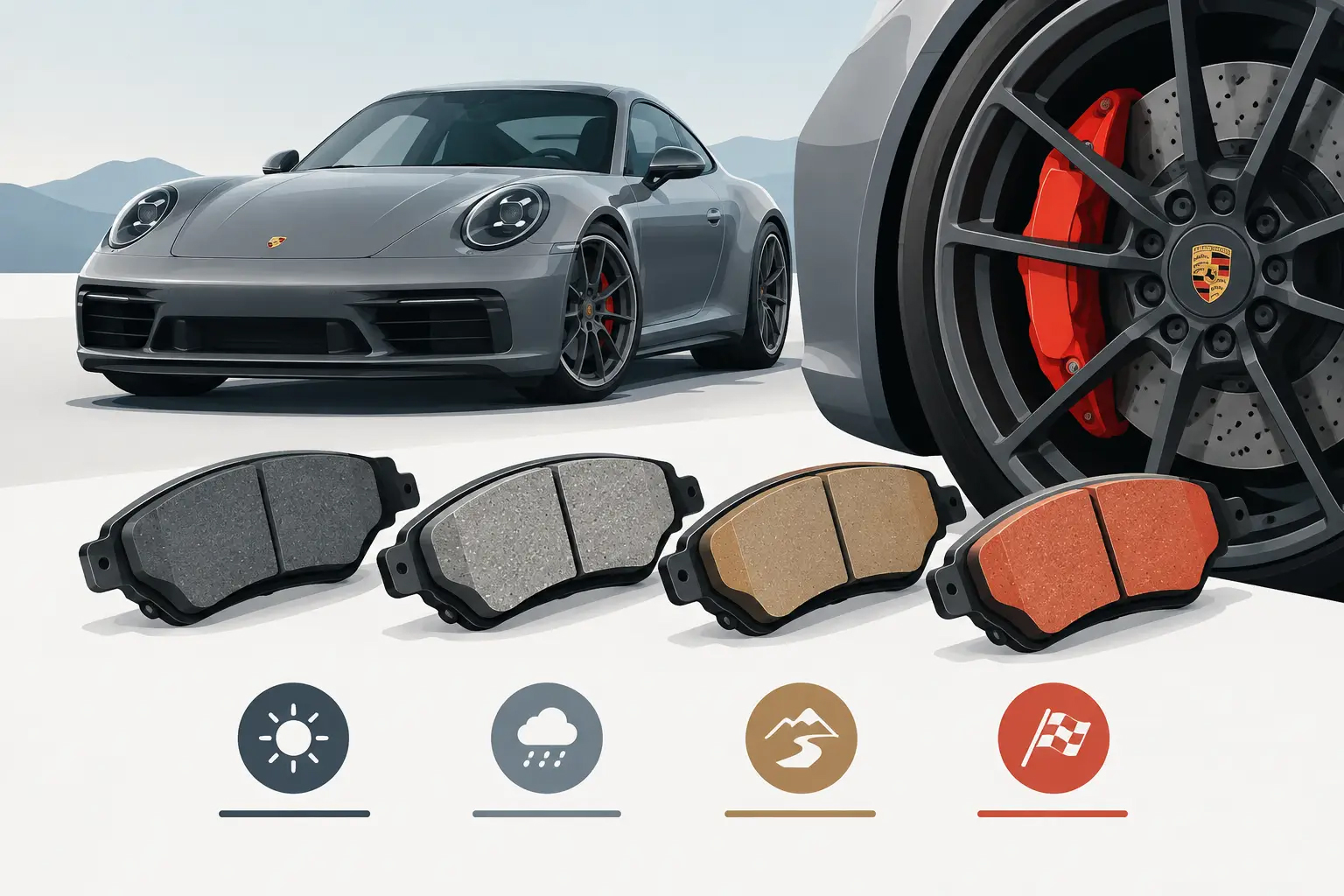
A fast Porsche that arrives at the braking zone with a long pedal, fading bite, or unstable response is not a performance car you can trust. To choose Porsche brake pad compounds correctly, start with the temperature, speed, vehicle weight, and braking repetition your car actually sees, not the most aggressive compound on a product label.
Brake pads are a friction material, but they are also a tuning component. The right compound supports predictable brake torque, pedal feel, thermal control, and rotor life. The wrong one can create cold-stop hesitation, excessive dust, noise, rapid rotor wear, or fade when the system is pushed hard.
Choose Porsche Brake Pad Compounds by Driving Demand
A pad compound should match the vehicle's primary duty cycle. A Porsche used for commuting, canyon roads, and occasional hard highway braking needs a different friction profile than a GT car making repeated laps with high rotor temperatures.
For normal road use and spirited driving, prioritize immediate cold bite, stable friction through moderate temperatures, low noise, and reasonable dust output. This type of compound reaches working effectiveness quickly and is more forgiving during short trips, rain, and stop-and-go traffic. It is not designed to tolerate sustained track temperatures indefinitely.
For fast-road and occasional track use, select a high-performance compound with a wider operating range and stronger resistance to fade. Expect more dust and possible noise, especially when cold. This is often the practical choice for owners who drive aggressively on the road but attend a few track days each year.
Dedicated track compounds are built for repeated high-energy stops. They maintain friction when rotor and pad temperatures rise beyond the range of a street-focused material. That benefit comes with trade-offs: reduced cold performance, more abrasive behavior, increased noise, and potentially accelerated rotor wear. A track pad is not automatically safer on the street simply because it has a higher temperature rating.
Endurance-oriented compounds favor consistency over a long session. Initial bite may be less aggressive than a sprint-race pad, but the driver gets a stable pedal and predictable deceleration lap after lap. For heavy Porsche platforms, turbocharged models, and cars running long sessions, that consistency can be more valuable than an aggressive first-stop feel.
Friction Level Changes More Than Pedal Feel
Brake torque is influenced by clamp force, effective rotor radius, and pad friction coefficient. A higher-friction compound can deliver stronger initial response with the same hydraulic pressure, making the pedal feel more immediate. But high friction also generates more heat at the pad and rotor interface.
That additional heat is not inherently a problem. It becomes a problem when the rotor, caliper, brake fluid, cooling system, or pad backing plate cannot manage it. A Porsche braking system is engineered as a package. Changing pads without considering rotor material, tire grip, vehicle weight, and track speed can move the thermal limit somewhere else in the system.
This matters when upgrading to larger calipers or carbon ceramic brake hardware. A pad with extreme bite may overwhelm available tire grip, trigger ABS earlier, or make threshold braking harder to modulate. The best compound is usually the one that gives the driver repeatable control, not the one that produces the sharpest first impression.
Cold Bite and Warm-Up Matter on the Street
Some race compounds need meaningful heat before they develop stable friction. During the first few stops on a cold morning, the pedal may feel dull or require more pressure than expected. That behavior is unacceptable for many street-driven Porsche vehicles, regardless of their horsepower.
A road-capable performance pad should provide reliable cold response, then remain stable as temperatures rise during spirited use. If a customer says they want a “race pad” but their car spends 95 percent of its time on public roads, ask how often the brakes truly reach track-level temperatures. The honest answer usually points to a fast-road compound instead.
Fade Is Not One Failure Mode
Drivers often describe any loss of braking confidence as fade, but the source must be identified before selecting a new pad. Pad fade occurs when the friction material exceeds its operating temperature. Fluid fade comes from boiling brake fluid and typically feels like a longer, softer pedal. Rotor overheating can produce surface distress, uneven transfer layers, vibration, or cracking. A glazed pad may feel hard and inconsistent after repeated overheating.
A higher-temperature pad may resolve pad fade, but it will not correct old fluid, insufficient cooling, worn rotors, sticking caliper hardware, or improper bedding. Diagnose the system before selling the solution.
Carbon Ceramic Rotors Require Compound Discipline
Porsche vehicles equipped with factory carbon ceramic brakes, or upgraded with a carbon ceramic system, require pads engineered for that rotor material and the specific caliper geometry. Do not assume a compound designed for cast iron rotors is suitable for carbon ceramic discs.
Carbon ceramic rotors operate differently from iron. They offer significant weight reduction, high thermal resistance, and excellent performance under repeated high-energy braking, but the pad must establish and maintain the correct friction relationship with the rotor surface. An incompatible compound can cause poor bite, noise, uneven deposits, excessive wear, or damage that defeats the value of a premium brake system.
The right pad supplier should specify whether the compound is approved for the exact rotor material and application. This includes front versus rear axle fitment, pad shape, thickness, sensor provision, backing plate design, and intended temperature range. “Fits Porsche” is not enough for a brake component operating at racing-grade thermal loads.
For performance workshops and distributors, complete-system compatibility is the safer commercial position. CCYS develops carbon ceramic brake systems and matching supporting components with factory-controlled production, allowing pad, rotor, caliper, and fitment requirements to be evaluated as one braking package rather than as unrelated parts.
Consider Vehicle Weight, Tires, and Brake Balance
A 911 Carrera, Cayenne Turbo, Taycan, and track-prepared GT3 place very different demands on their pads. Vehicle mass changes braking energy dramatically. An electric Porsche can add substantial weight and produce repeated high-speed deceleration loads, while a rear-engine 911 transfers weight aggressively under braking and depends on a balanced front-to-rear setup.
Tire grip also changes the decision. High-grip track tires allow the braking system to generate more deceleration before ABS intervention, which increases thermal demand. If the car has moved from street tires to R-compound tires, the previous pad may no longer have sufficient heat capacity for track use.
Avoid changing only one axle to a dramatically different friction level unless the application has been validated. Front and rear compounds contribute to brake balance, ABS behavior, vehicle stability, and pedal confidence. A vehicle-specific pad set is preferable to mixing materials based only on availability.
Installation and Bedding Protect the Upgrade
Even the right compound can disappoint when installed on poor rotor surfaces or bedded incorrectly. Before fitting pads, inspect rotor thickness, surface condition, runout, cracks, heat checking, hardware movement, caliper seals, and brake fluid condition. Replace compromised parts rather than asking a new pad to compensate for a worn system.
Bedding establishes a controlled transfer layer between pad and rotor. Follow the pad and rotor manufacturer’s procedure exactly. In general, bedding involves a sequence of moderate decelerations that progressively builds temperature without holding the car stationary on hot brakes. Parking with the pedal applied after heavy stops can imprint pad material onto the rotor and create a vibration complaint that is often mistaken for warped discs.
After bedding, inspect the contact pattern and confirm that the pedal remains firm under repeated stops. For track applications, monitor pad thickness and rotor condition after every event. Racing-grade hardware rewards disciplined inspection.
Ask the Questions That Select the Right Pad
Before choosing a compound, establish the Porsche model, year, brake system, rotor material, tire type, vehicle weight, and intended use. Then ask whether the complaint is weak cold response, noise, dust, track fade, soft pedal, rotor wear, or inconsistent braking. Each symptom points to a different decision.
The strongest braking upgrade is not the loudest, hardest, or most expensive pad. It is the compound that works at your actual operating temperature, matches the complete brake system, and gives the driver the same confident response at the end of a hard session as it did at the first braking zone.