

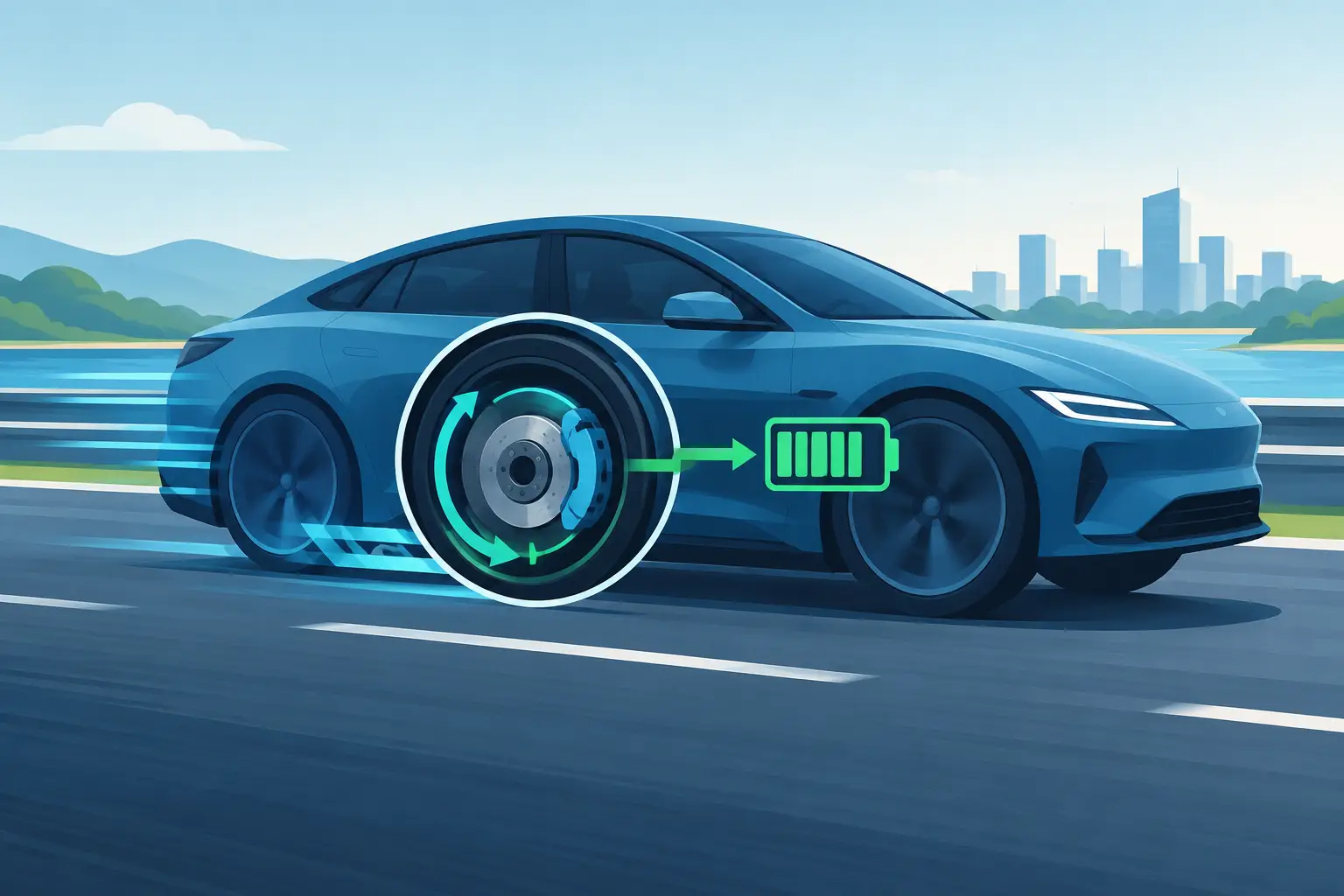
A heavy EV can feel brutally quick on the straight, then expose every weakness in its braking system at the first fast corner. That is why electric vehicle braking cannot be judged by one quiet stop in city traffic. For performance workshops, distributors, and serious drivers, the real question is whether the vehicle can deliver the same pedal response, stability, and stopping force after repeated high-energy braking events.
Electric powertrains change how a vehicle slows down, but they do not eliminate the need for serious friction brakes. They raise the demands on them. Battery mass, instant torque, regenerative-braking strategy, wheel fitment, and thermal load must all be considered as one system.
Why electric vehicle braking is different
An EV uses two braking paths. Regenerative braking turns the drive motor into a generator, recovering energy as the vehicle decelerates. Friction braking uses pads, rotors, calipers, and hydraulic pressure to convert motion into heat. Under light to moderate deceleration, regeneration can do much of the work. Under hard braking, at low speeds, with a full or cold battery, or when traction is limited, friction brakes must take over quickly and predictably.
That handoff is where engineering matters. A driver should not feel an uncertain pedal, a delayed bite, or a sudden change in deceleration as the control system blends regeneration and hydraulic braking. The brake hardware must also be ready for the moments when regeneration is reduced or unavailable. A long downhill section, repeated track laps, emergency stops, and high-speed driving can place enormous energy into the friction system in a short time.
EVs are commonly heavier than comparable internal-combustion vehicles because of their battery packs. More vehicle mass means more kinetic energy to control. Double the speed and braking energy rises by four times. A heavy performance EV arriving at high speed can therefore load its rotors, pads, calipers, tires, and brake fluid far beyond what ordinary street hardware was designed to manage.
Regenerative braking is not a substitute for brake capacity
Regeneration is valuable. It improves efficiency, reduces routine pad wear, and can make one-pedal driving effective in normal traffic. But it depends on conditions that are not guaranteed during aggressive use.
Battery state of charge is one example. When the battery is near full, the vehicle may limit how much energy it can accept. Battery temperature also affects charging capability. In cold weather, available regeneration can be reduced until the battery reaches an appropriate operating range. The system may also reduce regenerative input when wheel slip is detected or when stability control requires a different torque strategy.
For a workshop building or servicing a performance EV, the practical lesson is clear: size the friction system for the worst credible braking event, not the best-case regenerative event. The driver needs consistent mechanical braking when the vehicle is carrying passengers, running wider tires, towing where applicable, descending grades, or operating at track-level speeds.
Heat is still the enemy
The quiet nature of EV operation can hide brake temperatures until the damage is already done. Brake fade is not simply a comfort issue. As temperatures climb, pad friction can change, brake fluid can approach its boiling point, rotors can develop thermal stress, and pedal feel can become less reliable. Repeated heat cycles also accelerate wear in seals, dust boots, hardware, and rotor surfaces.
A racing-grade system addresses heat through the complete assembly rather than a single oversized component. Rotor material and mass affect heat absorption. Rotor design affects airflow and thermal distribution. Caliper stiffness helps maintain pedal consistency under high line pressure. Pad compound determines initial bite, friction stability, noise behavior, wear rate, and temperature tolerance. Proper bracket design and vehicle-specific fitment keep the caliper centered over the rotor and preserve intended pad contact.
Carbon ceramic brake systems are particularly relevant where lower unsprung weight and high thermal resistance are priorities. Compared with conventional iron assemblies, a properly engineered carbon ceramic system can significantly reduce rotating and unsprung mass while offering strong resistance to heat-related distortion and corrosion. Those gains can benefit steering response, suspension control, and high-speed confidence.
The trade-off is that carbon ceramic brakes are not a generic upgrade. Rotor dimensions, caliper piston sizing, pad selection, wheel clearance, brake balance, and intended use must match the vehicle. A poorly specified kit can create clearance issues, undesirable noise, poor cold behavior, or an unbalanced brake feel. Complete, vehicle-specific engineering is the standard performance buyers should demand.
Pedal feel depends on system integration
A firm pedal alone does not prove a brake system is better. The objective is controlled, repeatable deceleration with clear feedback from the first stop through the last. In an EV, that requires the hydraulic system and electronic brake controls to work together without surprises.
Caliper rigidity matters because a flexing caliper can consume hydraulic pressure before the pad fully clamps the rotor. Monobloc calipers are valued in high-performance applications for their structural stiffness and precision. Piston arrangement and pad area influence pressure distribution and heat management. Rotor diameter creates leverage, while rotor thickness and internal design influence its ability to absorb and release heat.
Brake balance matters just as much. Increasing front braking torque without considering rear contribution, tire grip, ABS behavior, and the vehicle’s electronic control strategy can reduce stability rather than improve it. On vehicles with advanced driver-assistance systems, the installation must preserve sensor routing, wheel-speed signal integrity, and proper clearance for all moving components.
Selecting an EV brake upgrade for its real job
The right specification depends on how the vehicle is driven. A premium EV used mainly for commuting may benefit most from corrosion resistance, clean operation, reduced unsprung weight, and dependable stopping after long intervals of light friction-brake use. A vehicle used for canyon roads, high-speed touring, or track sessions needs greater thermal capacity and more stable pad performance.
Distributors and installers should begin with vehicle-specific questions: What is the wheel diameter and spoke clearance? Is the vehicle stock, lowered, or fitted with larger wheels and tires? Is it used on track? Does it carry additional weight? What brake feel does the customer expect? Is quiet street operation more important than maximum high-temperature capability?
The answers determine whether a larger conventional system, a carbon ceramic kit, or a different pad and rotor configuration is appropriate. There is no single brake package that is perfect for every EV duty cycle. The strongest recommendation is the one that matches thermal demand, fitment, driver expectations, and service requirements without compromising safety systems.
Installation quality protects performance
High-end brake hardware cannot compensate for careless installation. Rotor surfaces must be clean and protected from contamination. Mounting faces need to be inspected for corrosion or runout. Hardware must be torqued to specification. Brake lines require proper routing and secure retention. After installation, the system should be bled correctly and bedded according to the pad and rotor manufacturer’s procedure.
Technicians should also inspect surrounding chassis components. Worn control-arm bushings, ball joints, tie-rod ends, wheel hubs, or stabilizer links can create vibration, instability, or inconsistent tire contact that a brake upgrade will not cure. Braking performance begins at the tire contact patch, and the suspension must keep that contact patch controlled when the vehicle transfers weight under deceleration.
For professional buyers, manufacturer support is part of the product. Clear fitment data, installation guidance, replacement-component availability, quality documentation, and warranty coverage reduce risk for both the installer and the vehicle owner. CCYS supports this standard with performance brake systems and chassis components produced under tightly controlled manufacturing processes, including 90% in-house production and IATF 16949 quality certification.
The standard should be repeatability
The best electric vehicle braking system does not make its case with one dramatic stop. It proves itself when the vehicle is heavy, fast, hot, and asked to brake again. Specify the system around real energy, real fitment, and real driving conditions, then give the customer the confidence to use the vehicle as intended.