

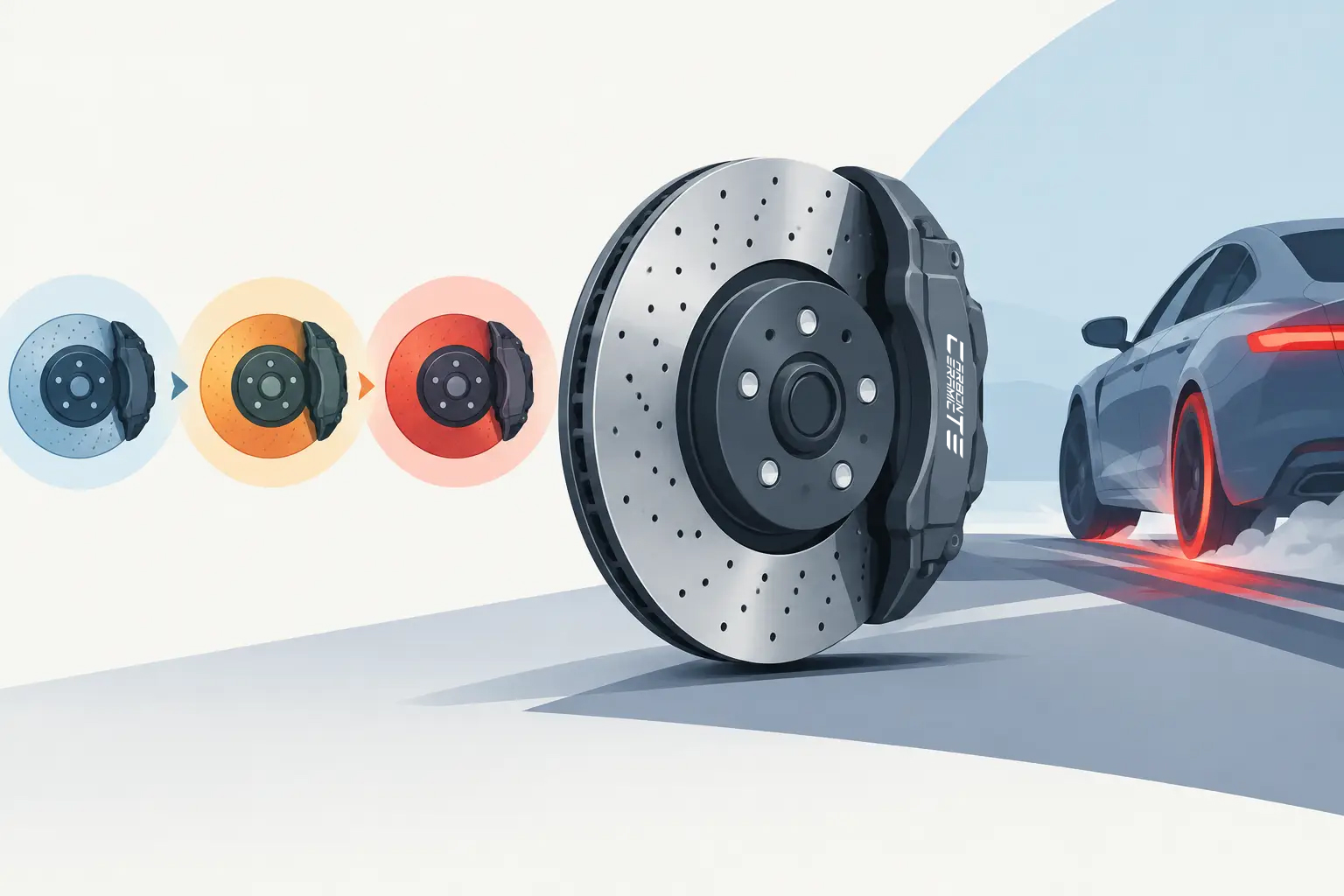
A hard brake pedal means little if the vehicle does not deliver predictable stopping force at the first corner. Drivers often ask whether ceramic discs need warmup, especially after fitting a carbon ceramic brake kit for track use, spirited road driving, or a high-output street build. The short answer is yes, but not in the way many drivers assume. Carbon ceramic discs do not need to be abused before they work. They need a few controlled brake applications to bring the entire system into its intended operating range.
The key distinction is between normal cold performance, brake bedding, and maximum performance under repeated heavy load. A correctly engineered carbon ceramic system should provide safe, usable braking from cold. Its strongest consistency, pedal feel, and high-temperature stability arrive as rotor, pad, caliper, and tire temperatures stabilize together.
Why Ceramic Discs Need Warmup
Carbon ceramic brake discs are built for extreme thermal resistance, low weight, and repeatable performance under demanding conditions. Their material behavior is different from conventional cast-iron rotors. They manage high heat exceptionally well, but the friction pairing between the disc surface and brake pad is temperature-dependent.
At low temperatures, some carbon ceramic systems can feel less aggressive than an iron rotor paired with a street-focused pad. The pedal may feel firm, yet the initial bite may be more measured. This is not automatically a fault. It can be a normal characteristic of a racing-grade friction package designed to resist fade at temperatures that would overwhelm standard braking hardware.
As temperature builds, the pad compound reaches a more effective friction window and the disc surface becomes more consistent. The result should be controlled bite, stable modulation, and strong repeatability through repeated stops. That is the benefit performance drivers are buying: braking confidence when speed, vehicle mass, and heat load rise together.
Warmup requirements depend on the complete system. A carbon ceramic rotor does not operate in isolation. Pad formulation, disc diameter and thickness, caliper stiffness, piston sizing, vehicle weight, tire grip, brake cooling, and driving environment all change the result. A street-oriented pad may offer excellent cold response, while a track-focused compound may require more temperature before it delivers its intended friction level.
Warmup Is Not the Same as Bedding In
These terms are often used interchangeably, but they solve different problems.
Bedding in is the initial conditioning procedure after installing new discs and pads. It creates a stable transfer layer of pad material on the disc surface and helps mate the two components correctly. The precise procedure must follow the kit or pad manufacturer’s instructions. Using an aggressive generic bedding routine can create unnecessary heat, uneven deposits, vibration, or surface damage.
Warmup happens during normal use after bedding is complete. It is the gradual temperature increase before high-demand braking. On a road car, a few smooth, progressive stops are usually enough to bring a properly matched street system into a more responsive range. On track, the warmup process is more deliberate because disc, pad, caliper, tire, and fluid temperatures all need to rise under control.
A driver should never interpret warmup as a license for repeated maximum-pressure stops on cold components. Sudden thermal shock is not good engineering practice for any brake system. Controlled load is the objective.
A practical road warmup routine
After a cold start, use the first several brake applications normally and progressively. Avoid long pedal holds immediately after a hard stop, particularly with new components. If the road is safe and traffic allows, apply several moderate decelerations with enough distance between them for the system to stabilize.
For most premium road applications, this is sufficient. If the brakes remain weak, grabby, noisy beyond the expected cold characteristics, or inconsistent after several normal stops, the answer is not more warmup. The system needs inspection for pad compatibility, disc condition, hydraulic issues, installation errors, or incorrect bedding.
A track warmup routine
A track session needs more discipline. Use the out lap to build heat progressively rather than chasing lap time on the first braking zone. Begin with moderate pedal pressure, increase load over several braking events, and pay attention to pedal feel and vehicle balance. Tires need temperature too. A brake system that is ready before the tire is ready can still create instability under trail braking.
The first hard stop should be earned, not guessed. Once the pedal response, brake balance, and tire grip feel consistent, the system is ready for sustained pace. After a hot session, use a cool-down lap when conditions permit. Avoid parking immediately with the brake pedal held firmly, since localized heat and pad contact can contribute to uneven material transfer.
What Cold Carbon Ceramic Brakes Should Feel Like
A correctly specified system should still be safe and controllable when cold. The driver may notice a slightly more deliberate initial response, especially in cool weather, wet conditions, or with a high-temperature pad compound. That is a manageable trade-off when the priority is fade resistance, lower unsprung weight, and braking consistency under repeated heavy deceleration.
What is not normal is a pedal that sinks, a steering wheel that shakes under braking, a car that pulls strongly to one side, or a sudden change in friction from one stop to the next. Carbon ceramic brakes are not supposed to feel mysterious. They should feel precise.
For distributors and workshops, this is why kit specification matters as much as rotor material. Matching the pad to the customer’s real use case is essential. A Porsche or BMW that sees commuting and weekend canyon driving needs a different friction balance than a Nissan GT-R or supercar that runs repeated track sessions. The best brake package is not the one with the highest claimed temperature number. It is the one that provides consistent stopping performance in the temperatures the vehicle will actually see.
Cold Weather, Rain, and Daily Use
Ambient conditions affect every braking system. In colder weather, a carbon ceramic disc and pad package may take longer to reach its best response. Surface moisture can also reduce initial friction briefly until the pad clears the disc. This is one reason a driver should test brake response gently after leaving a parking area in rain or freezing temperatures.
Carbon ceramic systems remain a strong choice for premium and performance applications because they combine thermal capacity with reduced rotating and unsprung mass. But a track-oriented setup can involve trade-offs in noise, cold bite, and daily-driving comfort. An honest recommendation considers the driver’s route, climate, wheel fitment, vehicle weight, and brake-use pattern.
When Warmup Is Not the Answer
Do not dismiss a braking concern by saying ceramic brakes are “just cold.” A professional inspection is warranted when any of these conditions appear:
- Brake response remains poor after several progressive stops.
- The vehicle pulls, vibrates, or produces repeated steering-wheel shudder under braking.
- A warning light, fluid loss, soft pedal, or unusual pedal travel develops.
- Disc surfaces show cracks, severe scoring, abnormal discoloration, or damaged hardware.
- Pads are worn unevenly or the caliper does not release freely.
Carbon ceramic components require correct handling during installation and service. Rotor fasteners, floating hardware, caliper mounting, pad retaining components, and wheel clearance must all meet the vehicle-specific specification. A premium disc cannot compensate for a contaminated pad, incorrect torque procedure, restricted cooling path, or improperly bled hydraulic system.
Engineering the System, Not Just the Disc
The most reliable carbon ceramic conversion is a complete, vehicle-specific system. Rotor dimensions must support the correct brake torque and thermal load. Caliper piston area must work with the master cylinder and electronic brake controls. Pads need a friction profile that suits the vehicle’s purpose. The wheel, hub, brake lines, and cooling path must also be considered.
That system-level approach is central to CCYS manufacturing, where approximately 90% of production is controlled in-house across development, machining, and quality management. For workshops and performance-part distributors, that control helps support consistent fitment and component matching rather than a collection of parts expected to work together by chance.
A carbon ceramic brake system should give the driver confidence before the braking zone gets serious. Build temperature progressively, use the correct pad for the job, and investigate any inconsistent behavior early. When the next corner arrives faster than expected, predictable braking is not a luxury. It is the margin that lets the driver stay in control.