

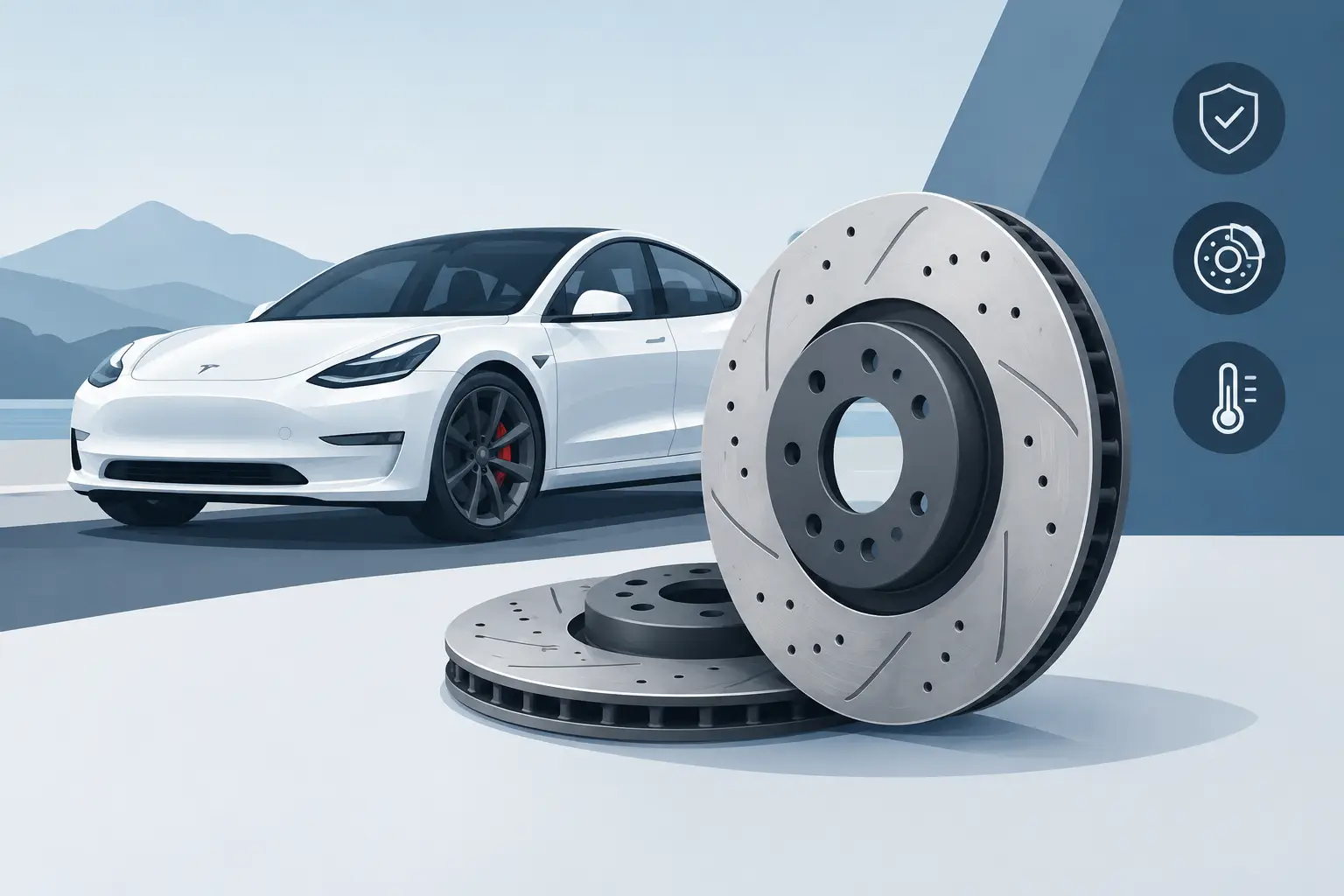
A Tesla’s instant torque can build speed quietly, but the next braking zone arrives with no such subtlety. When the pedal feels inconsistent after repeated hard stops, or a rotor develops vibration and hot spotting, the issue is not solved by choosing the most aggressive-looking disc. To select Tesla brake discs correctly, start with the vehicle’s exact brake architecture, then match the rotor to the car’s real thermal load, wheel package, and driving purpose.
For performance workshops and distributors, this approach prevents the most expensive kind of fitment problem: a brake upgrade that appears compatible on paper but compromises clearance, pedal consistency, electronic system behavior, or service life on the road.
Start With the Exact Tesla Brake Configuration
Tesla model names are not enough to identify a disc. Model year, trim, production revision, wheel diameter, factory caliper, and previous brake modifications can all change the required rotor dimensions. A Model 3 Performance, for example, should not be treated as interchangeable with a standard-range Model 3 simply because the body platform is similar. The same caution applies across Model S, Model X, and Model Y applications.
Confirm the front and rear axle separately. Record the original equipment rotor diameter, overall thickness, minimum service thickness, center bore, hat offset, bolt pattern, friction-ring height, and whether the disc is directional. Also verify the caliper type and pad shape. These measurements determine whether the rotor sits centrally in the caliper and whether the pad sweeps the intended friction surface.
A disc with the right diameter but the wrong offset can create pad overhang, piston misalignment, or wheel interference. Those are not cosmetic defects. They can accelerate wear, reduce usable braking torque, and introduce noise or vibration that customers may mistake for an electronic braking problem.
Confirm wheel and caliper clearance
Many Tesla owners move to larger wheels, aftermarket wheels, or performance suspension packages. Wheel diameter alone does not guarantee clearance. Spoke profile, barrel contour, offset, and the location of balancing weights all matter, particularly when fitting a larger rotor or monobloc caliper.
Use a vehicle-specific clearance template or physical test fitment before finalizing a big brake package. Leave room for thermal expansion and wheel flex under load. A setup that clears in a workshop may contact under heavy cornering if the margin is too tight.
Match Rotor Material to the Real Duty Cycle
The correct disc material depends on how heat enters and leaves the system. Tesla regenerative braking reduces routine friction-brake use, which can extend pad and disc life during commuter driving. It does not eliminate the demand placed on friction brakes during emergency stops, descending grades, track sessions, high-speed driving, towing, or repeated mountain-road braking.
A quality iron rotor remains a practical choice for many street-driven vehicles. It offers predictable behavior, broad pad compatibility, straightforward replacement, and lower initial cost. For customers whose Tesla sees normal urban and highway use, a properly engineered iron disc and matched pad package may be the most sensible service solution.
Carbon ceramic discs serve a different requirement. Their key advantages are lower weight, high thermal resistance, corrosion resistance, and strong consistency when repeated braking pushes temperatures beyond the comfortable operating range of conventional systems. Reducing rotating and unsprung mass can also support steering response, ride control, and suspension performance. For track-oriented Teslas, heavy premium EVs, and customers who demand a long-term performance solution, these gains can be significant.
The trade-off is that carbon ceramic systems require complete engineering. A carbon ceramic disc is not a universal substitute for an iron rotor. Its friction characteristics, thermal expansion, caliper design, pad compound, mounting hardware, and cooling requirements must work as one system. Pairing a premium disc with an incompatible pad or factory caliper can waste the material’s potential and create poor cold response, noise, or uneven wear.
Do not confuse drilling with thermal capacity
Cross-drilled and slotted friction surfaces can help with gas evacuation, water clearing, pad bite, and visual differentiation. They do not replace correct disc mass, ventilation design, material quality, or cooling airflow. A poorly engineered drilled disc can form stress cracks around the holes when exposed to repeated high-temperature cycles.
For hard-use applications, prioritize internal vane design, friction-ring mass, thermal stability, and precision machining. Slots or holes should be part of a validated disc design, not the main reason for selecting it.
Select Tesla Brake Discs as Part of a System
A rotor does not create braking performance alone. Clamp force, pad friction, piston area, brake fluid condition, hose expansion, tire grip, and brake cooling all influence what happens when the driver presses the pedal. This is especially relevant for EVs because their mass can be substantial even when weight distribution is favorable.
When upgrading beyond a direct-replacement disc, assess the complete system. A larger effective rotor radius can increase braking torque, while a multi-piston caliper can improve pressure distribution across the pad. Yet larger is not automatically better. An oversized front package can alter front-to-rear brake balance, interfere with wheel fitment, or add unnecessary cost for a car used primarily in traffic.
The best package matches the customer’s use case. A daily-driven Model Y may need quiet operation, corrosion resistance, reliable cold performance, and easy service access. A Model 3 Performance used for track days needs repeatable high-temperature braking, stable pedal feel, appropriate pad volume, and enough thermal headroom for multiple sessions. A heavy Model S or Model X used for high-speed touring requires substantial thermal capacity and components designed for the vehicle’s load.
Retain or respect the vehicle’s electronic safety systems. ABS, stability control, and regenerative braking strategies are calibrated around the vehicle’s brake behavior. Vehicle-specific kits engineered around correct rotor dimensions, caliper positioning, and hydraulic requirements are the disciplined choice over adapting unrelated racing parts.
Look Beyond the Disc Surface
A brake disc may look precise when new but fail early if its material, mounting interface, or manufacturing control is inconsistent. Ask for the specifications that indicate engineering discipline: runout tolerance, balance, metallurgy or ceramic-composite process, ventilation geometry, coating where applicable, hardware quality, and documented vehicle fitment.
For two-piece designs, examine the relationship between the friction ring and hat. Floating hardware can help manage heat expansion and reduce the chance of distortion, but it must be manufactured and assembled to the correct tolerance. The hat material and finish matter as well, particularly in regions with road salt and harsh weather.
Installation quality is equally decisive. Clean corrosion from the hub face, measure hub runout, torque hardware in sequence to specification, bed pads and discs correctly, and inspect caliper movement. Installing a new disc against an uneven hub can produce lateral runout from the first drive. The resulting pedal pulsation may be blamed on the rotor even though the root cause is at the mounting face.
Choose a Manufacturer That Controls the Critical Work
Brake components operate in an environment where small inconsistencies become large consequences. A supplier should be able to explain how its discs are engineered, machined, inspected, and matched to the rest of the system. For distributors and workshops, this also means reliable technical support, traceable fitment information, warranty backing, and parts availability after the initial sale.
CCYS maintains control of approximately 90% of production in-house, from research and development through precision machining and quality management. That level of control supports consistent execution across carbon ceramic brake systems, rotors, pads, calipers, and supporting hardware. IATF 16949 and ISO 9001 quality standards further matter because performance claims must be backed by repeatable manufacturing, not simply by premium materials.
Before ordering, provide the VIN, model year, trim, current wheel specification, intended driving use, and any existing brake or suspension modifications. This information allows the supplier or workshop to validate the complete application rather than guessing from a vehicle badge.
Brake confidence is built before the car reaches the first hard stop. Select the disc that fits the Tesla precisely, carries the right thermal capacity for its workload, and belongs to a system engineered to perform together. That is how a braking upgrade earns trust when regenerative braking steps aside and friction braking has to do the full job.