

Carbon/Carbon
Friction Technology
CTE engineers Carbon Fibre Reinforced Carbon (CFRC) — a high-strength composite where a graphitic matrix is reinforced with T700s continuous carbon fibres from Toray Japan, interweaved into a 3D multi-directional matrix for stable, high-temperature friction performance.
Carbon/Carbon Composite
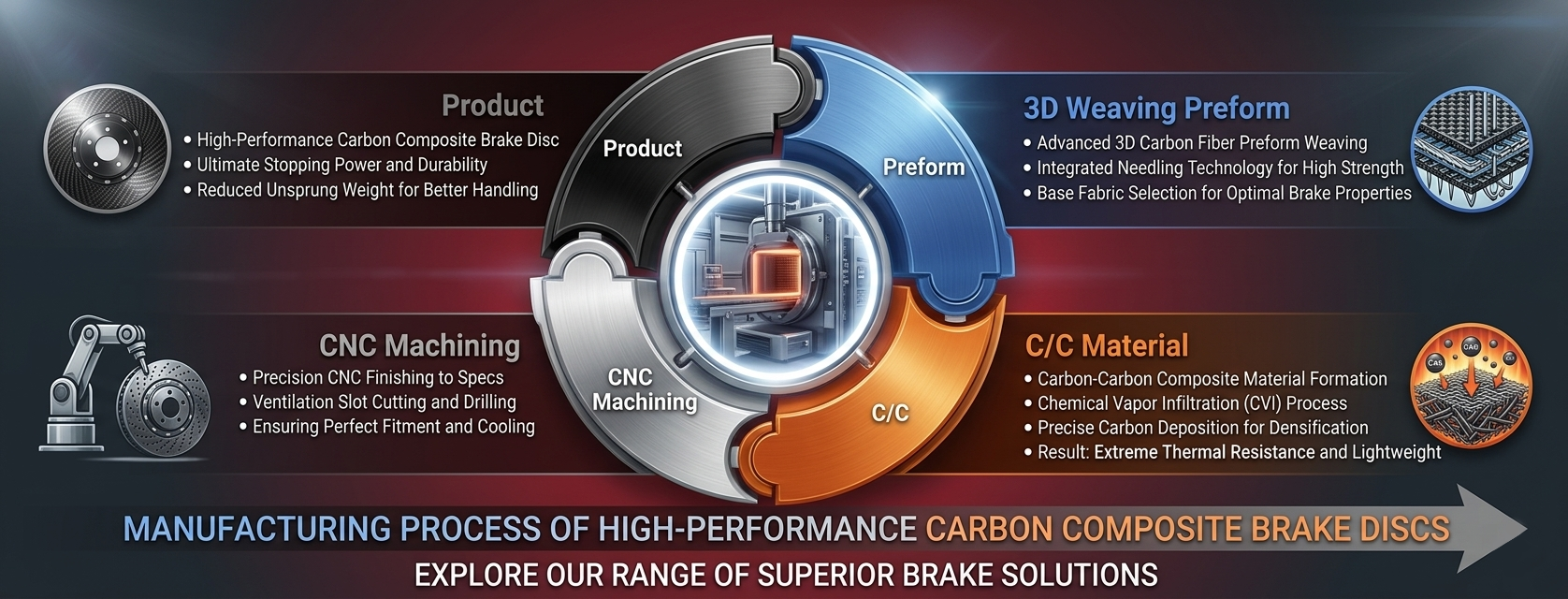
Carbon Fibre Reinforced Carbon (Carbon/Carbon or CFRC) consists of a carbon or graphite matrix fortified with high-strength carbon fibres. The material is heat-resistant, lightweight and mechanically strong — properties that make it the material of choice for demanding high-temperature applications.
T700s Continuous Long Fibre
CTE interweaves T700s-grade continuous (long) carbon fibre sourced from Toray Japan into a 3D multi-directional matrix — producing a stronger and more durable product with stable & consistent performance and improved heat management versus discontinuous (chopped) fibre alternatives.
Brief Manufacturing Process
3D Preform by Unique Needling of Carbon Fibre
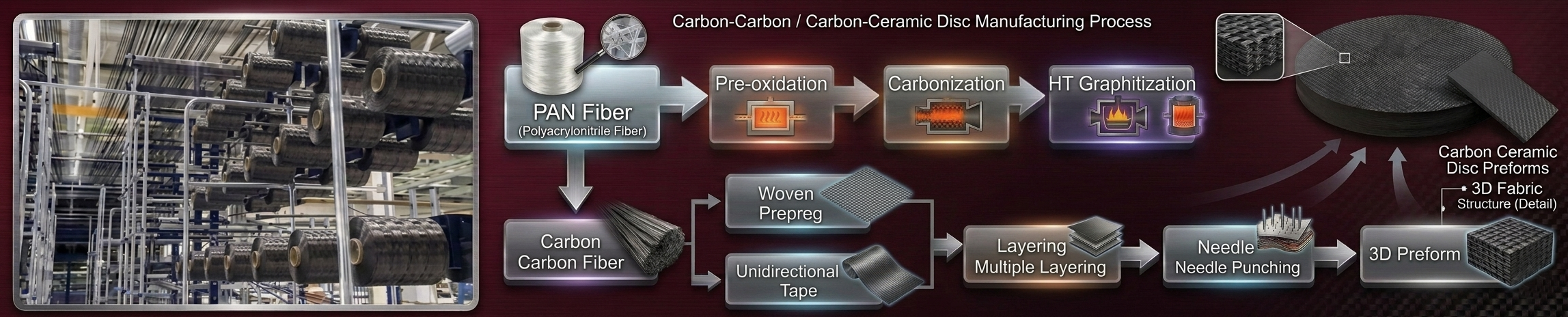
CTE's friction discs are made using carbon fibre based 3D fabrics prefabricated by a needle-punching process. A unique 3D structure is woven together from multiple layers of continuous fibre cloth to form the base carbon material (preform).
Unlike 2D laminate architectures, the needle-punched 3D preform interlocks fibres through the Z-axis, providing isotropic strength and superior resistance to delamination under the cyclic thermal and mechanical stresses experienced by brake and clutch friction components.
Chemical Vapour Infiltration (CVI) to Form the Carbon/Carbon Material
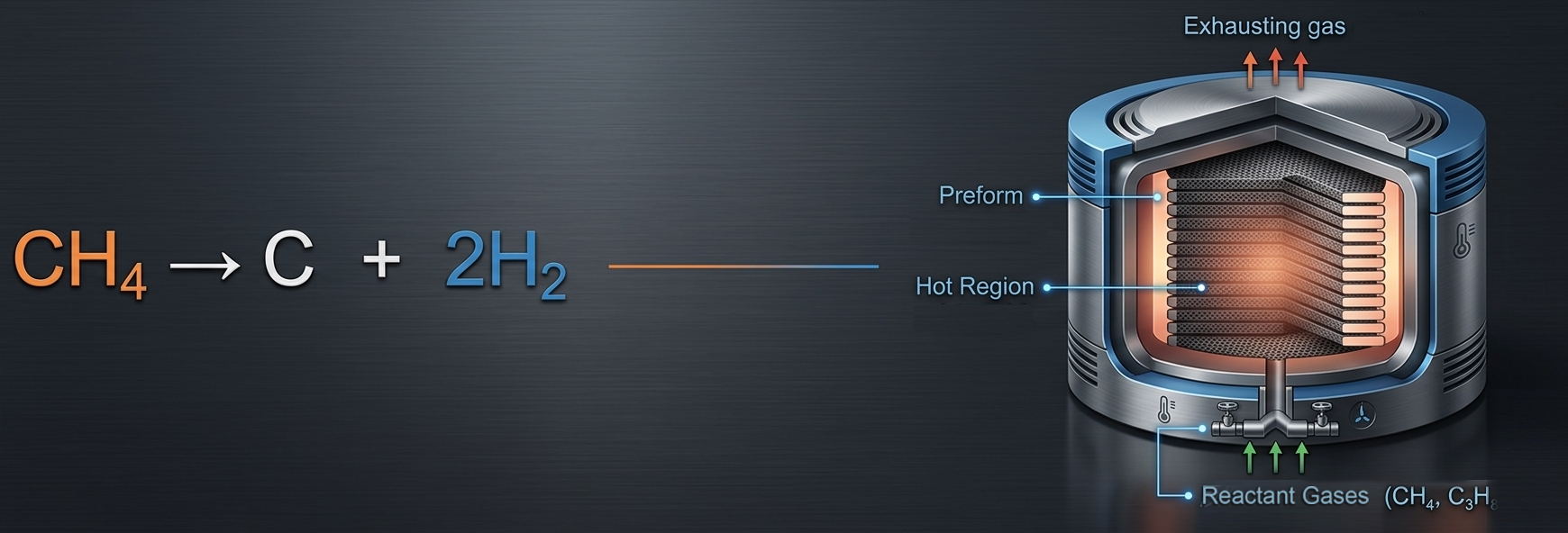
CTE has developed over several years a proprietary Chemical Vapour Infiltration (CVI) method of Ceramic Matrix Composite (CMC) fabrication. Reactant gases diffuse into the porous preform under controlled temperature and vacuum conditions, undergoing thermal decomposition on the fibre surface to deposit pyrolytic carbon.
The deposited carbon progressively fills the inter-fibre porosity, forming a dense composite of the carbon matrix and the 3D fibre preform. Multiple CVI cycles may be performed to reach the target bulk density.
Following densification, a heat treatment at 3000°C initiates graphitization — eliminating non-carbon elements and rearranging the atomic structure into a highly ordered, dense 3D crystalline graphite lattice, maximising thermal conductivity and friction stability.
Manufacturing Carbon/Carbon Composites
CTE's innovative CVI solution provides an environment for controlled gas injection mechanisms, precision temperature control, and vacuum conditions — producing Carbon/Carbon (C/C) composite materials by depositing carbon-rich material onto a designated carbon-based substrate.
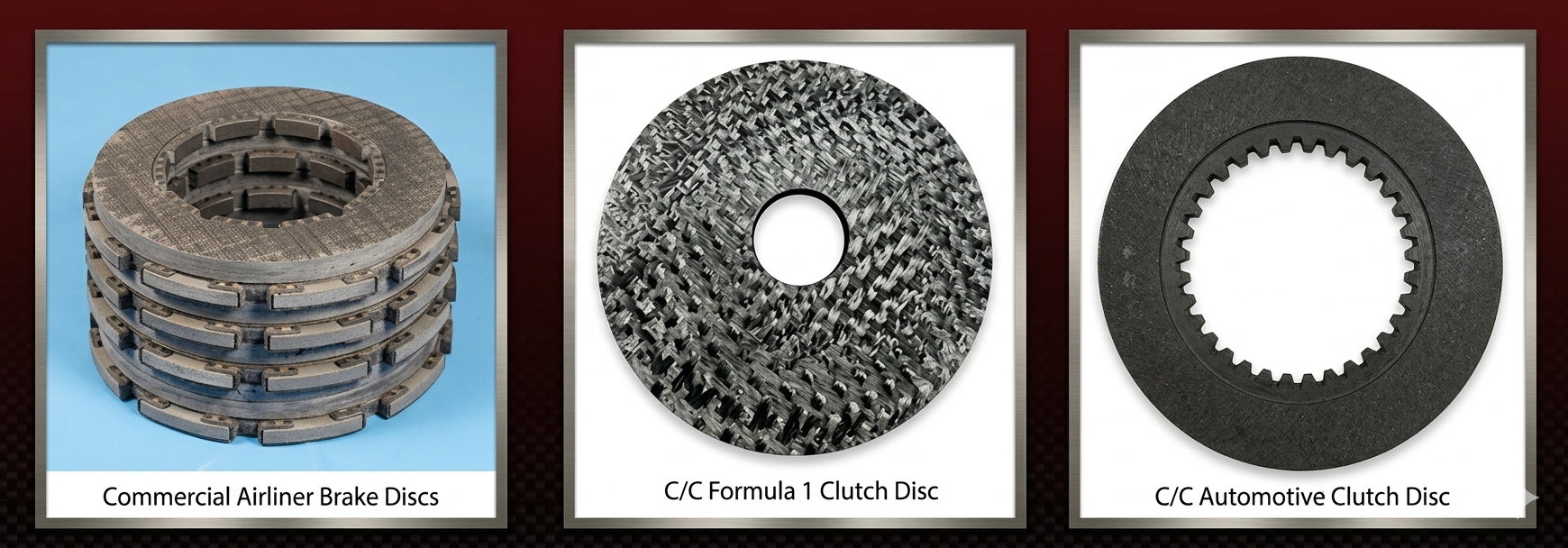
The resulting Carbon/Carbon composites are heat-resistant, lightweight, and high-strength — properties that make them suitable for high-demand friction components where consistent performance at extreme temperatures is critical.
Frequently Asked Questions
- What is Carbon/Carbon (C/C) composite material?
- Carbon/Carbon composite is a high-strength material consisting of a carbon or graphite matrix reinforced with carbon fibres. It is heat-resistant, lightweight, and mechanically strong — ideal for demanding high-temperature applications such as performance brake discs and clutch discs in motorsport and aerospace.
- What carbon fibre does CTE use for its C/C friction discs?
- CTE uses T700s-grade continuous (long) carbon fibre sourced exclusively from Toray Japan. These fibres are interweaved into a 3D multi-directional needle-punched matrix, producing superior strength, durability, and consistent friction performance compared to discontinuous (chopped) fibre alternatives.
- What is Chemical Vapour Infiltration (CVI)?
- CVI is a Ceramic Matrix Composite (CMC) fabrication process where hydrocarbon gases are diffused into a porous carbon fibre preform under controlled temperature and vacuum conditions. The gases thermally decompose on the fibre surface, depositing pyrolytic carbon that fills the porosity to form a dense Carbon/Carbon matrix. CTE has developed a proprietary CVI method refined over several years of R&D.
- Why is graphitization at 3000°C used in C/C manufacturing?
- Heating the CVI-densified preform to 3000°C eliminates residual non-carbon elements and rearranges the atomic structure into a highly ordered 3D graphitic crystalline lattice. This graphitization process maximises thermal conductivity, frictional stability, and mechanical performance of the finished Carbon/Carbon friction disc.
- What are the applications of CTE Carbon/Carbon friction discs?
- CTE C/C friction discs are primarily used in high-performance brake discs and clutch discs. Their combination of low weight, exceptional heat resistance, and stable friction characteristics makes them suitable for motorsport, track-day, and other applications requiring consistent braking or clutch performance at extreme temperatures.