

Manufacturing
Process
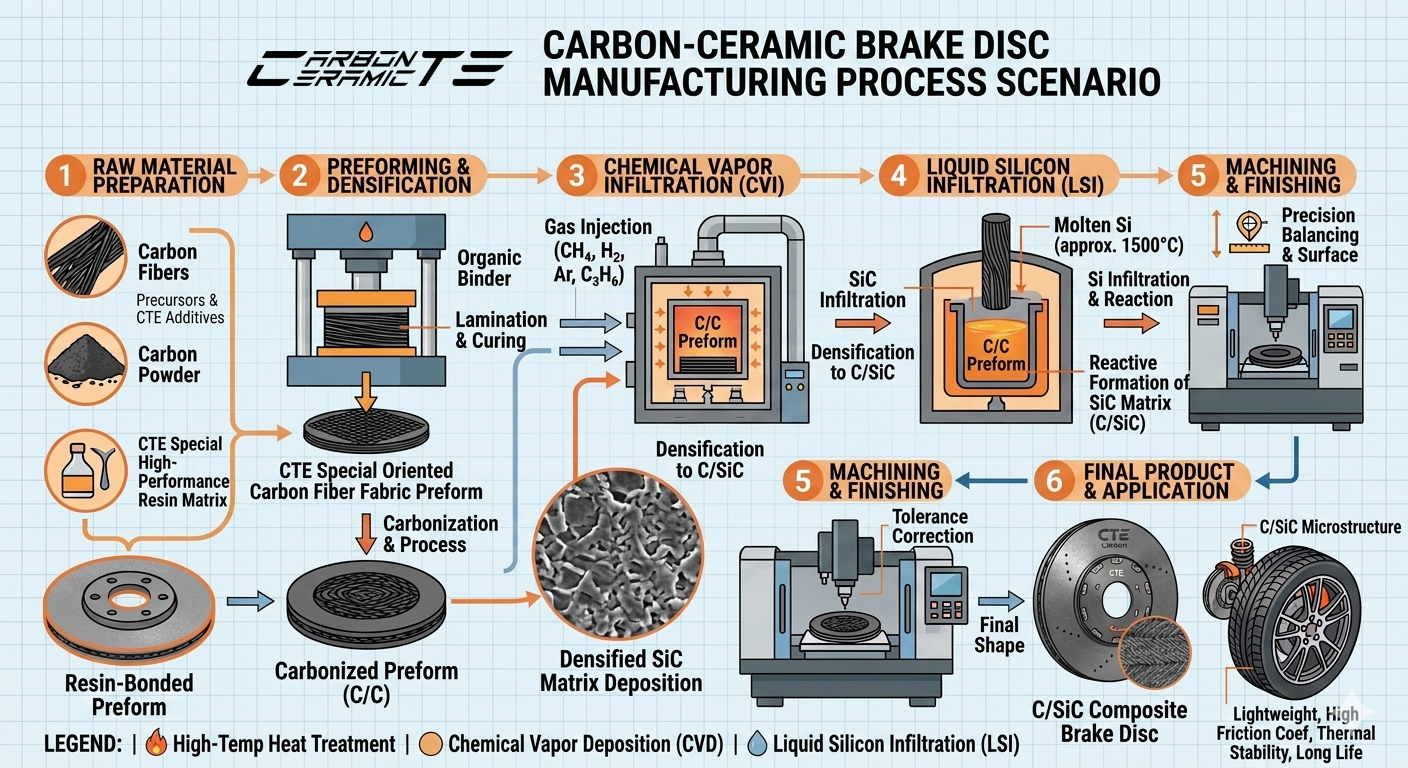
CTE's proprietary 5-step process transforms T700-grade continuous carbon fibers into high-performance Carbon/Silicon Carbide (C/SiC) ceramic brake discs — delivering 50% weight reduction and zero thermal fade at temperatures exceeding 1000°C.
Manufacturing Process
-
3D Fabric Preforming
T700 continuous carbon fibers woven into a 3D matrix via patented needle-punching for isotropic strength.
-
Carbonization & CVI
Vacuum carbonization + Chemical Vapour Infiltration deposits a dense C/C composite matrix.
-
Liquid Silicon Infiltration
Molten silicon reacts at 1500°C to form SiC matrix >2800 HV in-situ.
-
Precision Machining
CNC diamond grinding to ±0.05 mm; ultrasonic drilling; G2.5 dynamic balance.
-
Final Inspection & Application
50% weight reduction. Zero thermal fade to 1000°C+. Race-proven, OEM-qualified.
CTE Carbon: Engineering the Future of Braking
Aerospace-Derived Technology | Race-Proven Performance
More Than an Upgrade — A Transformation
CTE Carbon Ceramic brake discs are crafted from next-generation Carbon Fibre Reinforced Ceramic (CFRC). Developed through years of intensive R&D for major European OEM manufacturers, our proprietary process transforms Carbon/Carbon (C/C) into Carbon/Silicon Carbide (C/SiC) — the same material class deployed in aerospace turbine components and Formula-class racing. If you have piloted a European Hypercar or a track-ready Porsche equipped with upgraded ceramics, you have likely already experienced the precision and quality of CTE.
The CTE Advantage: Continuous Long-Fiber Technology
While most factory-standard carbon ceramic discs — such as the Brembo / SGL CCM — utilise T300-grade discontinuous (chopped) fibers, CTE utilises T700-grade continuous (long) fibers woven into a patented 3D matrix architecture. This distinction is fundamental: continuous fibers carry load along their full length, eliminating the micro-crack propagation pathways that limit chopped-fiber composites under repeated thermal cycling and mechanical stress.
| Feature | Standard OEM Discs (CCM) | CTE 3D Matrix (C/SiC) |
|---|---|---|
| Fiber Grade | T300 discontinuous (chopped) | T700 continuous (long fiber) |
| Fiber Architecture | 2D random mat | 3D needle-punched matrix |
| Matrix | Carbon/Carbon (C/C) or basic C/SiC | Proprietary C/SiC via LSI at 1500°C |
| Surface Hardness | ~1500–2000 HV | >2800 HV |
| Weight vs Cast Iron | ~40% reduction | ~50% reduction |
| Thermal Fade | Possible above 800°C | Zero fade to 1000°C+ |
| OEM Qualification | Standard OEM supply | European hypercar OEM qualified |
Frequently Asked Questions
- What is the difference between CTE C/SiC and standard OEM carbon ceramic brakes?
- Standard OEM discs use T300-grade discontinuous (chopped) carbon fibers in a 2D random architecture. CTE uses T700-grade continuous long fibers in a patented 3D needle-punched matrix, producing higher tensile strength, superior delamination resistance, and stable friction performance from cold start to beyond 1000°C.
- What is the maximum operating temperature of CTE carbon ceramic brake discs?
- CTE C/SiC discs maintain stable friction performance at temperatures exceeding 1000°C with zero thermal fade. The Silicon Carbide matrix — formed during Liquid Silicon Infiltration at 1500°C — provides exceptional thermal stability far beyond cast iron or standard composite discs.
- How much lighter are CTE carbon ceramic discs vs cast iron?
- CTE C/SiC discs deliver approximately 50% weight reduction versus cast iron equivalents. Reducing unsprung rotating mass directly improves steering response, ride quality, and overall braking system efficiency — particularly beneficial in motorsport and high-performance road use.
- Which vehicles are CTE carbon ceramic brakes compatible with?
- CTE supplies C/SiC brake discs for European hypercars, high-performance GT and sports cars, and track-day vehicles including Porsche models with upgraded ceramic brake systems. CTE technology has been qualified under major European OEM manufacturer programmes.