

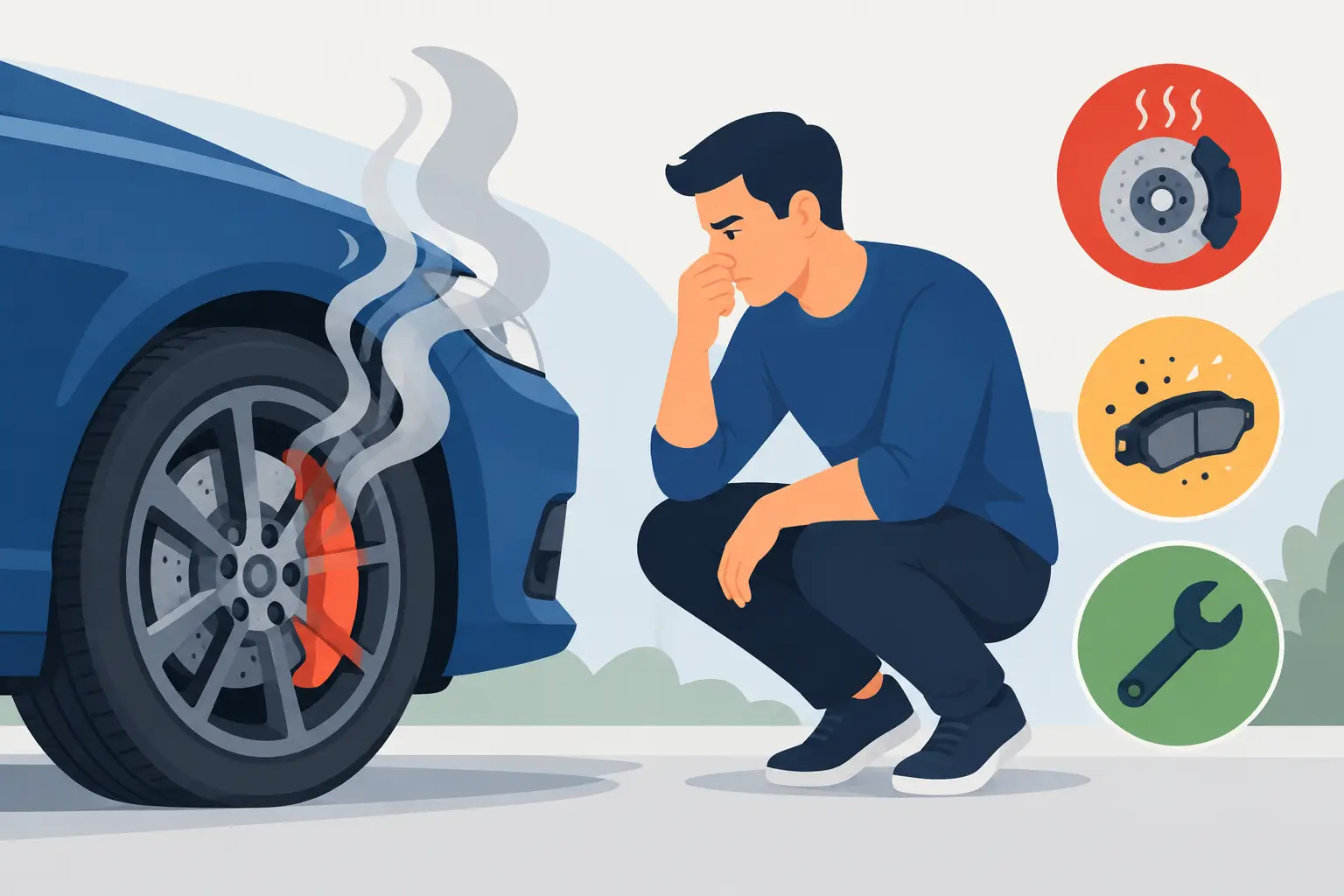
A sharp, acrid hot brake smell after a hard downhill section, repeated high-speed stops, or a short drive through town is not a scent to ignore. Brakes convert vehicle speed into heat, and some heat is expected. But when the smell is strong, persistent, or paired with smoke, pulling, vibration, or a soft pedal, the system may be operating beyond its safe thermal range.
For performance workshops, distributors, and drivers of heavy, powerful, or modified vehicles, the correct response is not simply to fit a more aggressive pad. The source of the heat must be identified. A brake system is a matched assembly of discs, pads, calipers, fluid, lines, wheel hardware, and vehicle-specific fitment. One component that drags, binds, or lacks thermal capacity can compromise the entire system.
What a Hot Brake Smell Usually Means
Brake pads contain friction materials and binding resins designed to work within a specific temperature window. Under heavy braking, these materials heat rapidly. A brief odor after a demanding mountain road, track session, or repeated emergency stops may indicate that the pads and rotors have reached elevated temperatures without necessarily failing.
The concern begins when the odor appears during ordinary driving, continues after the vehicle is parked, or comes from only one corner of the vehicle. In those cases, the heat may not be caused by driver demand at all. It may be caused by a brake that is not releasing correctly.
A hot brake smell can also be confused with other odors. Burning oil often has a thicker, smoky smell. A slipping clutch smells similar to overheated friction material but is usually noticed during acceleration, particularly in manual-transmission vehicles. An electrical smell can indicate wiring or a wheel-speed sensor issue. The location of the odor, the vehicle behavior, and a direct inspection matter more than guesswork.
When a Hot Brake Smell Requires an Immediate Stop
Do not continue driving to “see if it clears” if you see smoke from a wheel, feel a major loss of braking force, notice the vehicle pulling hard under braking, or find that one wheel is significantly hotter than the others. Pull over safely, select park or neutral as appropriate, and allow the system to cool naturally.
Do not spray water on hot rotors or calipers. Rapid cooling can distort a rotor, damage coatings, and create unnecessary thermal shock. Do not touch the wheel, rotor, or caliper. Even a wheel that appears normal can hold enough heat to cause a burn.
If the brake pedal becomes long, soft, or inconsistent after overheating, the vehicle should not be driven until inspected. High temperature can boil moisture-contaminated brake fluid, producing vapor in the hydraulic system. Vapor compresses under pedal pressure, unlike brake fluid, and that can dramatically reduce braking response when it is needed most.
A warning light, grinding noise, or visible fluid leak raises the priority further. These symptoms point to a mechanical or hydraulic fault, not merely a hard-use odor.
Common Causes of Overheated Brakes
Repeated Heavy Braking Beyond System Capacity
Long descents, towing, track use, and spirited driving can generate more heat than standard street brake hardware can reject. Rotor mass, ventilation design, pad compound, caliper stiffness, and airflow all influence thermal capacity. A vehicle may stop well once, then lose consistency after several high-energy stops as the pads and fluid exceed their operating range.
This is the classic path to brake fade. Pad fade occurs when the friction material becomes too hot to maintain stable bite. Fluid fade occurs when hydraulic fluid reaches a temperature at which it begins to form vapor. Both conditions can make a fast vehicle feel suddenly unpredictable.
Dragging Caliper or Sticking Slide Hardware
A seized piston, corroded slide pin, damaged dust boot, or restricted brake hose can keep a pad in contact with the rotor after the driver releases the pedal. This produces heat continuously, even during light cruising. Often, one wheel will smell hotter than the others, and the vehicle may pull to one side.
Performance calipers also require correct installation and service discipline. Pad movement must be free, hardware must be properly seated, and piston retraction must be normal. A high-performance brake kit cannot compensate for a caliper that is mechanically binding.
Incorrect Pad Bedding or Pad-Rotor Mismatch
New pads and rotors need a controlled bedding procedure to transfer an even friction layer onto the disc surface. Skipping this process can create uneven deposits, vibration, noise, reduced bite, and localized hot spots. Bedding should be completed according to the pad and rotor manufacturer’s instructions, with controlled stops and adequate cooling periods.
Pad choice matters as well. A track-oriented compound may tolerate high temperatures but can require heat before offering its best cold response. A street compound may provide quiet daily operation but overheat under repeated heavy use. There is no universal “best” pad. The right selection depends on vehicle weight, tire grip, power output, driving environment, and how often the brakes are pushed near their limits.
Restricted Wheel Movement or Parking Brake Faults
A sticking electronic or mechanical parking brake can create a hot rear brake smell after the vehicle has been parked or driven at low speed. On vehicles with integrated rear parking-brake mechanisms, poor adjustment or actuator faults can keep the rear pads lightly applied.
Wheel bearing issues, incorrect wheel offset, or contact between a wheel and brake component can also create heat and odor, although these problems often produce additional noise or resistance. A complete inspection should include the wheel, hub, backing plate, and surrounding components rather than focusing only on the pad surface.
What to Inspect Before Replacing Parts
Once the brakes have cooled, a qualified technician should compare rotor appearance, pad thickness, and wheel temperature across all four corners. A single blue or darkened rotor, unusually worn inner pad, tapered pad wear, or a burnt caliper finish can reveal where the problem started.
Inspect the caliper pistons, guide pins where applicable, brake hoses, pad retaining hardware, and rotor faces. Check for fluid leaks and evaluate fluid condition. Old brake fluid absorbs moisture over time, reducing its boiling point. On vehicles used for track days, heavy towing, or high-speed road driving, fluid maintenance intervals should reflect actual thermal use, not only the minimum factory schedule.
Rotor thickness and runout should be measured, not estimated visually. Rotors that have been overheated may develop cracking, hard spots, or distortion. Surface discoloration alone does not always mean replacement is required, but cracks, excessive runout, or operation below minimum thickness do.
For shops diagnosing modified vehicles, confirm that the complete brake package matches the application. Correct bracket geometry, rotor offset, wheel clearance, line routing, and pad shape are essential. A component that physically fits is not automatically engineered for the vehicle’s braking loads.
Preventing Brake Odor During Demanding Use
The most effective prevention is to specify the system for the vehicle’s actual job. A luxury SUV, an EV with substantial curb weight, a turbocharged sports coupe, and a track-prepared supercar place very different demands on brakes. Wheel diameter, unsprung weight, thermal load, brake bias, and tire capability should all be considered before selecting a kit.
For repeated high-energy braking, larger thermal capacity and reduced unsprung mass can make a measurable difference. Carbon ceramic systems are engineered to manage extreme heat while reducing rotating and unsprung weight compared with many conventional iron-based setups. However, the benefit depends on a complete, vehicle-specific system with compatible calipers, pads, rotors, brackets, and hardware.
Driver technique also matters. On long descents, use engine braking where appropriate and avoid dragging the brakes continuously. On track, build pace progressively after installation, allow cool-down laps, and avoid holding the pedal firmly at a stop immediately after an extreme braking event. Holding hot pads against a stationary rotor can transfer material unevenly and create pedal pulsation later.
CCYS develops complete carbon ceramic brake systems with racing-grade thermal resistance, vehicle-specific engineering, and controlled in-house manufacturing. For distributors and workshops, the value is not only peak stopping power. It is the consistency of a system designed to maintain control when heat becomes the limiting factor.
The Right Decision Is Based on the Cause
A brief brake odor after legitimate heavy use may be a warning to review driving technique or thermal capacity. A recurring smell during normal driving is a fault until proven otherwise. Treat it as a diagnostic signal, inspect the full brake assembly, and correct the root cause before the next demanding drive.
Braking confidence is earned before the corner, not after the smell appears. A properly specified, properly serviced system gives the driver a margin when road speed, vehicle weight, and heat all rise at once.