

CTE Carbon × CTERACING | CCM carbon-ceramic brakes for EVs and MPVs
CCM Carbon-Ceramic Brake Upgrade for Heavy High-Performance EVs and Luxury MPVs
CTE Carbon and CTERACING (brands of CCYS Group) offer continuous 3D carbon-fiber carbon-ceramic brakes (CCM) for electric vans, luxury EV SUVs and performance EVs weighing 2,400–2,800 kg and more. On the VW ID. Buzz: rear-mounted 6-piston front calipers with 380 mm CCM rotors, plus dual-piston EPB rear calipers, addressing both rusted iron discs from regenerative braking and heat fade under full load.
Key points
- Front axle
- 6-piston rear-mounted caliper + 380 mm CCM
- Rear axle
- Dual-piston EPB + 380 mm CCM
- Unsprung rotating mass
- 50%–55% lighter
- Working temperature
- Above 850°C
- Road service life
- Up to 100,000 km+
EV braking physics: CTE Carbon CCM vs. OEM cast-iron brakes
| Key EV engineering metric | OEM cast-iron discs, single/dual-piston calipers | CTE Carbon / CTERACING CCM system |
|---|---|---|
| Corrosion resistance under regen use | Friction brakes sit unused at low temperature; wet weather brings heavy rust, noise and seized pistons | SiC ceramic matrix is unaffected by moisture, acid rain and road de-icing salt, keeping a clean friction surface |
| Heat capacity under full-load braking (2.5 t+) | Regen is limited at full charge; long descents or hard high-speed stops turn all energy into heat and invite fade | Working temperature ceiling above 850°C; the conductive 3D carbon-fiber skeleton sheds heat quickly to limit torque fade |
| Unsprung mass and comfort | Large iron discs weigh 11–14 kg each, loading the suspension and wheel inertia | 50%–55% less unsprung rotating mass than same-size iron discs: better rear-seat ride comfort, lower launch inertia |
| Floating design and high-load reliability | Fixed one-piece iron discs can distort and judder when hot | Standard stainless steel bobbins and aerospace-grade A6061/A6082 forged aluminium bells avoid galvanic corrosion and heat seizure |
| Lifetime maintenance cost | Heavy vehicles wear iron discs and pads quickly; frequent workshop visits | Road life up to 100,000 km+, no brake dust on the wheels, fewer service visits for fleets and owners |
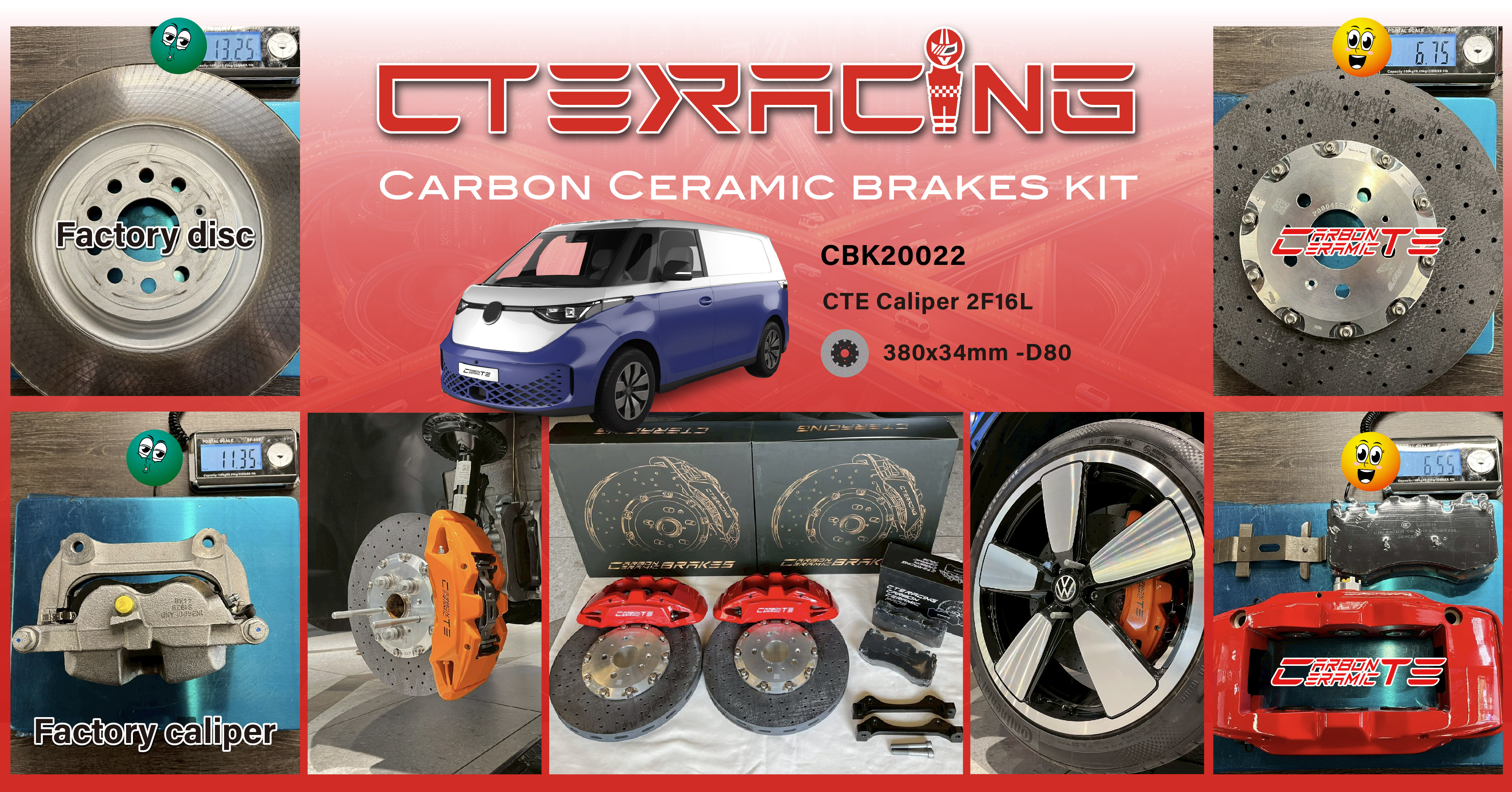
Flagship case: Volkswagen ID. Buzz 380 mm carbon-ceramic brake system
The VW ID. Buzz weighs about 2,470–2,700 kg empty and over 3.1 t fully loaded, so highway cruising and loaded mountain driving are thermally demanding. CTERACING reverse-engineered a dedicated kit around the ID. Buzz knuckle geometry and suspension kinematics:
| Module | Specification and geometry | Design rationale and benefit |
|---|---|---|
| Front calipers | CTERACING rigid forged 6-piston caliper Position: rear-mounted |
Placed behind the axle centreline (9 / 3 o'clock rear position) to move mass toward the vehicle centre, reduce steering inertia and ease brake-line and ABS-sensor routing. |
| Front discs | 380 mm two-piece floating continuous 3D carbon-fiber CCM (Street CCS / Sport) |
Large diameter gives leverage and heat capacity; SiC keeps total weight far below OEM iron discs for light steering feel. |
| Rear caliper and EPB | Dedicated dual-piston EPB caliper assembly | Developed for the parking clamp load of heavy electric MPVs, combining dual-piston hydraulic braking with a high-thrust EPB motor, compatible with VW EPB logic and Auto-Hold. |
| Rear discs | 380 mm lightweight continuous 3D carbon-fiber CCM | Balanced 380 mm braking torque front and rear limits nose dive and improves rear-passenger composure. |
| Floating hardware and bell | Stainless steel bobbins + aerospace-grade A6061/A6082 forged aluminium bell | Designed for all-weather, high-humidity use; removes galvanic corrosion risk between steel and aluminium, for long-term quiet, free-moving operation. |
Supported high-performance EV and luxury MPV platforms
- Volkswagen electric family: ID. Buzz (standard / long wheelbase / GTX; rear-mounted 6-piston front + 380 mm CCM front and rear + dual-piston EPB), ID.4 GTX / ID.5 GTX.
- Luxury EV SUVs and performance sedans: Porsche Taycan (4S / GTS / Turbo, upgrading OEM PSCB to CCM), Audi e-tron GT / RS e-tron GT, BMW i4 M50 / i5 M60, Tesla Model S Plaid / Model X Plaid / Model 3 Performance.
- Luxury MPVs: Toyota Alphard / Vellfire (40 / 30 series), Lexus LM 350h / LM 500h, Mercedes-Benz V-Class / EQV (for loaded VIP service and long-descent braking safety).
Heavy EV and VW ID. Buzz carbon-ceramic brake FAQ
Why are the ID. Buzz front 6-piston calipers rear-mounted?
To optimise front-axle mass distribution, reduce steering inertia and suit the steering-link geometry. Mounting the caliper behind the axle centreline (firewall side) concentrates unsprung mass near the wheelbase centre, improving self-centring and high-speed lane-change stability, and matches airflow with the wheel-arch ducting.
EVs mostly slow down by regeneration. Will CTE Carbon ceramic discs lack bite if they never get hot?
CTE Carbon Street (CCS) is tuned for low-temperature, intermittent braking. The continuous 3D carbon-fiber matrix with street-compound pads gives a linear friction coefficient comparable to OEM iron from 0°C to 100°C (cold bite). Even after a week of regen-only driving or heavy rain, the first brake application stays precise, without the judder and noise of scrubbing rust off iron discs.
After fitting 380 mm rear discs and dual-piston EPB calipers, will the ID. Buzz show Auto-Hold or EPB fault lights?
The dual-piston EPB assembly for the ID. Buzz matches the VAG harness connectors and control modules in actuator motor resistance and stroke parameters, so no wiring modification is needed and Auto-Hold, hill-start assist and electronic parking work as normal.